
← All technical articles · News
Industry Insights
Ball Joint Boot Cracked? Dust Boot Damage, Inspection and Replacement Guide
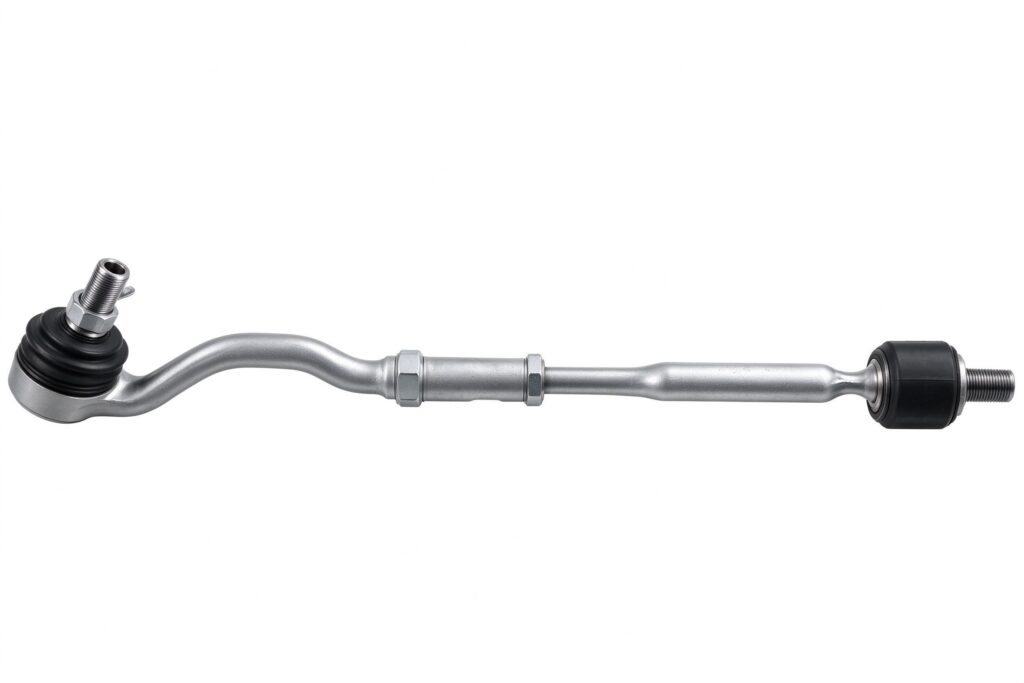
The ball joint boot — the small rubber dust cover sealing the ball joint where the stud exits the housing — is the single most important wear item most drivers never look at. A cracked boot does not mean the joint is dead; what gets past the crack is what kills it. Caught early, a boot with cracks but no grease leak can often be replaced on its own; once grease is leaking or the joint has developed play, the correct repair is the complete joint or arm assembly. This guide explains how the boot fails, how to inspect it in five minutes, and how to decide between a boot-only repair and a full replacement.
Quick decision table: boot condition vs. what to do
| Boot condition | What you see | What to do |
|---|---|---|
| Healthy | Intact rubber, no cracks, no grease residue | No action; recheck at every service or twice a year[2][5] |
| Surface cracks, no leak | Hardened or lightly cracked rubber, still sealing, dry around the joint | Plan a boot replacement soon — some cars allow a boot-only repair at this stage[6][11] |
| Torn or split, no play | Visible tear or missing section; joint is still tight when rocked | Replace promptly. If the car still allows a separate boot, do it now; otherwise replace the joint/arm[2][6] |
| Split with grease leak / joint play | Grease weeping down the housing, or measurable play at the joint | Replace the complete ball joint or arm assembly, then a four-wheel alignment[2][6][11] |
What a ball joint boot actually does
A ball joint is a spherical bearing that connects the control arm to the steering knuckle, letting the wheel steer and travel over bumps at the same time. The boot is the seal around that pivot: it keeps dust, road salt, water and gravel out of the joint, it retains the factory grease, and its flexible rubber allows the full range of motion without restricting steering[5]. In practice the boot is the only thing standing between the hardened ball-and-socket surfaces and an abrasive mixture of water and grit — which is why MOT testers call a missing dust cover a failure in its own right, even when the joint underneath is still tight[2].
Why boots fail
- Age: the boot is thin rubber a few inches above the road; a decade of heat, ozone, salt and grit is usually enough on its own[2]. Chinese workshop experience puts typical boot aging at roughly 60,000–80,000 km or 4–5 years depending on road conditions[1].
- Stone and debris impact: stones and road debris punch through the leading face of the joint, common on gravel roads and after underbody scrapes[1][2].
- Pressure washing: a high-pressure washer or steam lance aimed straight at the joint can lift the lip of the cover off its seat and blow the grease out with it[2].
- Repair damage: a fork-type ball joint separator tears the cover almost every time it is used[2]; poor installation or low-quality parts are also named causes in field reports[1].
- Clamp corrosion: the metal ring clamping the cover to the housing corrodes, works loose and falls off[2].
What happens after the boot opens
Once the seal is broken, the grease washes out within a few wet weeks and what replaces it is an abrasive paste of grit and water[2]. The joint then wears at a rate that has nothing to do with mileage — a joint that was good for another 60,000 miles can develop measurable play over a single winter[2]. Of 27 million tracked suspension advisories, 18.7% later returned as a failure[3]. NHTSA data attributes roughly 5,000 vehicle crashes per year in the United States to suspension component failures including ball joints[7], and an NHTSA technical service bulletin warns that a lower-arm ball joint may gradually deteriorate with long-term use and can become unsafe if the vehicle is used continuously without proper inspection[8]. Left long enough, a worn ball joint separates and drops the wheel out from under the corner — a catastrophic, preventable failure mode[2][7].
How to inspect your boots in five minutes
Checking is genuinely useful and takes minutes. Turn the steering to full lock, shine a torch at the outer end of the lower arm and look for a rubber cap that is split, collapsed or simply not there, and for grease weeping down the housing — do this each autumn before road salt goes down, and on both sides[2]. A more thorough check with the car safely lifted on stands: grab the tyre at 3 and 9 o’clock and rock it side to side (this tests the tie rod ends), then at 12 and 6 o’clock for vertical play (this tests the ball joints)[5]. Any visible movement at the joint means the joint itself is worn. Tester thresholds used by UK MOT inspectors are more than 2 mm of play on a 12 mm pin, 3 mm on a 25 mm pin, or 10% of diameter on anything larger — measured, not judged[2]. In Chinese workshop practice, a normal ball joint gap is below 0.5 mm (roughly two bank-card thicknesses), and sealed-type joints should have their boots checked every 20,000 km, with intervals tightened to 15,000 km on gravel roads and 10,000 km for high-intensity use such as ride-hailing[9].
Boot-only repair or complete joint?
The decision depends on how far the failure has progressed, not on how the car feels from the driver’s seat. Factory service procedures draw the line clearly: if the boot is damaged and grease is leaking, replace the part as an assembly; if the boot is soft and cracked but not leaking, a boot-only replacement is acceptable — this is the documented procedure in Honda Accord and Fit factory manuals and in the Dongfeng Honda M-NV suspension section[6][11].
The catch is availability. On most modern front suspensions the joint is sealed for life and integral to the lower arm, so a separate boot is simply not sold; the honest repair is a complete arm[2]. On older cars, rear joints and anything with a bolt-in joint, a boot or separate ball joint is available: roughly £8–£40 for the part plus about an hour of labour (£90–£150 fitted), while an arm-integral job lands at £180–£280 including alignment[2]. UK average independent prices for a ball joint are £70–£160 per corner, or £140–£280 when the joint is built into the arm[3]; US repair-shop estimates for ball joint replacement run about $307–$452[10]. The economic rule is simple: the boot is a preventive part that costs a few dozen pounds; the joint is the expensive part that a neglected boot destroys[2].
Why Hetian ball joints are built to keep the boot working
Hetian Auto has manufactured suspension and steering components since 1998, operates a 160,000 m² facility, holds IATF 16949 certification and a CNAS-accredited laboratory, and exports chassis parts to more than 30 countries with over 100 patents. Ball joints and tie rod ends leave the factory only after passing the same quality gates that test ball stud hardness, torque and sealing — because a boot that is correctly moulded, correctly clamped and correctly lubricated at the factory is what keeps water and grit away from the ball for the life of the part.
FAQ
1. Can I drive with a cracked ball joint boot?
Technically yes, but it is a race against contamination. A torn boot lets water and grit in and grease out, and a joint that was good for years can develop play within one winter[2][5]. Drive straight to a shop if you see grease leaking; if the boot is cracked but dry, schedule the repair soon.
2. Can I replace just the boot instead of the whole ball joint?
Sometimes. Factory procedures allow a boot-only replacement when the boot is cracked but not leaking grease, provided a separate boot exists for your car[6][11]. On most modern front suspensions the joint is sealed for life, so the complete arm is the only correct repair[2].
3. How do I know if the joint is already worn, not just the boot?
Lift the car, rock the wheel at 12 and 6 o’clock, and feel for play at the joint; testers use thresholds of roughly 2 mm on a 12 mm pin or 3 mm on a 25 mm pin[2]. Any visible movement means the joint, not just the boot, must be replaced.
4. How often should ball joint boots be inspected?
At least once a year, or every six months in harsh climates; every 20,000 km for sealed joints is the common workshop interval, tightened to 15,000 km on gravel and 10,000 km for intensive use[5][9]. Tie the check to oil changes or tyre rotations so it is not forgotten.
5. What does a failing boot sound or feel like?
Early on, nothing — it is a ramp find. Later, once contamination has done its work: a knock over bumps, a clunk on full lock, wandering steering under braking, and inner-edge tyre wear[2][7].
6. Is a torn boot an MOT failure?
In the UK, yes. A dust cover that is missing or no longer prevents dirt ingress is a major defect and a failure, whether or not the joint underneath has play; a cover that is perished but still sealing is a minor defect[2].
7. Why do some garages quote a whole arm for a cracked boot?
Because on most modern cars the boot is not sold separately — the joint is sealed for life and integral to the arm[2]. Ask whether the joint is a separate part on your car; if it is, a boot-only or joint-only repair may be available and far cheaper[3].
Related Guides
- Ball Joint Failure Symptoms: Safety Risks and Replacement
- Ball Joint Factory Quality Gates: How Ball Studs Are Tested Before Shipment
- Chassis Noise Diagnosis: How to Identify Worn Control Arms, Ball Joints, Bushings and Links by Sound
- OEM vs. Aftermarket Suspension Parts: Quality Explained
- What Is a Suspension Bushing? Materials, Function and Failure Modes
- Product category: Ball Joints
References
[1] 球头胶套流黄油咋办(Ball Joint Boot Grease Leak: What to Do), 汽车之家论坛(Autohome Forum), 2026-09-19, https://club.autohome.com.cn/bbs/thread/9fb288fa2030dcb4/116187039-1.html, accessed 2026-10-19.
[2] Suspension Joint Dust Cover Missing or Split — MOT Defect Explained, The MOT Files, updated 2026-09-08, https://motfiles.co.uk/mot-failures/suspension-dust-cover-missing, accessed 2026-10-19.
[3] “Ball Joint Dust Cover Damaged” — MOT Advisory Explained, PriceMyRepair, 2026, https://pricemyrepair.co.uk/mot-advisory-ball-joint-dust-cover/, accessed 2026-10-19.
[4] 换转向拉杆球头防尘套,花小钱预防性维护(Replacing a Tie Rod End Dust Boot as Preventive Maintenance), 抖音(Douyin), 2022-08-15, https://www.iesdouyin.com/share/video/7131878481964633375, accessed 2026-10-19.
[5] What Is a Ball Joint Boot and Why It Matters, CarInterior, 2026-01-26, https://carinterior.alibaba.com/question/ball-joint-boot-guide-replacement-tips, accessed 2026-10-19.
[6] Honda Accord: Ball Joint Boot Inspection / Replacement, Honda Accord MK8 (2008–2012) Service Manual, https://www.haccord.org/ball_joint_boot_inspection_replacemen-1151.html, accessed 2026-10-19.
[7] What Are the Signs of Ball Joint Failure? A Complete Driver’s Guide, Anhui Tianyu Auto Parts, 2026, https://www.tianyuautoparts.com/news/industry-news/what-are-the-signs-of-ball-joint-failure-a-complete.html, accessed 2026-10-19.
[8] REFERENCE: All Models — Suspension Lower Arm Ball Joint May Gradually Deteriorate, NHTSA ODI TSB MC-10152052-9999, 2018, https://static.nhtsa.gov/odi/tsbs/2018/MC-10152052-9999.pdf, accessed 2026-10-19.
[9] 底盘球头保养科普(Chassis Ball Joint Maintenance Guide), 太平洋汽车(PCauto), 2026-03-23, http://m.pcauto.com.cn/note/867803889260298707.html, accessed 2026-10-19.
[10] How Much Does Ball Joint Replacement Cost?, ThePricer, 2026, https://www.thepricer.org/ball-joint-replacement-cost/, accessed 2026-10-19.
[11] 23M M-NV 悬架系统:球节护罩更换和检查(Dongfeng Honda M-NV Suspension: Ball Joint Boot Inspection / Replacement), 东风本田维修手册, https://tos-acp-manual.dongfeng-honda.com/MNV24/WEIXIU/9a808f93c848.html, accessed 2026-10-19.
Last updated: Oct 19, 2026 · Reviewed by the Hetian engineering team