
← All technical articles · News
Industry Insights
Ball Joint Failure: Symptoms, Safety Risks, and Replacement
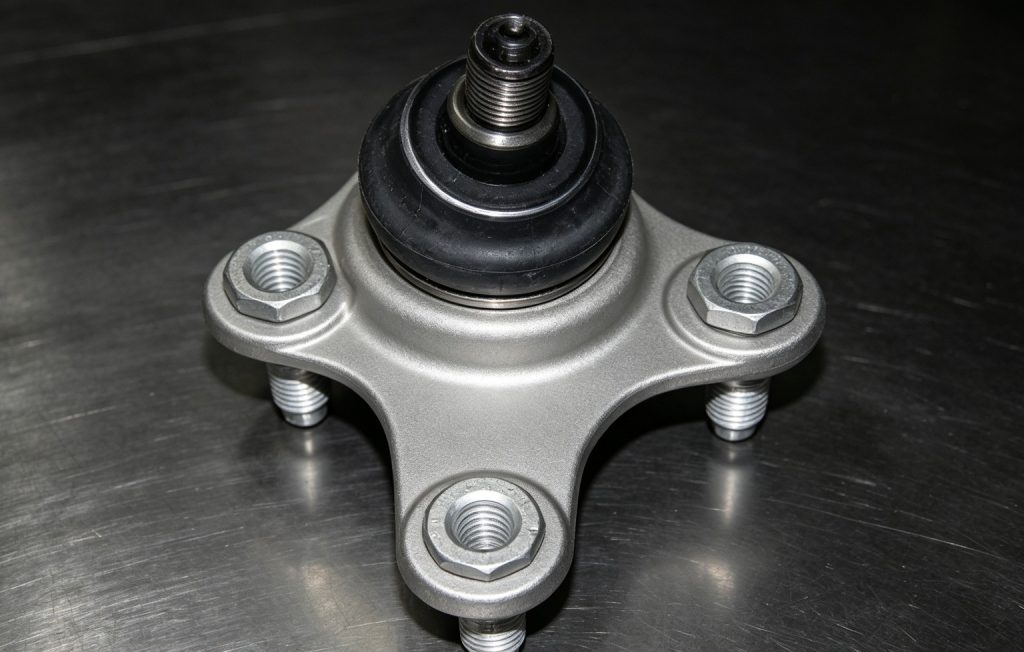
A ball joint is one of the most safety-critical components in a vehicle’s suspension. It is the pivot that allows the steering knuckle to move up and down with the suspension while turning left and right with the steering system. When a ball joint wears past its limit, it does not degrade gradually like a brake pad—it can separate completely and without warning, causing the wheel to collapse and total loss of steering control [2][5]. This guide maps the early warning signs, the measurable wear limits, the safety risks of driving on a failing joint, and what to verify when buying replacement ball joints.
Ball Joint Failure Symptoms Quick-Reference Table
| Symptom | Severity | Urgency | Cost if Ignored |
|---|---|---|---|
| Clunking or knocking over bumps | Mild to Moderate | Repair within 1–2 weeks | Tire damage $100–$250 [1] |
| Loose or wandering steering | Moderate | Repair immediately | Accelerated tire wear $200–$500 [1] |
| Uneven inner or outer tire wear | Moderate | Inspect tires, schedule repair | New front tires $200–$500 [1] |
| Steering wheel vibration | Moderate | Schedule inspection | Suspension component damage [4] |
| Pulling or unstable braking | Moderate to Severe | Inspect before long trips | Brake line / knuckle damage [6] |
| Visible play > 1/4 inch or torn dust boot | Severe | Do not drive; tow to shop | Wheel collapse, loss of control [3][5] |
What a Ball Joint Does and How It Fails
A ball joint consists of a hardened steel ball stud seated inside a precision-machined socket, packed with grease and sealed by a rubber or polyurethane dust boot. The stud’s tapered shank is clamped into the steering knuckle, while the housing bolts to the control arm. This arrangement lets the wheel follow road irregularities and respond to steering input simultaneously [7][9].
Failure begins when the grease seal tears or the boot retention ring loses its grip. Once water and grit enter the socket, the polished ball and socket surfaces wear rapidly. The ball wears a groove into the socket, creating measurable play; in advanced stages the stud can pull out of the socket entirely [2][9]. NHTSA field reports show that 12.4% of suspension-related recalls since 2018 involved ball joint design flaws—including inadequate dust boot retention, insufficient grease retention volume, or substandard ball stud hardness below SAE J429 Grade 8 specifications [7].
Six Warning Signs of a Failing Ball Joint
1. Clunking or popping over bumps. The most common early symptom. As the ball wears a groove in the socket, excess play lets metal components contact where they should not, producing a distinct clunk or pop near the wheel when hitting potholes or turning sharply [1][8].
2. Loose or wandering steering. The steering wheel feels vague and does not respond crisply. At highway speed the driver must make constant small corrections to keep the vehicle tracking straight [1][9].
3. Uneven tire wear. Worn ball joints change the camber angle, causing the inside or outside edge of the front tire to wear faster than the rest of the tread. This is often the first visible sign a driver notices [1][4].
4. Steering wheel vibration. Play in the ball joint creates oscillation that travels through the steering linkage, especially noticeable at highway speed or on rough roads [4][9].
5. Pulling or unstable braking. When a ball joint has excessive play, the wheel can shift slightly under braking loads, causing a pull, a darting sensation, or a generally unsettled front end when stopping [6].
6. Visible play or a damaged dust boot. If the boot is torn, cracked, or missing, or if rocking the tire by hand produces perceptible in-and-out movement, the joint is in advanced wear. Movement of 1 mm or less may be borderline; 2 mm or more is a clear failure requiring replacement [3][5].
Safety Risks: Why a Failing Ball Joint Is Not a “Wait and See” Repair
Driving on a severely worn ball joint is unsafe because the joint can fail completely without warning, causing sudden loss of steering control or suspension collapse—especially during emergency maneuvers, high-speed turns, or hard braking [2]. A completely separated ball joint causes the wheel to fold outward or collapse, resulting in total loss of vehicle control at any speed [3][5]. Continued operation also increases the risk of secondary damage to brake lines, steering components, the knuckle, and the control arm [2]. U.S. federal in-use inspection standards (49 CFR Part 570) require that ball joint seals shall not be cut or cracked, and structural parts shall not be bent or damaged [12].
How to Measure Ball Joint Wear
Professional inspection uses a dial indicator to measure axial (vertical) and radial (horizontal) play. SAE J-193 defines the axial and radial play test standards that measure resistance to loads causing the ball stud to move up and down or side to side—any measurable play indicates the joint requires replacement [11]. Common manufacturer specifications include radial play ≤ 0.050 inch (1.27 mm) measured at the knuckle flange per SAE J1726 [8], and axial play ≤ 0.050 inch with radial play ≤ 0.030 inch per ASE A4 suspension diagnostic standards [10]. European and performance applications often specify tighter tolerances of ≤ 0.003 inch (0.08 mm) vertical displacement [9].
Many load-carrying ball joints feature built-in visual wear indicators—a raised area around the grease fitting. With the wheels on the ground, if the raised area is flush or recessed with the surrounding housing, the ball joint is worn more than 0.050 inch and must be replaced [10]. A quick field test is to raise the front end and rock the tire in and out (not rotational, which is normal); any perceptible in-and-out movement indicates ball joint play [5].
Replacement and What to Verify When Buying
Ball joints should be replaced in pairs (left and right on the same axle) because both sides have accumulated similar mileage and wear. After replacement, a wheel alignment is mandatory because the ball joint affects camber and caster [4][5]. Always torque the ball stud nut and housing bolts to the manufacturer’s specification—typical lower joint torque is 70–85 ft-lbs (95–115 Nm), confirmed against the factory service manual [8].
When sourcing replacement ball joints, verify: dust boot retention design and material, grease retention volume, ball stud hardness (meeting or exceeding SAE J429 Grade 8), socket material and heat treatment, and the manufacturer’s quality system certification [7]. Hetian Automotive has produced steering and suspension components since 1998, operates a 160,000 m² facility with IATF 16949 certification and a CNAS-accredited laboratory, exports to over 30 countries, and holds more than 100 patents.
FAQ
Q: Can I drive with a bad ball joint?
A: Only for very short distances at low speed to reach a repair shop. A severely worn ball joint can separate without warning, causing wheel collapse and total loss of steering control [2][3].
Q: What is the most common first symptom of ball joint wear?
A: Clunking or popping noise from the front suspension over bumps or during sharp turns, caused by excess play in the worn joint [1][8].
Q: How is ball joint wear measured?
A: With a dial indicator measuring axial (vertical) and radial (horizontal) play per SAE J-193 and SAE J1726 standards. Common limits are radial ≤ 0.050 inch (1.27 mm) and axial ≤ 0.050 inch; European vehicles often specify ≤ 0.003 inch [8][9][10][11].
Q: Should ball joints be replaced in pairs?
A: Yes. Both sides on the same axle have similar mileage and wear; replacing only one side leaves the other at risk. A wheel alignment is required after replacement [4][5].
Q: What does a torn dust boot mean?
A: A torn, cracked, or missing boot allows water and grit to enter the socket, accelerating wear. U.S. federal inspection standards (49 CFR Part 570) require ball joint seals not be cut or cracked [7][12].
Q: How do I verify a replacement ball joint is quality?
A: Check dust boot retention, grease volume, ball stud hardness (SAE J429 Grade 8 or better), socket heat treatment, and manufacturer certification such as IATF 16949 [7].
Related Guides
- Ball Joint Failure: Symptoms, Safety Risks, and Replacement (Suspension Safety Series)
- Tie Rod End vs. Ball Joint: How to Tell Them Apart and Diagnose Wear
- Suspension Parts Replacement Intervals: When to Replace Ball Joints, Control Arm Bushings, Links and Tie Rod Ends
- How to Verify Genuine vs. Counterfeit Suspension Safety Parts: A Buyer’s Checklist
- Product category: Stabilizer & Ball Joint & Link
References
[1] “7 Symptoms of Bad Ball Joints (and What Each One Costs to Ignore),” Ball Joint Replacement Cost, May 26, 2026, https://balljointreplacementcost.com/symptoms, accessed September 17, 2026.
[2] “Signs Your Suspension Ball Joint Is Failing,” PartCatalog.com, September 5, 2026, https://www.partcatalog.com/blogs/suspension/signs-your-suspension-ball-joint-is-failing, accessed September 17, 2026.
[3] “Bad Ball Joint Symptoms,” Car Problem Diagnosis, April 22, 2026, https://www.prjctx.net/issue/bad-ball-joint-symptoms, accessed September 17, 2026.
[4] “Ball Joint Replacement When Needed: Signs, Costs, and Timing,” AutoFixNotes, May 30, 2026, https://autofixnotes.com/ball-joint-replacement-when-needed/, accessed September 17, 2026.
[5] “What Are the Signs of Ball Joint Failure? A Complete Driver’s Guide,” Tianyu Auto Parts, May 9, 2026, https://www.tianyuautoparts.com/news/industry-news/what-are-the-signs-of-ball-joint-failure-a-complete.html, accessed September 17, 2026.
[6] “Signs Your Ball Joint Is Bad,” VehicleRuns.com, June 24, 2026, https://vehicleruns.com/maintenance-repair/ball-joint/symptoms/, accessed September 17, 2026.
[7] “What Is a Ball Joint? Your Suspension’s Key Pivot,” AutoMotoFlux, May 29, 2026, https://automotoflux.com/wheels-tires/what-is-a-ball-joint-on-a-car, accessed September 17, 2026.
[8] “Where Is a Ball Joint Located? | Wheel & Suspension Guide,” AutoMotoFlux, January 22, 2026, https://automotoflux.com/wheels-tires/where-is-a-ball-joint-located, accessed September 17, 2026.
[9] “How to Check for Bad Ball Joints: A Mechanic’s Deep Dive,” AutoMotoFlux, March 23, 2026, https://automotoflux.com/wheels-tires/how-to-check-for-bad-ball-joints, accessed September 17, 2026.
[10] “2.1 Front Suspension Component Diagnostics,” OpenExamPrep ASE A4 Study Guide, July 1, 2026, https://open-exam-prep.com/study-guides/ase-a4/suspension-systems/front-suspension-diagnostics, accessed September 17, 2026.
[11] “Precision Results: Axial & Radial Play,” Precision Control Arms, December 24, 2025, http://www.precisioncontrolarms.com/Precision-RESULTS, accessed September 17, 2026.
[12] “49 CFR Part 570—Vehicle In Use Inspection Standards,” U.S. Government Publishing Office, https://www.govinfo.gov/content/pkg/CFR-2003-title49-vol5/pdf/CFR-2003-title49-vol5-part570.pdf, accessed September 17, 2026.
Last updated: Sep 17, 2026 · Reviewed by the Hetian engineering team