
← All technical articles · News
Industry Insights
Ball Joint Factory Quality Gates: How Ball Studs Are Tested Before Shipment
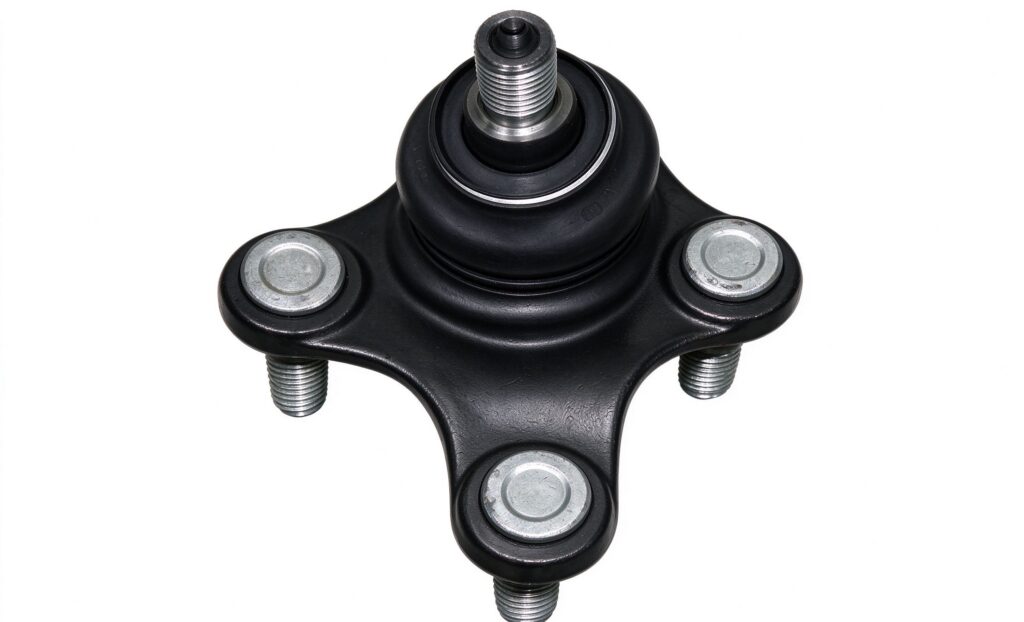
Ball joints are safety-critical suspension parts, and the tests that decide whether a joint is shippable are not paperwork theater — they are measurable, standardized, and repeatable. The industry reference is SAE J193, the recommended practice that defines laboratory test procedures for ball stud and socket assemblies, covering axial, lateral, and longitudinal loading [1][2]. What a buyer should take away is simple: a factory that cannot show you pull-out force data, fatigue cycles, dust-boot material specs, and salt-spray hours for the specific part number is not doing ball joint quality — it is doing hope. This guide walks through the quality gates a ball joint passes before it leaves the factory, and what each test actually proves.
Quick Reference: Ball Joint Factory Tests
| Test | What It Measures | Why It Matters |
|---|---|---|
| Pull-out (extraction) force | Force needed to pull the ball stud out of its socket, per SAE J193 procedure [3] | A stud that pulls out under load means the wheel loses its anchor to the suspension arm — a loss-of-control failure [4] |
| Fatigue cycling | Repeated load cycles under combined axial, radial and angular loading [5] | The most meaningful predictor of long-term field performance [6] |
| Rotation & swing torque | Resistance to rotation and articulation of the stud in the socket | Confirms proper preload and lubrication; too high means binding, too low means wear-out play |
| Dust boot & seal test | Boot material, temperature range and sealing integrity | A torn boot lets water, salt and grit destroy the joint from the inside [7] |
| Salt spray (corrosion) | Corrosion resistance of housing, stud and coating | Corroded joints seize, crack boots and shed material into the bearing surface |
| Dimensional & play check | Axial and radial play against specified limits, per SAE J193 [8] | Excess play at birth means the joint is already wearing out |
Why ball joints are tested like safety parts
A ball joint is the pivot that connects the suspension arm to the steering knuckle. It carries a large share of the vehicle’s weight, transmits braking and cornering forces, and lets the wheel steer. Under SAE J193, every ball stud and socket assembly is subject to axial, lateral and longitudinal forces that differ only in direction and magnitude depending on the application [2]. Industry manuals cite typical passenger-car ball joints designed for axial loads exceeding 10,000 N, surviving over 100,000 miles of service before play exceeds manufacturer limits [9]. That is why the factory test schedule treats a ball joint the way it treats a brake part — not as a commodity.
Quality gate 1: material, heat treatment and the stud itself
Everything downstream depends on the ball stud. Hardened studs are specified against standards such as SAE J490, which covers the dimensional data for ball joints used in automotive control linkages [10]. Production-grade ball pins are commonly specified in the HRC 55–65 hardness range with anti-rust surface treatment [11]. A softer stud wears its spherical surface, generates play, and eventually lets the joint separate. Heat treatment records and hardness checks per batch are the first evidence a buyer should ask for.
Quality gate 2: assembly, preload and pull-out force
Once the stud is seated in its socket — over a polymer or sintered bearing with grease — the assembly must be preloaded so it rotates smoothly but has no free play. The pull-out test then measures the force required to separate the ball pin from the housing, with a typical load application rate of 5 mm/min under the SAE J193 procedure [3]. If that force is below the OE spec, there is a risk the joint could fail during normal driving, causing the wheel hub to lose its anchor to the suspension arm and the vehicle to lose directional control [4]. In practical terms, OE-grade studs are commonly held at or above 25 kN pull-out force for heavy applications, with higher-spec aftermarket parts pushing to 28 kN or more [12]. Rotation life tests at 500,000 cycles or more without abnormality are another common production gate [11].
Quality gate 3: fatigue, sealing and corrosion
Fatigue under real-world loading
Fatigue testing runs the joint through repeated cycles of load and movement, simulating years of road use in a compressed timeframe, and is regarded as the most meaningful predictor of long-term field performance [6]. Test systems apply combined axial, radial and angular loads to evaluate fatigue life, wear and loss of stiffness [5]. The difference between a joint that passes and one that fails is not cosmetic — it is the difference between a part that outlives the bushings around it and one that comes back under warranty.
Sealing and the dust boot
The dust boot is the joint’s first line of defense. Quality boots are made of chloroprene (CR) rubber or equivalent, with operating temperature ranges such as −40 °C to +120 °C [13][14]. The boot keeps water, salt, sand and grit out of the lubricated bearing; once it tears, contamination destroys the joint from the inside [7]. Buyers should verify boot material and temperature rating, not just whether a boot is present.
Corrosion protection
Salt spray testing (typically 96 hours or more) validates that the housing, stud and coatings will not corrode into failure in service [11]. Corroded joints seize up, crack their boots, and shed corrosion products into the bearing surface — a slow failure that no inspection procedure on the vehicle can catch in time.
What this means for aftermarket buyers
For distributors and repair shops, the takeaway is practical. Ask the factory for: pull-out force data for the exact part number, fatigue cycle counts and the test standard used, dust-boot material and temperature range, salt-spray hours, and per-batch hardness and play records. A factory that answers with data is doing quality; one that answers with assurances is not. As a manufacturer with an in-house CNAS-accredited laboratory and IATF 16949-certified processes, Hetian runs these gates on the ball joints it ships — and publishes the standards its parts are built to [15].
FAQ
1. What is SAE J193 and why does it matter?
SAE J193 is the recommended practice that defines laboratory test procedures for ball stud and socket assemblies, covering axial, lateral and longitudinal loading, pull-out strength, and play measurement [1][2]. It is the common language factories and buyers use to compare ball joint quality.
2. What is a pull-out test?
It measures the force required to pull the ball stud out of its socket, typically at a load application rate of 5 mm/min [3]. If the force is below OE spec, the joint risks separating during driving and causing loss of directional control [4].
3. How many fatigue cycles should a ball joint survive?
Production-grade parts are commonly validated at 500,000 rotation cycles or more [11], while OEM-level fatigue programs run into the millions of cycles under combined axial and radial loading [5][6]. The specific number depends on the application and the OE requirement.
4. What ball stud hardness should I look for?
Production ball pins are commonly specified in the HRC 55–65 range with anti-rust surface treatment [11]. Softer studs wear faster and develop play sooner.
5. Why is the dust boot considered critical?
The boot keeps water, salt, sand and grit out of the lubricated bearing [7]. Quality boots use chloroprene rubber or equivalent, rated for temperatures from roughly −40 °C to +120 °C [13][14]. A torn boot is the most common reason a ball joint dies early.
6. Do I need to see test data for every part number?
Yes. Ball joint quality varies by design, materials and assembly, so test data for the specific part number — not a generic brochure — is what separates a real quality gate from marketing.
Related Guides
- Ball Joint Failure: Symptoms, Safety Risks, and Replacement
- Tie Rod End vs. Ball Joint: What’s the Difference?
- How to Select a Control Arm Manufacturer: A Buyer’s Guide
- OEM vs. Aftermarket Suspension Parts: Quality Explained
- Product category: Ball Joints
References
[1] “J193_198702: Ball Stud and Socket Assembly Test Procedures — Recommended Practice,” SAE International, https://saemobilus.sae.org/standards/j193_198702-ball-stud-socket-assembly-test-procedures, accessed 2026-10-11.
[2] “SAE J193 Ball Stud and Socket Assembly — Test Procedures,” SAE International, 1996, https://img.antpedia.com/standard/pdf/T31/1704/SAE%20J%20193-1996_0000.pdf, accessed 2026-10-11.
[3] “SAE J193 Ball Stud and Socket Assembly Test Procedures (pull-out procedure),” PDFCoffee, https://pdfcoffee.com/saej-193-v-001-pdf-free.html, accessed 2026-10-11.
[4] “Steering & Suspension Quality Test Results — Ball joint pull out test,” Delphi Autoparts, 2026-01-28, https://www.delphiautoparts.com/en-gb/mom/how-to/article/steering-suspension-quality-test-results, accessed 2026-10-11.
[5] “Steering Component Durability Testing,” MTS Systems, 2026-09-05, https://www.mts.com/en/applications/automotive/steering-system/steering-component-durability, accessed 2026-10-11.
[6] “Who Are the Best Ball Joint Manufacturers in the World?” GDST Auto Parts, 2026-06-15, https://gdstauto.com/who-are-the-best-ball-joint-manufacturers-in-the-world/, accessed 2026-10-11.
[7] “Suspension Arm Ball Joint Dust Cover for Ford Fiesta,” AliExpress Wiki, 2026-05-22, https://www.aliexpress.com/s/wiki-ssr/article/suspension-arm-ball-joint-dust-cover-ford-fiesta, accessed 2026-10-11.
[8] “Precision Testing Results — Axial & Radial Play per SAE J-193,” Precision Control Arms, https://www.precisioncontrolarms.com/Precision-RESULTS, accessed 2026-10-11.
[9] “The Load-Carrying Ball Joint,” Anhui Tianyu Auto Parts, 2026-07-24, https://www.tianyuautoparts.com/news/page/2/, accessed 2026-10-11.
[10] “SAE J490_201210: Ball Joints with Inch Threads — General and Dimensional Data,” SAE International, 2012-10-15, https://saemobilus.sae.org/content/J490_201210, accessed 2026-10-11.
[11] “Ball Joint for Reliable Motion Control and Automotive Applications,” Sunlite Industrial Technology, https://www.bg.sunlitetek.com/product/ball-joint.html, accessed 2026-10-11.
[12] “Sourcing Toyota JPN Taxi Sway Bar Links — Ball Stud Pull-out Force ≥25 kN (OE) / ≥28 kN,” GSW Auto Parts, 2026-05-14, https://www.gswautoparts.com/sourcing-toyota-jpn-taxi-ntp10-sway-bar-links-engineering-solutions-for-high-mileage-fleets/, accessed 2026-10-11.
[13] “Suspension and Steering Components — Dust boot CR chloroprene rubber, −50 °C to +120 °C,” NGN Parts, https://ngn-parts.com/suspensionparts.html, accessed 2026-10-11.
[14] “Ball Joint — Support Guide Joints,” GSP Europe, 2026-08-20, https://www.gsp-europe.com/en/products/support-guide-joints/, accessed 2026-10-11.
[15] Hetian Auto (芜湖禾田汽车工业有限公司), company profile, https://hetianparts.com, accessed 2026-10-11.
Last updated: Oct 11, 2026 · Reviewed by the Hetian engineering team