
← All technical articles · News
Industry Insights
Toyota Corolla (E120) Front Suspension Parts: OE Cross-Reference and Replacement Guide
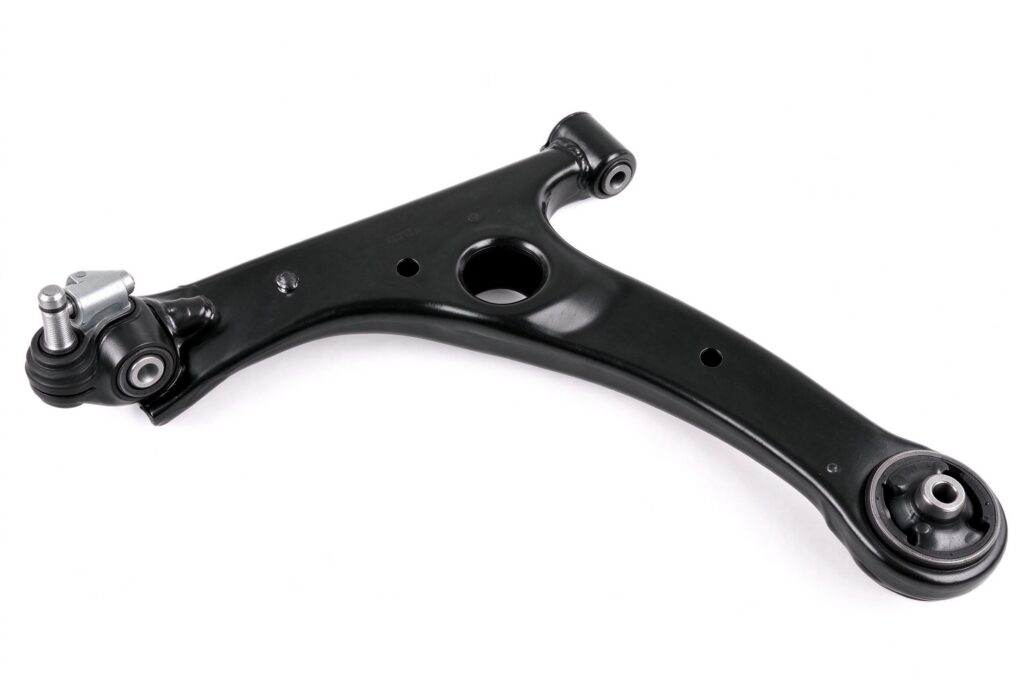
The Toyota Corolla E120 (2002–2007, chassis codes ZZE12_/NDE12_/ZDE12_) uses a simple and durable MacPherson front suspension: a lower control arm with a pressed-in ball joint, a steering tie rod end on each side, and a stabilizer bar connected by short links. When clunks, squeaks or loose steering show up, the fix is almost always one of these four part families, not a full strut assembly. This guide gives the OE numbers and Hetian references for each part, what each failure sounds like, and how to verify the part before you order.
OE Cross-Reference Quick Table (Corolla E120)
| Part | Position | Hetian No. | Key OE Numbers | First Failure Signal |
|---|---|---|---|---|
| Front lower control arm | LH | H31-30262 | 48069-05070 | Clunk over bumps; bushing squeak |
| Front lower control arm | RH | H31-30263 | 48068-05070 / 48068-13010 | Clunk over bumps; bushing squeak |
| Tie rod end | LH (Euro) / LH (US) | H31-50628 / H31-50072 | 45047-19115 / ES80432 | Steering play, clunk when turning |
| Tie rod end | RH (Euro) / RH (US) | H31-50629 / H31-50073 | 45046-19265 / ES80431 | Steering play, clunk when turning |
| Lower ball joint (tie rod axle joint) | L&R (Euro) / L&R (US) | H31-50265 / H31-50071 | 45503-19255 / 45503-02150 | Pop over bumps; uneven front tire wear |
| Stabilizer bar link | L&R (Euro) / RH (Euro) | H31-50127 / H31-51577 | 48830-42010 / 48830-21020 | Rattle at low speed over small bumps |
| Lower arm bushing / arm with bushing | RH (Euro) | H31-63398 | 48068-02020 | Squeak or creak from the front lower arm |
| Strut mount (top mount) | — | H31-62926 | 48609-12420 | Knock over bumps; creak while turning |
Why the E120 front end is easy to diagnose
The E120 uses a strut-type front suspension: the lower control arm (Toyota calls it “front suspension arm, lower”) carries the spring load through a ball joint pressed into the arm’s outer end, while the inner end pivots on rubber bushings bolted to the subframe[1]. The steering rack connects to each knuckle through an outer tie rod end, and the stabilizer bar is tied to the strut by a short link on each side[1][8]. Every wear item is visible and testable without removing major assemblies, which makes the E120 one of the most predictable platforms for chassis repair.
Part-by-part: OE numbers and what failure sounds like
1. Front lower control arm (48068/48069 series)
The lower arm is the load-bearing pivot of the front corner. Toyota part numbers start 48069 for LH and 48068 for RH; the E120 Euro version is 48069-05070 / 48068-05070, with 48068-13010 as a later RH supersession[1][8]. Typical wear signs are a hollow clunk when crossing sharp bumps and a squeak from the inner bushing when the body flexes—Toyota even issued a technical service bulletin for front lower arm bushing squeak on Corolla models, replacing the complete arm assembly when the bushing rubber fails[2]. Check the inner bushings for cracks and the ball joint boot for splits before replacing anything else[2][11].
2. Tie rod ends (45046/45047 series)
Outer tie rod ends connect the steering rack to the knuckle. Toyota numbers run 45047-xxxxx for LH and 45046-xxxxx for RH; the E120 Euro fitment is 45047-19115 (LH) and 45046-19265 (RH), while the US-built car uses ES80432 (LH) and ES80431 (RH)[5][8]. A worn tie rod end shows up as clunking or knocking when turning or crossing bumps, a steering wheel that feels loose or vibrates, and uneven wear on the inner or outer edges of the front tires[5][7]. A squeak from the joint usually means the dust boot is split and the grease has washed out; a grinding sound means metal-to-metal contact and needs immediate replacement[7].
3. Lower ball joint / tie rod axle joint (45503 series)
On the E120 the front lower ball joint is pressed into the control arm and is Toyota part number 45503-19255 (Euro, L&R) or 45503-02150 (US)[6][8]. The classic symptoms are popping or clunking from the front suspension over bumps and when turning, wandering steering that feels unstable at speed, and uneven wear on the front tires[6]. With the car lifted, grab the tire at 6 and 12 o’clock and rock it—visible play at the joint means replacement[6]. The ball joint boot is sealed: once play develops, the only repair is replacement, not lubrication[4].
4. Stabilizer bar links (48820/48830 series)
The stabilizer links are the most frequently replaced part on the E120 front end. Toyota numbers are 48830-42010 (Euro) and 48830-21020 (RH Euro), and the US-market link 48820-02030 covers Corolla, Matrix and Prius platforms from 2003 through 2018[8][9]. A failed link makes a “klotok” rattle over broken pavement, usually below 40 km/h, and the steering feels less stable in corners[3][4]. With the car on a lift, grab the link and twist—excessive free play or a dead spot means replacement[3][4]. They are sealed ball joints: when worn they are replaced, never rebuilt[4].
5. Bushings and strut mounts
Rubber bushings (Hetian H31-63398 for the RH lower arm, OE 48068-02020) and the strut mount/top mount (H31-62926, OE 48609-12420) complete the front end. Worn bushings squeak when the body rolls; a worn strut mount knocks over bumps and creaks during slow full-lock turns[2][11]. Both are low-cost items that are worth replacing at the same time as the arm if the rubber is cracked or separated.
Replacement and torque essentials
The E120 factory procedure tightens the lower control arm to the subframe to 137 N·m (101 ft·lbf) at the front mounting, with the ball joint clamped to the knuckle by a castle nut[1]. In practice the same torque family applies across the early 2000s Corolla: ball joint fasteners tighten around 142 N·m and the wishbone/arm around 215 N·m on adjacent model years[9]. Because the bushings are preloaded, the arm bolts should be tightened with the suspension loaded at normal ride height, and a four-wheel alignment must follow any control arm or tie rod work[1][11].
How to verify a replacement part before you order
- Match the OE number by side: 48069 = LH, 48068 = RH for the arm; 45047 = LH, 45046 = RH for the tie rod end. Never order “one part fits both sides” for these items[1][8].
- Check the boot and rubber: a split dust boot or cracked bushing is the #1 cause of premature failure, so the replacement part should arrive with intact, oil-resistant boots and bushings[2][7].
- Confirm the ball joint is sealed and lubricated for life: E120-style lower joints are closed units that cannot be serviced, only replaced[4][6].
- Verify the manufacturer: look for IATF 16949-certified production and parts with full OE cross-reference markings—the same quality gates that protect the arm, ball studs and bushings against early play[11].
Why buyers choose Hetian for Corolla E120 chassis parts
Hetian Auto has manufactured suspension and steering components since 1998, operates a 160,000 m² facility, holds IATF 16949 certification and a CNAS-accredited laboratory, and exports chassis parts to more than 30 countries with 100+ patents. The Corolla E120 range covered here—lower arms, tie rod ends, lower ball joints, stabilizer links and bushings—is produced against the same OE cross-reference numbers listed above, so distributors and workshops can match a single OE number to a verified Hetian reference without guesswork[11].
FAQ
1. My Corolla E120 clunks over speed bumps. What should I check first?
Start with the stabilizer links—they are the cheapest and most common cause of low-speed rattles—then check the lower control arm bushings and ball joint play with the car lifted[2][3]. A hollow metal clunk usually points to the arm or ball joint; a fast rattle on small bumps usually points to the links[4].
2. Can I replace just the lower arm bushing instead of the whole arm?
On the E120, the arm and ball joint are one assembly. If the bushing rubber is cracked but the arm and joint are sound, some workshops press in a new bushing; if the joint has play or the boot is split, replace the complete arm[2][11]. The safe rule is: ball joint play or a torn boot means a new arm assembly[6].
3. How do I know if my tie rod end is worn?
Clunking when turning or over bumps, a loose-feeling steering wheel, front-tire edge wear, and the car pulling to one side are the classic signs[5][7]. Lift the front wheels and rock each wheel side to side at 3 and 9 o’clock—play there points to the tie rod end[7].
4. What torque should the lower control arm bolts be tightened to?
The E120 factory spec is 137 N·m (101 ft·lbf) at the front subframe mounting, with ball joint fasteners in the 142 N·m range on adjacent Corolla model years[1][9]. Always tighten with the suspension loaded and finish with an alignment[1].
5. Do stabilizer links need to be replaced in pairs?
Yes—replace both left and right links together. The opposite link is usually worn to the same degree, and replacing one side only means the other side fails a few months later[3][8].
6. Is the lower ball joint serviceable?
No. The E120 lower ball joint is a sealed unit pressed into the control arm; when play develops it is replaced, not greased or rebuilt[4][6].
7. My front end squeaks only on cold mornings. What is it?
That is classic bushing behavior—cold and moisture stiffen the rubber, so the lower arm bushing or stabilizer link squeaks until it warms up[2]. Inspect the boots and bushings; cracked rubber should be replaced before it fails completely[11].
Related Guides
- What Is a Suspension Bushing? Materials, Function and Failure Modes
- Chassis Noise Diagnosis: How to Identify Worn Control Arms, Ball Joints, Bushings and Links by Sound
- Ball Joint Factory Quality Gates: How Ball Studs Are Tested Before Shipment
- OEM vs. Aftermarket Suspension Parts: Quality Explained
- Product category: Control Arms
References
[1] Toyota Corolla (E120): Front Suspension Arm Lower No.1 LH Service Procedure, Toyota Corolla Workshop (tcorolla.net), 2026, https://www.tcorolla.net/front_suspension_arm_subv_assy_lower_no_1_lh-1099.html, accessed 2026-10-17.
[2] Squeak Noise From Front Lower Suspension Arm Bushing, T-SB-0068-20, NHTSA / Toyota, 2020, https://static.nhtsa.gov/odi/tsbs/2020/MC-10178777-9999.pdf, accessed 2026-10-17.
[3] How to Replace Toyota Corolla Sway Bar Links: Step-by-Step Guide, CarInterior, 2026-01-26, https://carinterior.alibaba.com/question/toyota-corolla-sway-bar-link-replacement-guide, accessed 2026-10-17.
[4] Cara Cek Link Stabilizer Mobil Rusak, PT Toyota Astra Motor, 2026-04-20, https://www.toyota.astra.co.id/corporate-information/news-promo/read/cara-cek-link-stabilizer-mobil-rusak-sebelum-terlambat-dan-bikin-kaki-kaki-hancur, accessed 2026-10-17.
[5] Front Outer Tie Rod End for Toyota Corolla (2003–2008 / E120 Model), Banex Marketplace, 2026-10-02, https://marketplace.banexmall.com/product/front-outer-tie-rod-end-for-toyota-corolla-2003-2008-e120-model, accessed 2026-10-17.
[6] Ball Joint Toyota Corolla: Key Signs of Wear, AliExpress Wholesale, 2026-07-02, https://www.aliexpress.com/w/wholesale-ball%20joint%20toyota%20corolla.html, accessed 2026-10-17.
[7] Tie Rod End Noise Guide: How to Diagnose and Fix It, CarInterior, 2026-01-28, https://carinterior.alibaba.com/buyingguides/tie-rod-end-noise-symptoms-fixes, accessed 2026-10-17.
[8] Front Suspension for 2007 Toyota Corolla, OEM Genuine Toyota Parts, 2026-05-03, https://www.oemgenuineparts.com/v-2007-toyota-corolla–le–1-8l-l4-gas/suspension–front-suspension, accessed 2026-10-17.
[9] 1999 Toyota Corolla Sedan Front Suspension Fastener Tightening Specifications, Garage.Wiki, 2025-10-30, https://garage.wiki/toyota/corolla-sedan/seventh-generation-facelift/1999/front-suspension-fastener-tightening-specifications.html, accessed 2026-10-17.
[10] Genuine Toyota Stabilizer Bar Link 48820-02030 (2003–2018 Corolla), Frontier Toyota Parts, 2026-05-14, https://parts.frontiertoyota.com/v-2015-toyota-corolla–le-eco–1-8l-l4-gas/suspension–suspension-components?assembly=2, accessed 2026-10-17.
[11] 汽车下摆臂全科普:结构+寿命+检测+更换(Automotive Lower Control Arm Complete Guide), 汽车之家论坛 (Autohome Forum), 2026-05-13, https://club.autohome.com.cn/bbs/thread/67cd1265ea377b02/115109783-1.html, accessed 2026-10-17.
Last updated: Oct 17, 2026 · Reviewed by the Hetian engineering team