
← All technical articles · News
Industry Insights
Suspension Parts Fitment Check: How to Verify OE Numbers, Sides and Versions Before Buying
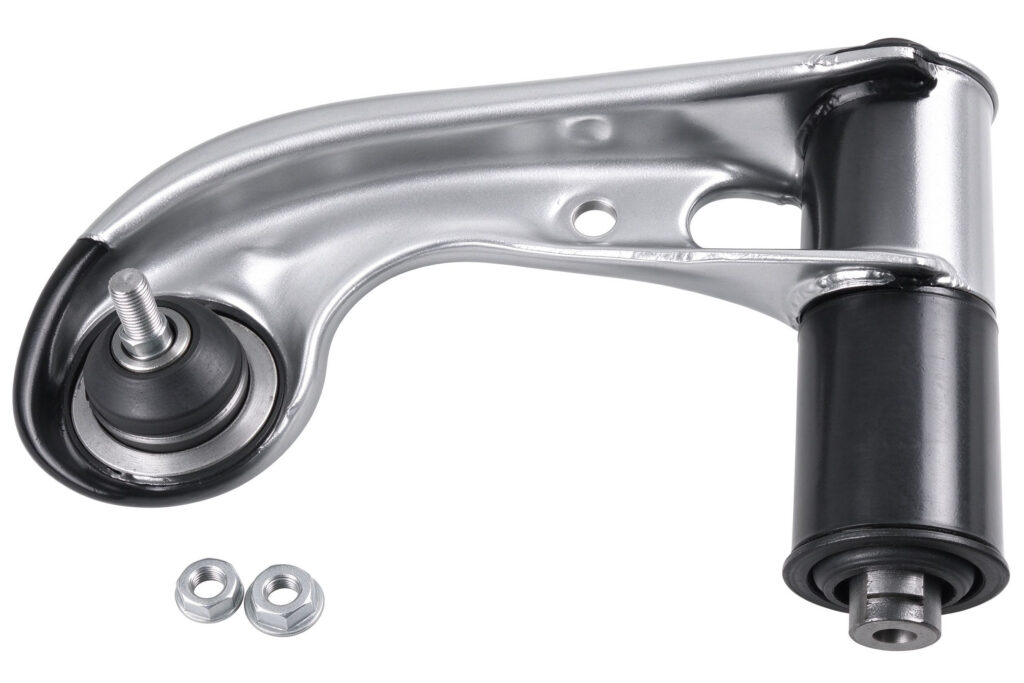
Most “wrong part” orders are not a quality problem — they are a verification problem. Industry estimates put online auto-parts return rates at roughly 20–35%, and fitment errors are the number-one cited reason a part comes back [1]. A further 40% of online auto-parts returns trace to fitment mismatches [2]; a high return rate and a low repeat-purchase rate are the same problem read from two ends [3]. Before you order a control arm, ball joint or tie rod, three checks — the OE number, the left/right side, and the part version — prevent nearly all of those returns. This guide turns them into a five-minute checklist for any quote.
| Buying Path | What It Means | Fitment Reliability | Best For |
|---|---|---|---|
| OEM part (dealer/factory) | The exact factory number for your VIN [7] | Highest — factory catalog data, supersession tracked | Warranty work and critical safety joints |
| OE-matching aftermarket part | Supplier builds to the OE number and lists the same applications [14] | High — verified against the OE reference, but you still confirm side and version | Distributors and workshops with reference numbers |
| Cross-referenced / “fits like” part | Interchange data maps the OE number to an equivalent [11][14] | Conditional — supersessions run one way; older-number substitutes are not guaranteed [11] | Buyers who check dimensions and fitment support |
Why a Part That “Looks Right” Still Does Not Fit
A control arm can differ across model years, body styles and drivelines — details a year/make/model dropdown cannot see [1]. Three failure clusters cover most wrong-part orders:
- Wrong application window. The part covers the model, but not your production year or engine code; the same-looking arm can carry a different OE number between generations [5].
- Wrong side. On most modern vehicles the left and right arms are mirror images — bends, gussets and ball-joint angles line up with one side only [8]. Swapping sides can contact the spring, frame or wheel and push alignment out of range [8].
- Wrong version. Standard, reinforced, sport or EV variants are not interchangeable — mounting points, bushings and ball-joint offsets change [12].
Check 1: The OE Number — Start From the VIN, Not the Car Name
The 17-character VIN identifies manufacturer, series, model year, factory and build information; for Japanese, Korean, Malaysian and many continental vehicles the chassis number is especially useful [4]. Use the VIN to confirm the build, then verify the OE number and its supersession chain [10].
Read the OE number completely, including the suffix. Supersessions run one way: an old number points forward to a replacement under stated conditions, but an older part is not guaranteed where a newer reference is specified — the new part may cover extra applications or change design [11]. If the original number is worn or the car was modified, ask the supplier to verify against the VIN and compare old and new parts side by side [5].

Check 2: Left vs. Right — Mirror Images Are Not the Same Part
Left and right refer to the vehicle’s sides as you sit facing forward [9]. The two sides are rarely interchangeable — different shapes, mounting positions and OE numbers [9]. Bushing offset, mounting-hole angle and ball-joint orientation differ between sides on many vehicles: Honda CR-V, for example, uses asymmetric arms where 51200-TL0-A01 (left) and 51200-TL0-A02 (right) must not be crossed [9]. For tie rods and control arms, side interchangeability is the exception — angle, offset, thread hand and joint clocking all change steering behaviour [10]. Buy the pair as the catalog lists it; odd/even numbering conventions exist precisely because the sides differ.
Check 3: Version — Standard, Reinforced, EV and Air-Suspension Variants
Within one model family, fitment varies: hatchback and sedan versions do not always share parts, and performance or electrified variants often use reinforced arms [9][7]. A W205 AMG control arm, for example, is not interchangeable with the standard C-Class arm due to reinforced mounting points, stiffer bushings and a higher-offset ball joint [12]. Confirm front or rear, left or right, upper or lower, complete arm or bushing-only — these distinctions change the reference and quantity needed [13].
A Five-Minute Fitment Checklist Before You Order
- Record and decode the VIN. Model year, engine code, drivetrain and body style — not just “make/model” [4][7].
- Confirm the OE number. Read the old part’s number (or query the VIN) and confirm the supersession direction before accepting a substitute [10][11].
- Confirm the side. Left or right as fitted to the vehicle; buy the pair as the catalog lists them [8][9].
- Check critical dimensions. Verify mounting-hole spacing, ball-joint taper and thread spec against the old part or the supplier’s data sheet [5][9].
- Ask the supplier to verify. Use a supplier who confirms fitment against the VIN or OE reference before shipping — in cross-border sourcing a wrong part costs freight, customs and two extra weeks of customer wait [6].
When quoting, never guess if a catalog lists alternatives — request the VIN or the original part reference first [13].
About Hetian
Hetian has produced suspension and chassis parts since 1998 across a 160,000 m² base, with IATF 16949, a CNAS-accredited laboratory, exports to 30+ countries and 100+ patents. Every control arm, ball joint and bushing we ship carries a full OE cross-reference so distributors can verify fitment before the part leaves the factory — verification belongs on the desk, not at the workbench.
FAQ
Q: Does a matching OE number guarantee the part fits?
Not by itself. The vehicle may have been modified or the old number misread, and a superseded number may point to a changed design. Verify against the VIN and compare the old part [5][11].
Q: Can I swap left and right control arms?
On most modern vehicles, no. The arms are mirror images with different bends, gussets and ball-joint angles; swapping sides can contact springs or the frame and push alignment out of range [8][9].
Q: Why does the same model year list two different control-arm numbers?
Mid-year changes, engine/trim variants and reinforced or sport versions use different arms. Use the VIN and the old part number, not the model name alone [1][13].
Q: Is a cross-referenced “fits like” part safe?
It can be, but interchange data is directional: supersessions run one way, and the substitute must match dimensions and mounting points. Confirm the reference chain and supplier fitment support before ordering [11][14].
Q: What is the most common mistake in cross-border parts sourcing?
Verifying against year/make/model instead of the VIN. The wrong part then costs freight, customs and weeks of customer wait [1][6].
Q: Should I buy a control arm as a pair even if only one side is worn?
Buy the correct side, but many workshops replace both sides together so wear and alignment stay symmetric. Confirm each side’s number separately — they are different parts [8][9].
Related Guides
- Aftermarket Control Arm Quality: A Supplier Verification Checklist for Chassis Parts Buyers
- Toyota Corolla (E120) Front Suspension Parts: OE Cross-Reference and Replacement Guide
- Honda Accord Front Suspension Parts: OE Cross-Reference and Replacement Guide (2003–2022)
- Chassis Noise Diagnosis: How to Identify Worn Control Arms, Ball Joints, Bushings and Links by Sound
- Control Arms — Product Category
References
[1] The Auto Parts Returns Problem: Data & Fixes, VinSnap, 2026-10-10, https://vinsnap.net/parts-returns-report, accessed 2026-10-29
[2] Vehicle-Specific Auto Parts Compatibility Guide, Alibaba.com Seller Blog, 2026-10-21, https://seller.alibaba.com/blogs/2026/southeast-asia/auto-parts/vehicle-fitment-guide-honda-toyota-ford-alibaba-b2b, accessed 2026-10-29
[3] Auto Parts Ecommerce — Fitment Percent Lift, Digital Heroes, 2026-04-28, https://digitalheroesco.com/industries/auto-parts/, accessed 2026-10-29
[4] How to Match Parts Fitment Correctly Every Time, Saiko, 2026-07-25, https://saiko.com.my/blog/how-to-match-parts-fitment-correctly, accessed 2026-10-29
[5] How to Match OEM Part Numbers Before Buying Car Parts, DrivenExt Auto Parts, 2026-07-18, https://drivenextautoparts.ae/how-to-read-and-match-oem-part-numbers-before-ordering-car-parts-online/, accessed 2026-10-29
[6] VIN Decoding for Auto Parts Sourcing — A Buyer’s Guide, Partzeal, 2026-04-26, https://www.partzeal.com/ru/guides/vin-decoding-for-auto-parts-sourcing, accessed 2026-10-29
[7] Car Parts Fitment Guide: Avoid Sourcing Mistakes, The Garage Shop, 2026-04-23, https://the-garage.shop/understanding-car-parts-fitment-avoiding-common-sourcing-mis, accessed 2026-10-29
[8] Are Upper Control Arms Interchangeable?, Four Wheel Ask, 2025-12-29, https://fourwheelask.com/are-upper-control-arms-interchangeable/, accessed 2026-10-29
[9] How to Identify the Right Control Arm: Front, Rear, Upper, Lower, Left or Right, DPANS, 2026-09-24, https://zzwelcom.com/how-to-identify-the-right-control-arm/, accessed 2026-10-29
[10] How Do LHD and RHD Steering Parts Differ?, MR.FAST, 2026-08-08, https://mrfastauto.com/how-do-lhd-and-rhd-steering-parts-differ/, accessed 2026-10-29
[11] Part Number Interchange: When One Number Fits Another Car, VINsearch, 2026-10-03, https://vinsearch.online/guides/part-number-interchange/, accessed 2026-10-29
[12] W205 AMG RHS Replacement: Exact Part Number & Installation Guide, CarInterior, 2026-03-02, https://carinterior.alibaba.com/tips/w205-amg-rhs-replacement, accessed 2026-10-29
[13] Control Arm & Bushing Buying Guide — Position Fitment, BILUSI Auto Parts, 2026-08-16, https://bilusiaparts.com/blogs/news/control-arm-bushing-buying-guide-position-fitment, accessed 2026-10-29
[14] Cross Reference Part Number Lookup: Free Databases (2026), Suplif, 2026-04-25, https://www.suplif.ai/en/blog/cross-reference-auto-parts/, accessed 2026-10-29
Last updated: Oct 29, 2026 · Reviewed by the Hetian engineering team