
← All technical articles · News
Industry Insights
Aftermarket Control Arm Quality: A Supplier Verification Checklist for Chassis Parts Buyers
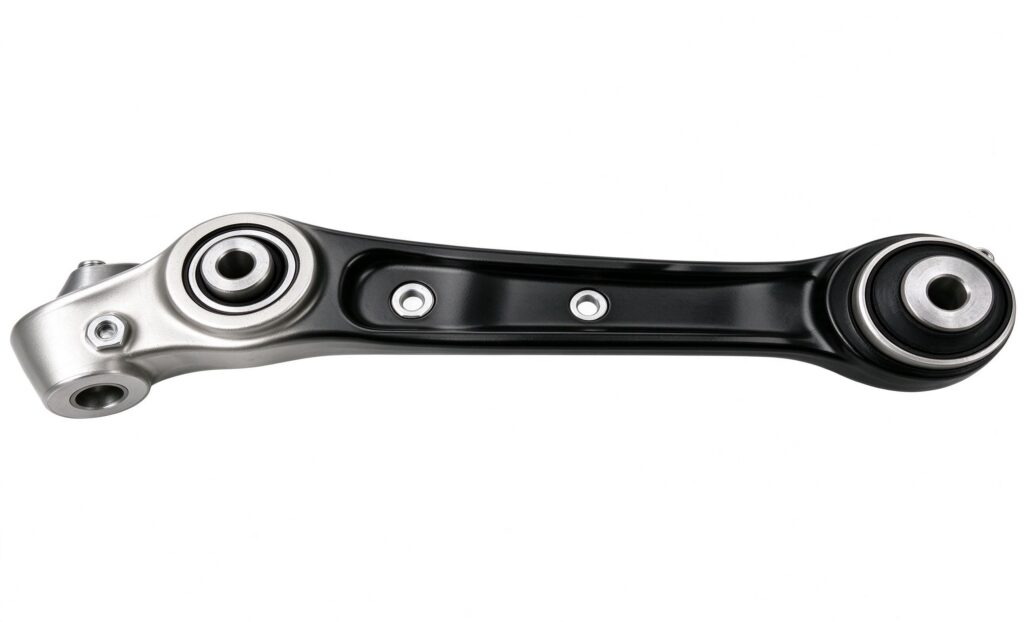
Buying aftermarket control arms is not a price-per-piece decision. In March 2026, ZF North America recalled 275 aftermarket TRW (JTC 1619) and Lemförder (38526 01) control arms sold for Porsche 718 and 911 models because a manufacturing notch in the bushing inner sleeve could compress further under tightening, damage the front axle carrier and cause a loss of vehicle handling [1][2]. China’s State Administration for Market Regulation issued a parallel recall of 138 imported TRW JTC 1619 front control arms for the same root cause — an inner sleeve that was too short [3]. The lesson for distributors and workshops is direct: verify the supplier, not just the certificate. This checklist covers the six areas that separate a chassis-grade control arm from a warranty claim waiting to happen.
Quick-Reference: What to Verify Before You Order
| Check Area | What You Ask For | Why It Matters |
|---|---|---|
| Quality system | IATF 16949 certificate + audit scope; PPAP documents | A certificate proves a system exists; PPAP proves this part meets the spec [8][11] |
| Material traceability | Steel grade, heat-treatment batch records | Batch-level documentation is what lets a recall be contained [6][10] |
| Dimensional capability | Cp/Cpk on arm and bushing features; ±0.2 mm or tighter | Reduces fitment issues and returns [7][10] |
| Bushing press-fit | Inner sleeve length, interference tolerance, press-force data | The ZF recall was an inner-sleeve defect — the exact failure mode to screen for [1][2][3] |
| Corrosion protection | Pre-treatment process, salt-spray hours, coating type | Blind spots in pre-treatment cause early debonding and cracks [12] |
| Fatigue and load testing | Third-party fatigue results (e.g., 200,000+ cycles), pull-out tests | Predicts real-world service life on safety-critical parts [10][13] |
What the ZF Recall Actually Shows
NHTSA campaign 25E020 covers aftermarket TRW JTC 1619 and Lemförder 38526 01 track control arms sold for Porsche 718 Cayman, 718 Boxster and 911 Speedster models [1]. The defect is a manufacturing notch in the bushing inner sleeve. Once the arm is tightened into the subframe, the notch can be compressed further, the sleeve can crack, and the cracked subframe can damage the front axle carrier and cause a loss of vehicle handling and control [2]. ZF’s remedy is free replacement, with labor time estimated at 8–12 hours [1][2]. The parallel Chinese recall, number S2025E0068V, covers 138 imported TRW JTC 1619 front control arms produced between June 1, 2024 and March 5, 2025, with the same root cause: an inner sleeve that was too short, which could damage the front subframe it connects to [3].
Two things stand out. First, both arms were OE-branded aftermarket products from one of the largest Tier-1 suppliers in the world — the defect happened despite a mature quality system. Second, the failure mode is invisible at installation: the sleeve length and notch sit inside the rubber bushing. No visual inspection of the assembled arm catches it. Only dimensional and press-fit records can [1][2][3].
Why Aftermarket Chassis Parts Need a Different Bar
Control arms are safety-critical suspension components: they locate the wheel, carry braking and cornering loads, and transmit NVH. In the IATF 16949 framework they are typically classed with steering and brake parts where certification and PPAP are non-negotiable [9][11]. For a part in this category, an ISO 9001-only factory is a red flag — IATF 16949 is the automotive-specific quality standard that goes beyond general ISO 9001 [9]. And as GDST Auto notes, certificates prove a quality management system exists; they do not guarantee product performance. You must verify how the system is applied — material control, dimensional checks, performance testing [8].
Six Verification Areas for Control Arm Suppliers
1. Quality System and PPAP Evidence
Ask for the IATF 16949 certificate and check the audit scope covers suspension parts. Then ask for the PPAP package for the specific part number you are buying. PPAP (Production Part Approval Process) is where system certification becomes product-level proof: its 18 elements document that the production process can consistently make parts to the customer’s specification [11]. OEMs apply this rigorously — Stellantis, for example, requires PPAP status A before delivery without deviation, and Ford requires final APQP/PPAP records to be kept for the life of the part plus one year [4][5]. If a supplier cannot produce a PPAP file for the part you are quoting, that is not a documentation gap; it is a risk signal.
2. Material and Heat-Treatment Traceability
Control arm performance depends on the steel grade and the heat treatment. Batch-level documentation for steel grade and heat treatment is a mandatory check in automotive sourcing [10]. In practice this means the supplier can trace a finished arm back to the specific steel coil and the heat-treatment furnace run — the same traceability chain that lets a manufacturer contain a defect to 138 parts instead of recalling an entire distribution channel [3][6].
3. Dimensional Capability on the Arm and the Bushing
Ask for Cp/Cpk values on key arm and bushing features, and check the tolerance regime — ±0.2 mm or tighter is the typical bar for control arm factories [7][10]. Dimensional capability matters twice for control arms: the arm geometry sets the suspension alignment, and the bushing bore tolerance sets the press-fit. If the interference fit is oversized on an aluminum arm, the hoop stress can tear a micro-crack into the bore edge on day one, which then propagates under millions of cycles [13].
4. Bushing Press-Fit and Inner Sleeve Verification
This is the area the ZF recall puts on the table. The inner sleeve length, the interference tolerance and the press-force records are the documents that prove the bushing will not crack or come loose in service [1][2][3][6]. A serious supplier runs a Manufacturing Execution System (MES) that records every press-fit batch — compound mixing, machining, coating, vulcanization — so the exact state of a batch can be reconstructed the moment a quality fluctuation appears [6]. If a supplier treats traceability as retrospective paper logs, walk away [6].
5. Corrosion Protection and Surface Treatment
Early cracking and debonding in control arm bushings is frequently traced to a blind spot in anti-corrosion pre-treatment: when salt spray and moisture penetrate micro-defects, the metal interface corrodes and the rubber-to-metal bond fails [12]. On the arm itself, the coating specification — type, thickness and salt-spray hours — predicts corrosion behavior and fatigue life [7]. In high-salt regions, corrosion pits can form beneath protective coatings within a few winters and propagate under cyclic loading [14].
6. Fatigue and Load Testing
Third-party fatigue testing of at least 200,000 cycles and verified load-bearing capacity is part of the standard sourcing matrix for control arms [10]. Ask who performed the test, on what fixture, and to what load spectrum. Fatigue results are also where lightweighting bets are validated: forged aluminum arms can save weight, but galvanic corrosion at the steel-sleeve/aluminum-bore interface and press-fit micro-cracks are the two failure modes that must be engineered out [13].
Red Flags That Should Stop an Order
Some warning signs are cheap to spot before money moves. A supplier that cannot show PPAP documents for the quoted part; an ISO 9001-only factory for a safety-critical arm; no batch traceability from finished part back to steel coil and heat treatment; no third-party fatigue data; and no press-fit records for the bushing. Any one of these is enough to disqualify a candidate for chassis parts [6][8][9][10][11]. So is a price that sits far below the market: a control arm that skips pre-treatment, testing or traceability looks identical in the catalog and fails in the field.
FAQ
1. Is IATF 16949 certification enough to trust a control arm supplier?
No. IATF 16949 proves a quality management system exists, not that this specific part meets the spec [8][9]. Use the certificate as the entry filter, then verify PPAP, material traceability, dimensional data and test results for the exact part number.
2. What is PPAP and why should an aftermarket buyer care?
PPAP (Production Part Approval Process) is an 18-element evidence package proving the production process can consistently make parts to specification [11]. Aftermarket buyers rarely ask for it, which is exactly why OEM-level distributors should — it is the difference between a system certificate and product-level proof.
3. Why did the ZF control arms fail if they were made by a Tier-1 supplier?
The recalled TRW and Lemförder arms had a manufacturing notch in the bushing inner sleeve, and in the Chinese recall the inner sleeve was too short [1][2][3]. Both defects are invisible after assembly — the sleeve sits inside the rubber bushing. The recall shows that even mature quality systems need dimensional and press-fit verification on the exact feature that carries the load.
4. What does “bushing press-fit traceability” actually mean?
It means the supplier’s MES records the press-fit parameters and material history of each batch — compound, machining, coating, vulcanization — so any quality fluctuation can be traced to its exact batch and node [6]. Retrospective paper logs are not traceability.
5. What fatigue test level should I ask for on a control arm?
A commonly cited bar in sourcing matrices is third-party fatigue testing of at least 200,000 cycles plus verified load-bearing capacity [10]. Ask for the test report and confirm who ran it, on what fixture and with what load spectrum.
6. Are cheap aftermarket control arms ever a good deal?
For a safety-critical chassis part, cost savings usually come from skipping pre-treatment, testing or traceability — none of which is visible in the catalog [7][12][13]. The ZF recall’s 8–12 hour labor cost per vehicle is a reminder of what a defective arm costs once it is installed [1][2].
Related Guides
- How to Select a Control Arm Manufacturer: A Buyer’s Guide
- How to Qualify a Bushing Supplier for Chassis Programs
- Lightweight Chassis Trends: Aluminum Forged vs. Stamped Steel Control Arms
- OEM vs. Aftermarket Suspension Parts: What Buyers Should Know
- What Is a Suspension Bushing? Definition, Function and Types
- Product category: Control Arms
References
[1] “IMPORTANT SAFETY RECALL, NHTSA Recall No. 25E020,” National Highway Traffic Safety Administration, 2025, https://static.nhtsa.gov/odi/rcl/2025/RCONL-25E020-7422.pdf, accessed October 9, 2026.
[2] “NHTSA Recall 25E020,” OEMDTC, https://oemdtc.com/recall/?number=25E020000, accessed October 9, 2026.
[3] “采埃孚销售服务(中国)有限公司召回部分进口前控制臂 (Recall No. S2025E0068V),” State Administration for Market Regulation, May 9, 2025, https://www.samr.gov.cn:3030/zlfzj/qxcpzh/zhdt/art/2025/art_8a62fd0c7a5041dea4e49684a6882f3c.html, accessed October 9, 2026.
[4] “Stellantis Customer-Specific Requirements for use with IATF 16949,” IATF Global Oversight, June 2025, https://www.iatfglobaloversight.org/wp/wp-content/uploads/2025/06/STELLANTIS-CSR-for-use-with-IATF16949-v1.pdf, accessed October 9, 2026.
[5] “Ford Motor Company Customer-Specific Requirements for IATF-16949:2016,” IATF Global Oversight, January 2025, https://www.iatfglobaloversight.org/wp/wp-content/uploads/2025/02/Ford-IATF-CSR_January-2025-FINAL.pdf, accessed October 9, 2026.
[6] “Control Arm Bushing Press-Fit Data Traceability,” GJBUSH, August 21, 2026, https://www.gjbush.com/control-arm-bushing-press-fit-data-traceability/, accessed October 9, 2026.
[7] “Is your 2026 suspension kit sourcing strategy really future-proof?,” MR.FAST, July 9, 2026, https://mrfastauto.com/is-your-2026-suspension-kit-sourcing-strategy-really-future-proof/, accessed October 9, 2026.
[8] “How Do You Choose a Reliable Control Arm Manufacturer?,” GDST Auto Parts, May 31, 2026, https://gdstauto.com/how-do-you-choose-a-reliable-control-arm-manufacturer/, accessed October 9, 2026.
[9] “How to Verify Auto Parts Manufacturer Credentials Before Placing a Bulk Order,” TSY Auto Parts, April 3, 2026, https://tsyauto.com/verify-auto-parts-manufacturer-credentials/, accessed October 9, 2026.
[10] “Control Arm Factory Sourcing Criteria,” Accio, October 4, 2026, https://www.accio.ai/find-product/control-arm-factory, accessed October 9, 2026.
[11] “Automotive Metal Parts Sourcing: What Certification Really Means (PPAP 18 Elements),” Alibaba Seller Central, October 6, 2026, https://seller.alibaba.com/blogs/2026/southeast-asia/metal-crafts/automotive-parts-sourcing-standards-guide-alibaba-b2b, accessed October 9, 2026.
[12] “Why Control Arm Bushings Crack Early,” GJBUSH, May 13, 2026, https://www.gjbush.com/why-control-arm-bushings-crack-early-gjbush/, accessed October 9, 2026.
[13] “Aluminum Control Arm Lightweighting & NVH Tuning,” GJBUSH, May 27, 2026, https://www.gjbush.com/aluminum-control-arm-lightweighting-nvh-tuning/, accessed October 9, 2026.
[14] “Q60 Control Arm Failure Reasons: Top 7 Causes & Fixes,” CarInterior, March 2, 2026, https://carinterior.alibaba.com/tips/q60-control-arm-failure-reasons, accessed October 9, 2026.
Last updated: Oct 9, 2026 · Reviewed by the Hetian engineering team