
← All technical articles · News
Industry Insights
China Tesla Control Arm Factory Audit Guide: EV Loads, Aluminum Forging and 5 Manufacturing Gates
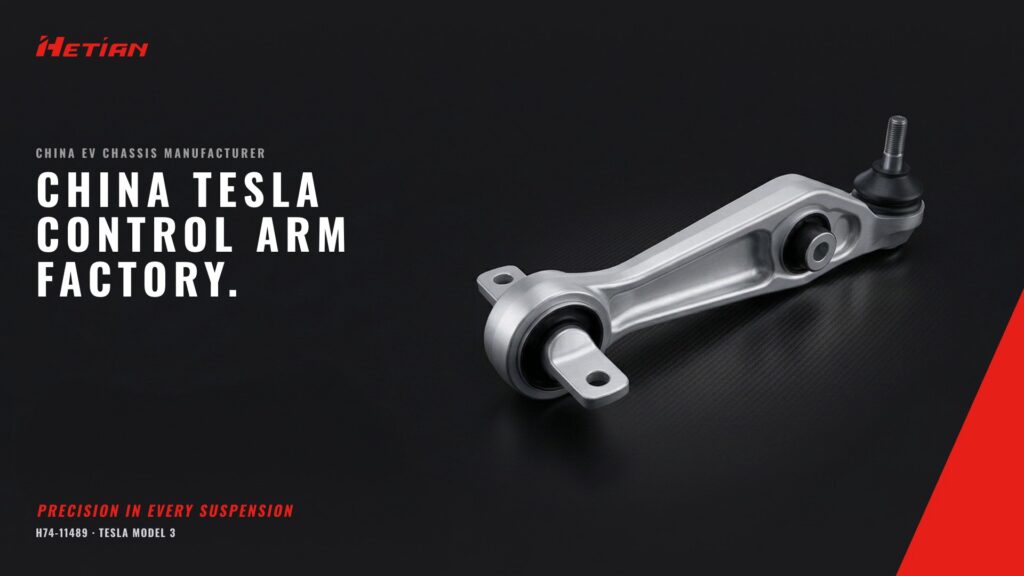
As global fleets of Tesla Model 3, Model Y, Model S, and Model X move steadily into their peak 3-to-8-year suspension service window, aftermarket brand owners, regional distributors, and EV specialist workshops are actively qualifying a reliable China Tesla control arm factory. Across those procurement conversations, the primary warranty risk is rarely fitment failure out of the box—it is premature ball-joint water ingress, bushing tearing under instant EV torque, or uncontrolled metallurgy that shows up 10,000–20,000 km after installation.
Evaluating a China Tesla control arm factory therefore requires looking past unit pricing to verify whether the manufacturer controls aluminum forging grain flow, continuous solution and aging heat treatment, 100% non-destructive testing (NDT), ball-joint sealing, and in-house EV rubber compounding. This guide breaks down Tesla front suspension failure modes, outlines five auditable manufacturing gates, and maps Wuhu Hetian’s live H74 aftermarket Tesla control arm coverage.
1. Quick Reference: Tesla Front Suspension Arms & Field Failure Modes
Before issuing an RFQ or approving samples, sourcing and engineering teams should align each Tesla front suspension link with its structural load path and documented aftermarket failure pattern:
| Platform & Arm Position | Public OE Root Family | Primary Load Role | Field Pain Points & Audit Focus |
|---|---|---|---|
| Model 3 / Y Front Upper Control Arm (FUCA) | 1044321 / 1044326, 1188321 / 1188326 series | Camber control during jounce/rebound and upper knuckle location | Water intrusion past the ball-joint seal washes out grease, triggering loud low-speed creaking (documented in Tesla TSB SB-20-31-006) [2]; audit boot sealing, airtightness testing, and high-pressure spray durability. |
| Model 3 / Y Front Lower Lateral Link (Straight) | 1044341 series (Model 3) & 1188341 series (Model Y) | Lateral cornering constraint and lower damper clevis mount | Model 3 and Model Y lateral links look similar but are NOT universally interchangeable; strict jig control prevents mix-ups. Also note NHTSA Recall 21V-835 context on lateral-link fastener security [1] and forged grain flow. |
| Model 3 / Y Front Lower Compliance Link (Curved) | 1044351 / 1044354 (LH) & 1044356 / 1044359 (RH) series | Longitudinal impact absorption, braking, and regen-torque loads | Large compliance bushing endures high-frequency braking/regen reversals; audit rubber-to-metal bond peel strength, heat treatment hardness, and FPI/X-ray screening along curved sections. |
| Model S / Model X Forged Aluminum Front & Rear Arms | 1041570 / 1041575, 1027322 / 1027327 series | High curb-weight chassis stability and heavy-load steering response | High vehicle mass and instant torque stress ball studs; China SAMR’s Oct 2020 recall covered 29,193 imported 2013–2017 Model S/X units for potential front aft-link ball-stud cracking under severe impact [3]. |
Regulatory filings and service bulletins point to two practical conclusions for aftermarket buyers. First, sealing and assembly details drive warranty costs: Tesla’s Technical Service Bulletin SB-20-31-006 addressed front upper control arm ball-joint water ingress across Model 3, Model Y, and Model X [2], showing how minor dust-boot or cap sealing flaws quickly escalate into noisy, corroded joints. Second, structural and fastening integrity is non-negotiable on heavy EVs—highlighted both by NHTSA Recall 21V-835 (Tesla SB-21-31-003, affecting 2,791 Model 3/Y units for potentially loose lateral-link fasteners) [1] and China SAMR’s October 2020 recall of 29,193 imported Model S/X units involving front aft-link ball-stud crack risks [3].
2. Why Conventional ICE Control Arm Processes Fall Short on EV Platforms
A replacement control arm that merely copies outer mounting points can fail rapidly on a Tesla because the duty cycle has changed. As detailed in our engineering analysis on EV Chassis Parts Selection: How Battery Weight and Instant Torque Change Requirements for Bushings, Ball Joints, and Control Arms, floor-mounted battery packs add substantial permanent static load across every corner, while electric drive motors deliver full torque from zero RPM followed by thousands of regenerative-braking torque reversals each week.
When a factory relies on unverified castings or outsourced heat treatment, hidden subsurface porosity, forging folds, or inconsistent solution-aging hardness remain invisible on the incoming QC table—only to emerge in service as clunks, alignment drift, rapid inner-shoulder tire wear, or structural fatigue cracks.
3. Five Manufacturing Gates to Audit in a China Tesla Control Arm Factory
To keep batch quality consistent across aftermarket orders, a qualified China Tesla control arm factory needs vertical integration over metallurgy, heat treatment, NDT, rubber compounding, and precision machining rather than subcontracting safety-critical steps. Using Wuhu Hetian’s 160,000 m² four-plant manufacturing campus as a benchmark, here are five verifiable gates on the shop floor:
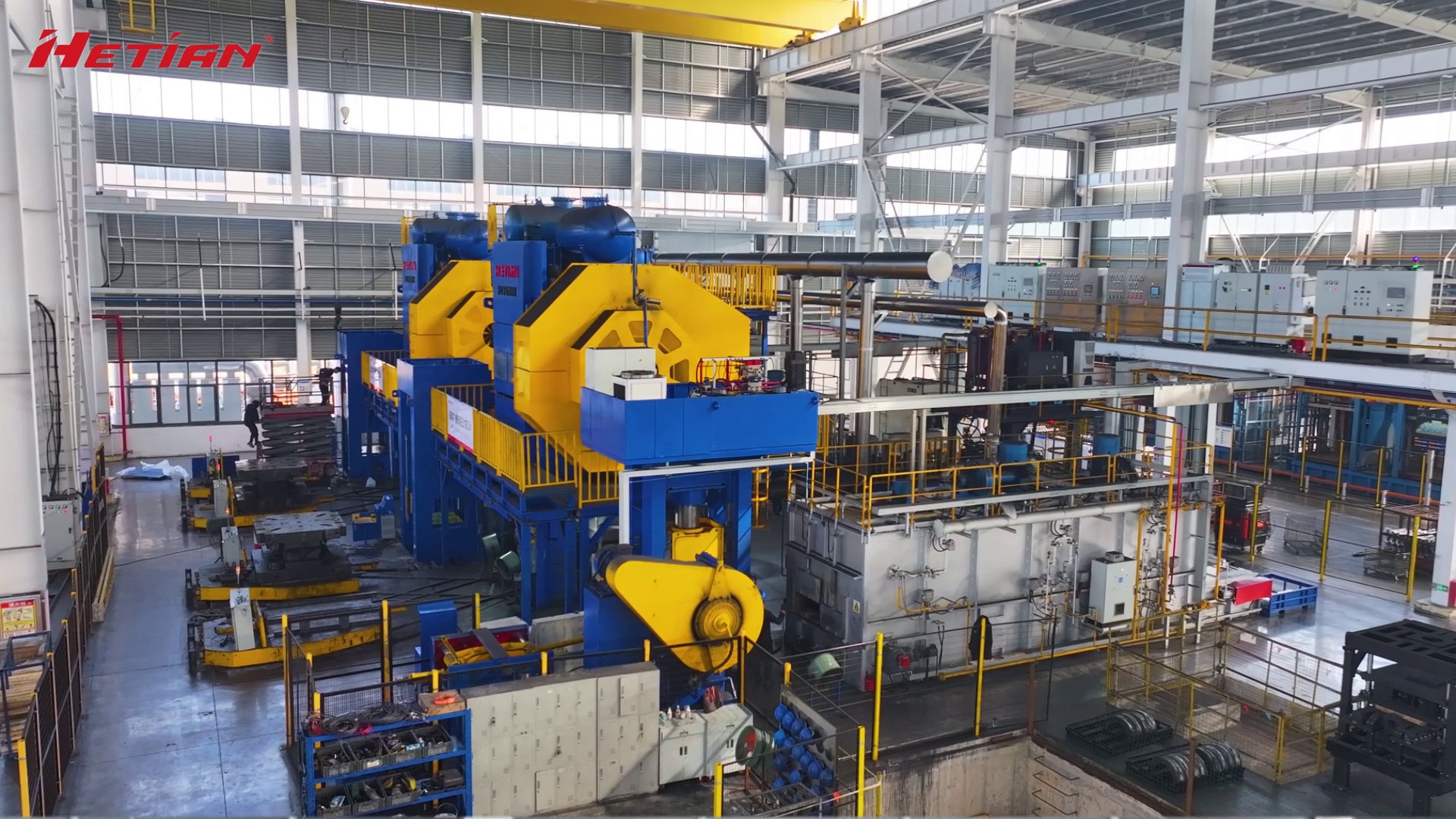
1. Heavy-Tonnage Closed-Die Aluminum Forging (10 Lines, Up to 6,000T): Tesla suspension arms require high strength without excess unsprung mass. Hetian’s 30,000 m² forging workshop (7 million pcs/year capacity) operates 10 dedicated aluminum forging lines—including 2×6,000T, 2×2,500T, 4×1,600T, and 2×1,000T presses—paired with robotic billet handling and induction heating so metallic grain flow follows primary arm load paths.
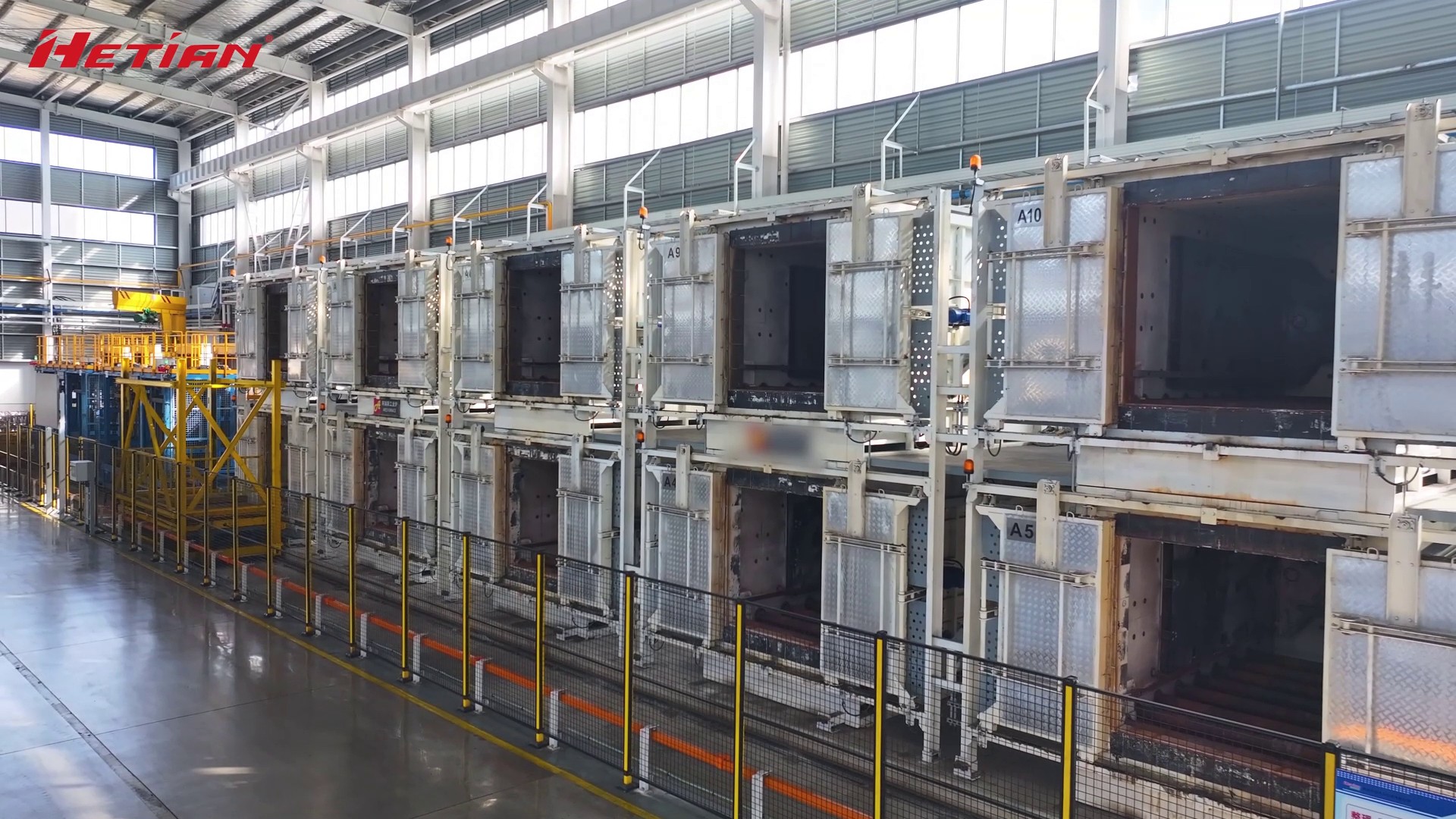
2. In-House Continuous Solution & Aging Heat Treatment: Forged aluminum blanks only achieve reliable yield strength and impact toughness when quenching and artificial aging stay inside tight thermal windows. Hetian runs a dedicated 2,000 m² continuous solution and aging furnace complex (6 million pcs/year), archiving furnace temperature curves, Brinell/Vickers hardness, and ZEISS metallography per heat lot.
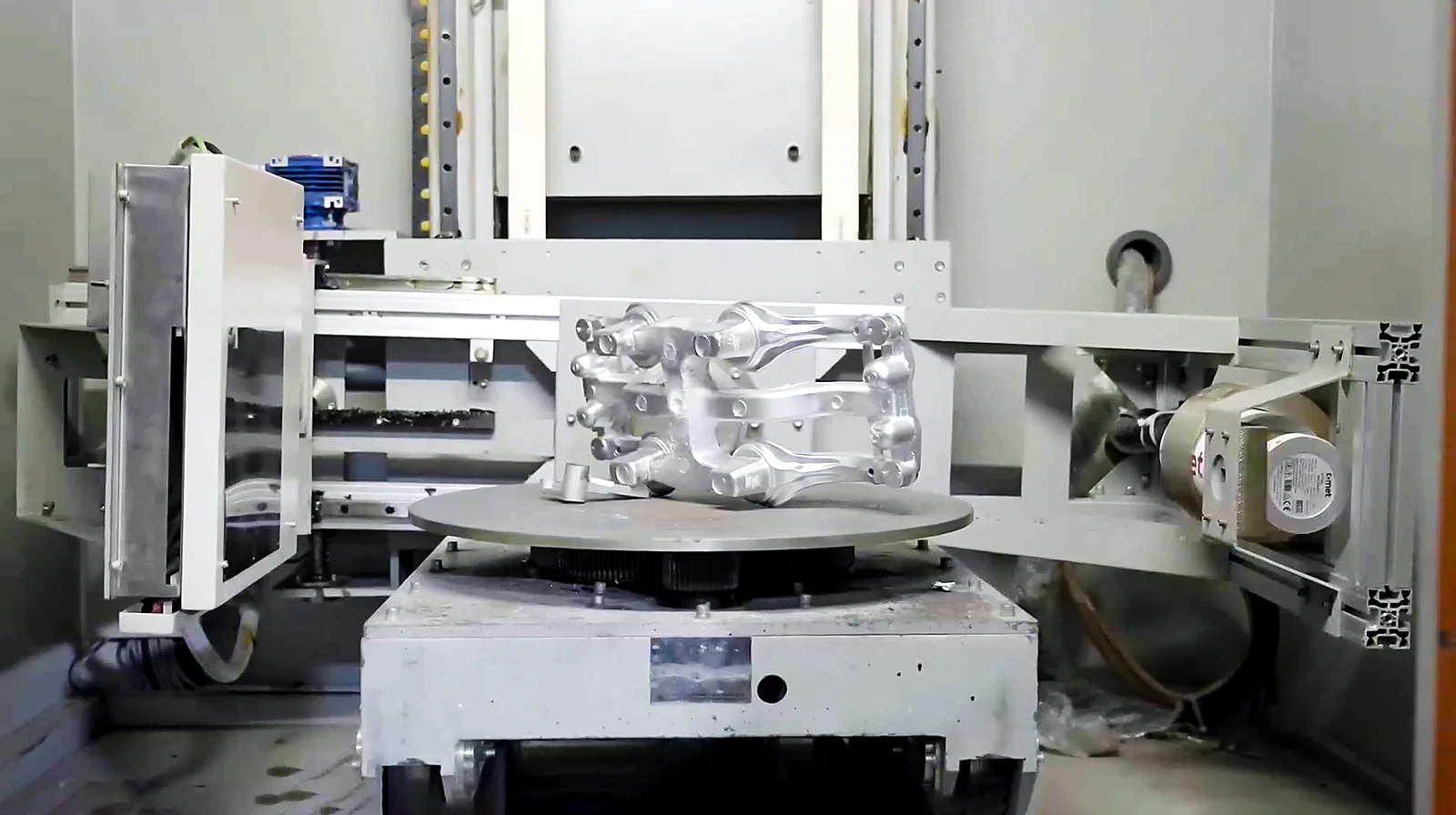
3. 100% Inline Non-Destructive Testing (3 FPI Lines & Industrial X-Ray): Subsurface shrinkage porosity and hairline forging folds are invisible to the naked eye. Hetian screens safety-critical forged aluminum control arms 100% on 3 automated fluorescent penetrant inspection (FPI) lines and operates real-time industrial X-ray inspection cabins (1 million pcs/year) to catch internal voids before machining.
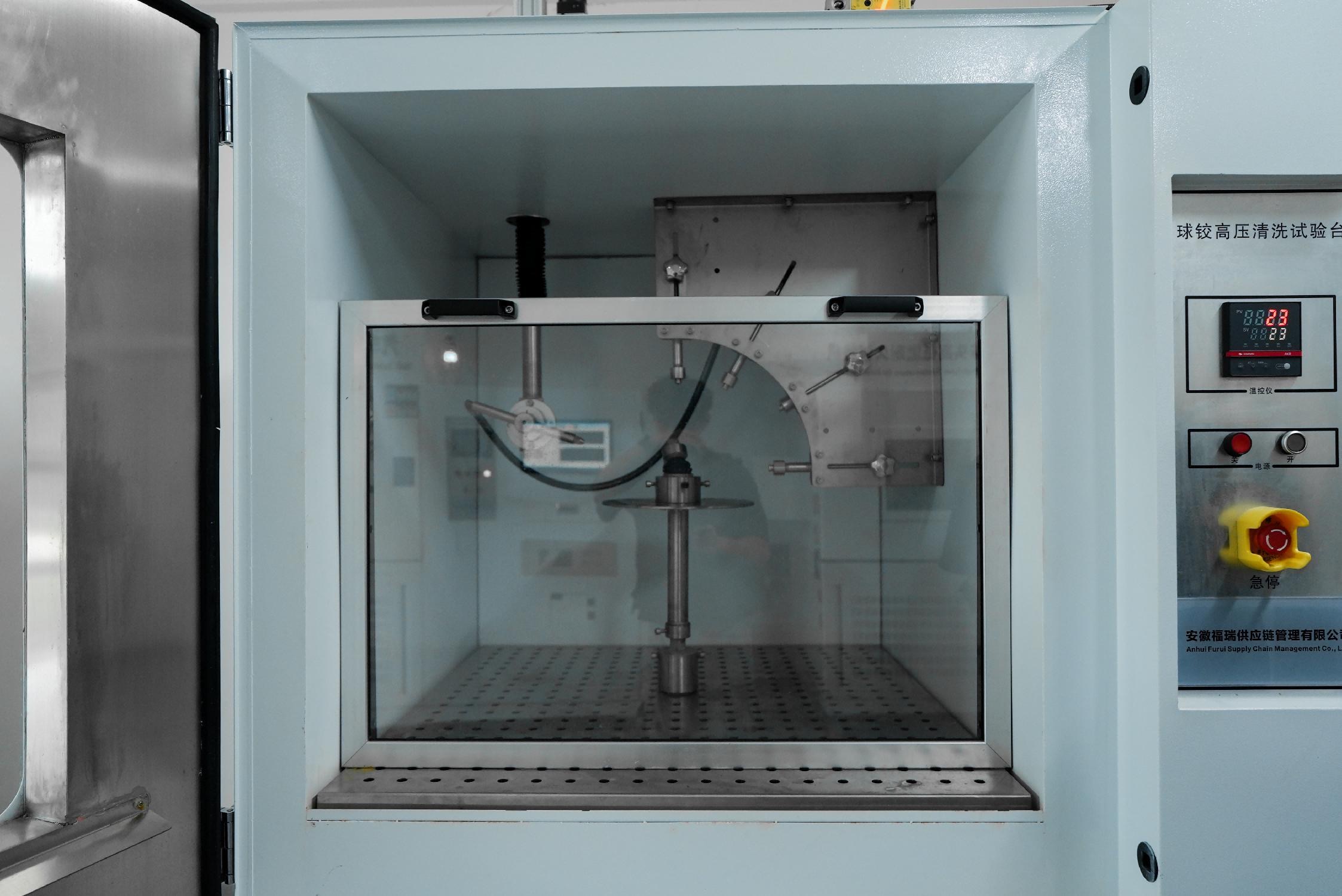
4. Ball-Joint Water-Ingress Sealing & In-House EV Rubber Compounding: To counter Model 3/Y upper ball-joint water intrusion squeaks and EV torque bushing tearing, Hetian molds engineering-plastic ball seats in-house, mixes and vulcanizes rubber compounds inside an 18,365 m² workshop, and validates finished joints on high-pressure mud-water spray test benches and 3-station thermal durability rigs inside its CNAS L13301 laboratory—backed by 100% inline boot airtightness and torque checks.
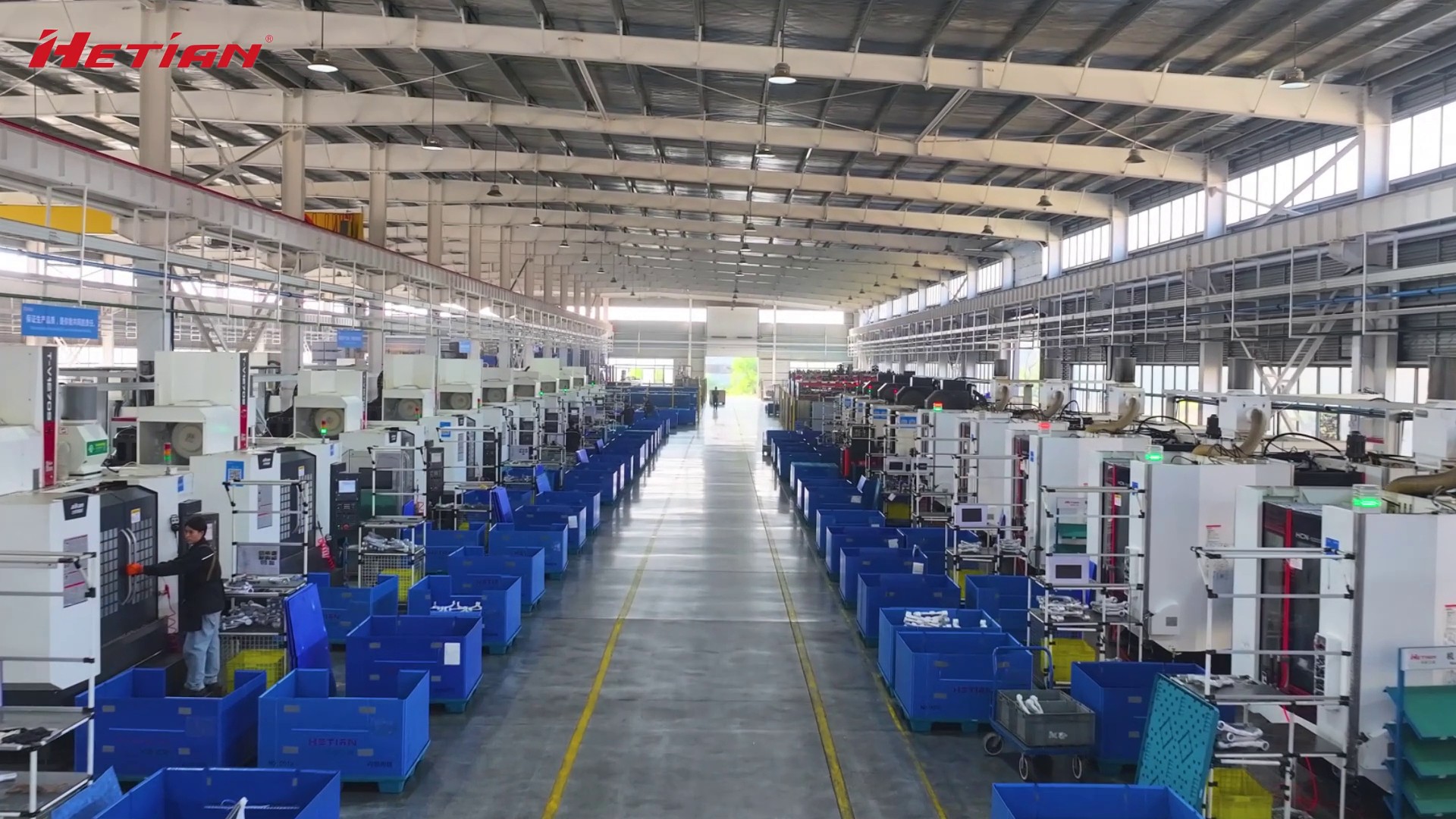
5. 108 CNC Machining Centers & Single-Piece QR Traceability: Because Model 3 and Model Y arms look deceptively similar, fixture slop or mixed lots quickly create costly fitment errors. Hetian operates 108 CNC centers (88 vertical + 20 horizontal) using in-house custom jigs and applies mandatory single-piece QR laser marking at final inspection for full lot traceability.
| Audit Gate | Failure Mode Prevented | Audit Evidence to Request | Wuhu Hetian In-House Capability |
|---|---|---|---|
| 1. Aluminum Forging & Continuous Heat Treatment | Low yield strength, impact fracture, overheated coarse grain | Heat-lot spectrometer reports, continuous furnace temperature logs, metallographic & hardness records | 30,000 m² forging workshop with 10 aluminum forging lines (up to 6,000T; 7M pcs/yr) + dedicated 2,000 m² solution & aging furnace lines; verified per heat lot with SPECTRO LAB OES and ZEISS metallography. |
| 2. 100% Non-Destructive Testing (FPI & X-Ray) | Subsurface porosity in castings, surface forging folds & micro-cracks | Proof of 100% inline NDT coverage on safety-critical aluminum arms rather than visual sampling | 3 automated fluorescent penetrant inspection (FPI) lines for 100% surface crack/fold screening on aluminum forgings, plus 1M pcs/yr industrial real-time X-ray inspection. |
| 3. Ball-Joint Sealing & Inline Torque Verification | Water ingress squeaks, stud wear, boot rupture, stud pull-out | Rolled-thread records, airtightness test parameters, high-pressure mud-water spray & salt-spray (NSS/CASS) validation | In-house engineering plastic seat molding, automated orbital riveting, metered greasing, boot airtightness testing, inline rotational/swing torque checks, and CNAS high-pressure spray & thermal wear rigs. |
| 4. In-House EV Rubber Bushing Compounding | Premature bushing tearing & rubber-to-metal bond separation | Compound mixing traceability, rheometer curves, bond peel-test results, ozone/thermal aging data | 18,365 m² rubber vulcanization workshop (30+ injection presses, 8 hydraulic presses, hydro-bushing fill lines) with in-house rubber mixing and 20 kN tensile bond validation. |
| 5. CNC Precision & Piece-Level QR Traceability | Bore misalignment, Model 3/Y mix-ups, untraceable warranty claims | Dedicated model fixtures, CMM dimensional reports, single-piece QR laser marking | 108 CNC machining centers (88 vertical + 20 horizontal) with in-house jigs/gauges and mandatory single-piece QR laser marking at final inspection. |
4. Wuhu Hetian: OEM-Grade Aftermarket Tesla Control Arm Coverage (H74 Series)
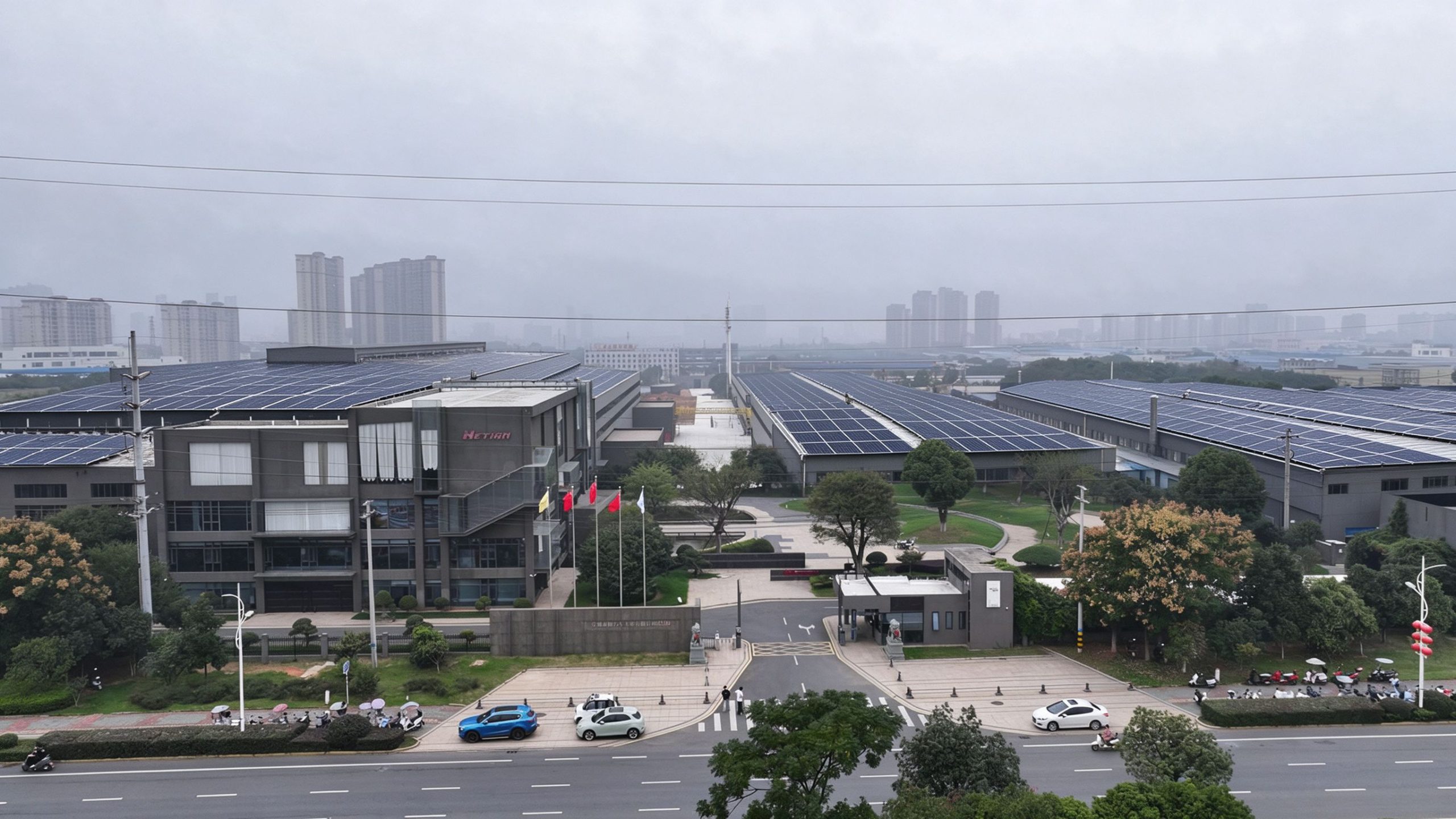
Founded in 1998 and headquartered in Wuhu, Anhui since 2011, Wuhu Hetian Automotive Industry Co., Ltd. is an IATF 16949 certified manufacturer (audited by TÜV SÜD) specializing in chassis suspension and NVH rubber-to-metal components [4]. Across 4 plants totaling 160,000 m², Hetian produces 9,500+ active part numbers—including over 1,800 aluminum control arm specifications across nine product series—serving customers in 50+ countries.
Recognized as a Chinese National Specialized “Little Giant” Enterprise and a National IP Demonstration Enterprise (holding 100+ granted patents and co-drafting 3 Chinese national standards), Hetian operates an ISO/IEC 17025:2017 testing center accredited by CNAS (L13301) and recognized by 20+ mainstream OEMs including BYD, Chery, Geely, Changan, Leapmotor, and Jetour [5]. Hetian applies those same OEM-grade manufacturing lines and laboratory validation gates to its aftermarket Tesla control arm portfolio—without claiming OEM Tier-1 supply status for Tesla.
Representative live Tesla control arm SKUs in Hetian’s H74 series are listed below; full model-year coverage and complete OE cross-reference mappings are verified via our online batch OE lookup tool or by requesting the digital catalog from our sales engineering team:
| Hetian Part No. | Representative Vehicle Platform | Position & Side | Product Specification Page |
|---|---|---|---|
| H74-40091 / H74-40092 | Tesla Model 3 / Model Y | Front Upper Control Arm (LH / RH) | H74-40091 · H74-40092 |
| H74-11489 | Tesla Model 3 (5YJ3, 2017–2024) | Front Lower Lateral Link (L&R) | View H74-11489 |
| H74-20022 | Tesla Model Y (5YJY) | Front Lower Lateral Link (L&R) | View H74-20022 |
| H74-11492 / H74-11493 | Tesla Model 3 / Model Y | Front Lower Compliance Link (LH / RH) | H74-11492 · H74-11493 |
| H74-11328 / H74-11329 | Tesla Model S (5YJS) / Model X | Front Aluminum Control Arm (LH / RH) | H74-11328 · H74-11329 |
If you already have an inquiry spreadsheet of Tesla OE references, paste up to 50 part numbers directly into our Batch OE Lookup Tool, or submit a request via Request a Quote to receive the full H74 digital catalog, sample CNAS test reports, and private-label packaging options.
5. Frequently Asked Questions (FAQ)
1. Are Tesla Model 3 and Model Y front lower lateral links interchangeable?
No—do not treat them as universally interchangeable. Although Model 3 (1044341 series) and Model Y (1188341 series) straight lower links share a similar visual silhouette, their geometry and fitment specifications differ. Always cross-check exact OE revision numbers and VIN fitment before shipping.
2. How can aftermarket suppliers prevent recurring water-ingress squeaks on Tesla front upper control arms?
Preventing repeat creaks comes down to dust-boot elastomer quality, crimping tightness, metered high-consistency grease, and 100% inline boot airtightness testing—backed in validation by high-pressure mud-water spray and multi-axis thermal durability rigs.
3. What distinguishes a forged aluminum Tesla control arm from low-cost cast or rebuilt parts?
Closed-die aluminum forging on 1,000T–6,000T presses aligns metallic grain flow along primary load paths. Combined with controlled solution-aging heat treatment and 100% FPI surface crack inspection, forged arms avoid the internal shrinkage porosity risks common in unscreened castings.
4. Which four audit documents should buyers verify first when qualifying a China Tesla control arm factory?
Request (1) active IATF 16949 certification scope, (2) CNAS ISO/IEC 17025 lab accreditation scope plus sample ball-joint durability and salt-spray (NSS/CASS) reports, (3) raw billet heat-lot spectrometer and metallographic records, and (4) inline FPI or X-ray NDT records for the target part numbers.
5. Is a four-wheel alignment required after replacing Tesla front control arms?
Yes. Control arm bushings and ball joints establish front camber, caster, and toe reference geometry. After torquing fasteners at normal ride height to OE specification, always perform a full four-wheel alignment to prevent uneven inner tire wear or steering wander.
Related Guides
- EV Chassis Parts: How Battery Weight & Instant Torque Reshape Control Arm Requirements
- Suspension Ball Stud Validation: Pull-Out and Fatigue Requirements Explained
- Chassis Fastener Torque Control: A Supplier Audit Checklist
- How a Ball Joint Is Made: Forging, Machining, Heat Treatment and Audit Details
- Wuhu Hetian Production Capabilities: 10 In-House Manufacturing & NDT Processes
References
[1] NHTSA Recall Campaign No. 21V835000 (Tesla Recall SB-21-31-003: Front Suspension Lateral Link Fasteners, 2019–2021 Model 3 & 2020–2021 Model Y), NHTSA Recalls API (api.nhtsa.gov), accessed 2026-11-24.
[2] Tesla Technical Service Bulletin SB-20-31-006 (Front Upper Control Arm Ball Joint Water Ingress Inspection, Reseal, and Replacement), public NHTSA manufacturer communication records, accessed 2026-11-24.
[3] State Administration for Market Regulation (SAMR, China), October 23, 2020 Vehicle Recall Announcement (29,193 imported Model S and Model X vehicles for front suspension aft-link ball stud risk and concurrent rear upper-link campaign), samr.gov.cn, accessed 2026-11-24.
[4] Wuhu Hetian Automotive Industry Co., Ltd., Company Profile & In-House Manufacturing Capabilities (About Hetian & Capabilities), and IATF Global Oversight, accessed 2026-11-24.
[5] Wuhu Hetian Automotive Industry Co., Ltd., Accredited Testing Center (CNAS L13301 / ISO/IEC 17025:2017), CNAS Laboratory & cnas.org.cn, accessed 2026-11-24.
Last updated: Nov 24, 2026 · Reviewed by the Hetian engineering team
