
← All technical articles · News
Industry Insights
Suspension Ball Stud Validation: Pull-Out and Fatigue Requirements Explained
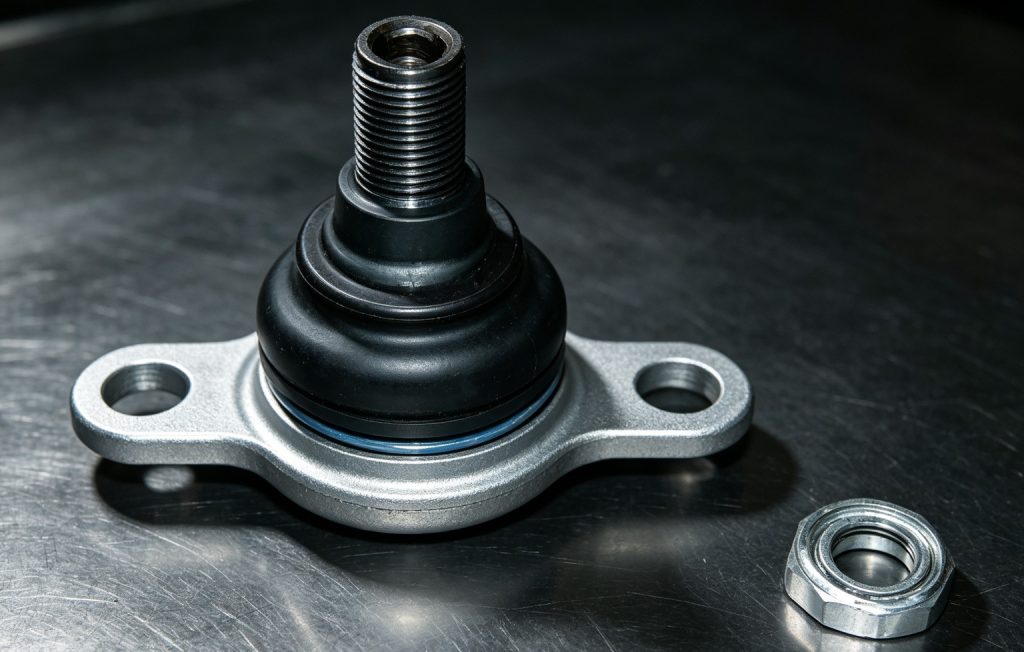
When NHTSA opened a preliminary evaluation covering roughly 1.2 million Tesla Model 3 and Model Y vehicles in July 2026 over reports of front lower lateral link detachment, it highlighted a question every chassis parts buyer should ask: how is a ball stud proven safe before it goes on a car [1][2][5]. The two validation tests that matter most are the pull-out test, which measures the axial force needed to separate the ball stud from its socket, and the fatigue test, which cycles the joint through millions of load repetitions [7][9][11]. This guide explains both tests, the standards behind them, and what documentation a buyer should request from a supplier.
Key Ball Stud Validation Tests Quick-Reference Table
| Test | What It Measures | Typical Method | Why It Matters |
|---|---|---|---|
| Pull-out (stud separation) | Axial force required to pull the ball stud out of the socket [9] | Load applied perpendicular to mounting surface at a set rate (e.g. 5 mm/min) until separation [7] | Verifies the joint stays anchored under worst-case load [9][11] |
| Fatigue (cyclic durability) | Survival over repeated load cycles without cracks or excess play [10] | Cyclic axial/swing loading for defined cycle counts, e.g. 1.2 million cycles at high axial load [10] | Simulates real driving life; catches failure modes pull-out cannot [10][11] |
| End play / clearance | Wear-induced radial clearance after cycling [10] | Play measured before/after fatigue test, threshold e.g. 0.020 in (0.5 mm) [10] | Keeps steering precision; limits slack growth over life |
| Corrosion (salt spray) | Surface protection durability [8] | Salt-spray exposure per standard with post-test function check | Prevents seized or weakened joints in service [8] |
| Boot / seal durability | Seal integrity against contamination [11] | Flexing and environmental aging of rubber boot | Torn boot = contamination = early failure [11] |
What the 1.2 Million-Vehicle Investigation Tells Us
On July 31, 2026, NHTSA’s Office of Defects Investigation opened preliminary evaluation PE26006 into approximately 1.2 million 2018–2020 Tesla Model 3 and 2021–2023 Model Y vehicles, after 156 owners reported that the front lower lateral link detached from the suspension, many with no prior warning [1][2][4][5]. This is the same kind of failure mode that earlier NHTSA files linked to ball-joint separation at the knuckle on other Tesla models [12]. The investigation can end in a recall, but for parts suppliers the lesson is already clear: lateral-link and ball-joint assemblies must hold together under axial load and repeated service loads, and the proof is test data, not marketing claims [9][10].
Pull-Out Test: Proving the Stud Stays Put
The pull-out test answers one question: how much axial force does it take to separate the ball stud from the housing [9]. The assembly is placed in a load/deflection machine and load is applied perpendicular to the ball joint mounting surface until separation; a typical load application rate is 5 mm/min, and the test is repeated under compressive load with separate samples [7]. If the force required is below the original-equipment specification, the joint risks failing under normal driving, because the wheel hub would no longer be anchored to the suspension arm [9]. Suppliers who cannot give a specific pull-out force number are doing inspection, not qualification [11].
Fatigue Test: Proving the Joint Survives Service Life
A single static pull-out test cannot predict how a joint behaves after thousands of miles of bumps, steering input, and potholes. Fatigue testing cycles the part under repeated load to simulate real driving. Under common OEM-style fatigue protocols, a properly built ball joint must survive on the order of 1.2 million cycles at a high axial load before exceeding a defined total play limit such as 0.020 inches [10]. Industry and regional standards set explicit floors: for example, the T/ZZB 0537-2018 group standard for passenger-car chassis ball joint assemblies requires more than 1.2 million fatigue cycles with no leakage, cracks, or fractures [8]. Fatigue testing catches failure modes that pull-out tests cannot, such as crack growth, socket wear, and boot fatigue [11].
Beyond the Two Core Tests
End-play and clearance control. Wear between the ball and socket grows with cycling; OEM validation sets a maximum clearance after the fatigue test, because excess play destroys steering precision [10].
Corrosion protection. Ball studs and housings are zinc- or otherwise surface-treated; salt-spray testing verifies the coating survives service exposure so the joint does not seize or weaken [8].
Boot integrity. The rubber boot keeps grease in and grit out. A torn boot leads to contamination and rapid wear, which is why boot durability is part of qualification, not cosmetics [11].
Assembly torque and process control. Several past NHTSA investigations into ball-joint separation traced root causes to assembly variation, not just component strength [12]. Process control in production is therefore part of the validation story.
What Buyers Should Request From Suppliers
Ask for the actual test report, not a certificate number. For each ball joint or link you source, request: the pull-out force value with the test method (load rate and direction); the fatigue test cycle count, load, and post-test play measurement; salt-spray hours and post-test function; boot material and aging data; and production process-control evidence such as IATF 16949 certification. A supplier that cannot produce numbers for both core tests is not offering qualification [11]. Hetian Automotive has produced steering and suspension parts since 1998, operates a 160,000 m² facility with IATF 16949 certification and a CNAS-accredited laboratory, exports to over 30 countries, and holds more than 100 patents.
FAQ
Q: What is a ball stud pull-out test?
A: It measures the axial force required to separate the ball stud from the housing; load is applied perpendicular to the mounting surface until separation, typically at a set rate such as 5 mm/min [7][9].
Q: Why is fatigue testing needed if the part passes a pull-out test?
A: Because service life is a matter of repeated loads. Fatigue testing cycles the joint millions of times and checks for cracks, wear, and play growth—failure modes a single static test cannot catch [10][11].
Q: How many fatigue cycles does a ball joint need to pass?
A: Common OEM-style protocols require on the order of 1.2 million cycles at high axial load; the T/ZZB 0537-2018 standard requires more than 1.2 million cycles with no leakage, cracks, or fractures [8][10].
Q: What causes a suspension link to detach while driving?
A: Detachment can follow stud pull-out, fastener loosening, or fracture of the link end; NHTSA’s current Tesla investigation covers front lower lateral link detachments reported by owners [2][4][5].
Q: How can I verify a supplier’s test claims?
A: Request the full test report with method, load values, cycle counts, and post-test measurements, plus process-control certification such as IATF 16949. If the supplier cannot give specific numbers for both pull-out and fatigue, treat it as unqualified [11].
Q: Do aftermarket ball joints need the same validation as OE?
A: Yes. The load and fatigue demands are identical in service; buying from a manufacturer that validates to OEM-style protocols reduces the risk of early failure and liability.
Related Guides
- Safety-Critical Auto Parts Verification: How to Check Suspension and Steering Parts for Authenticity
- Tie Rod End vs. Ball Joint: How to Tell Them Apart and Diagnose Wear
- Ball Joint Failure: Symptoms, Safety Risks, and Replacement
- Suspension Parts Replacement Intervals: When to Replace Ball Joints, Control Arm Bushings, Links and Tie Rod Ends
- Product category: Stabilizer, Ball Joint & Link
References
[1] “NHTSA: Opening Preliminary Evaluation Into Est. 1.2 Mln Tesla Vehicles Over Lower Lateral Link Detachment,” CGTN, July 31, 2026, https://news.cgtn.com/news/2026-07-31/news-1PehSITHblC/p.html, accessed September 15, 2026.
[2] “Regulators Probe Suspension-Failure Complaints in Tesla Vehicles,” Morningstar (Dow Jones), August 1, 2026, https://www.morningstar.com/news/dow-jones/202607316660/regulators-probe-suspension-failure-complaints-in-tesla-vehicles, accessed September 15, 2026.
[3] “Tesla Model Y suspension faces issues in both the US and China,” Auto.pub, September 7, 2026, https://auto.pub/en/tesla-model-y-suspension-issues-us-china, accessed September 15, 2026.
[4] “Tesla Recalled the Same Suspension Part Twice. Now NHTSA Is Investigating 1.2 Million Cars.,” vehicle-safety.org, August 19, 2026, https://www.vehicle-safety.org/stories/tesla-suspension-three-recalls-same-part, accessed September 15, 2026.
[5] “Tesla’s Suspension Problem Just Became a Federal Investigation Covering 1.2 Million Cars,” Steel Horse Rides, August 31, 2026, https://steelhorserides.com/teslas-suspension-problem-just-became-a-federal-investigation-covering-1-2-million-cars/, accessed September 15, 2026.
[6] “120万辆特斯拉堪忧了!车主:开着开着,方向突然没了,” 有驾, August 4, 2026, https://youjia-pc.bdstatic.com/article/10039531022760448491.html, accessed September 15, 2026.
[7] “SAE J193 (Ball Stud and Socket Assemblies — Test Procedure),” SAE International / PDFCOFFEE, https://pdfcoffee.com/saej-193-v-001-pdf-free.html, accessed September 15, 2026.
[8] “乘用车底盘球头总成 T/ZZB 0537—2018 (Passenger Car Chassis Ball Joint Assembly),” Zhejiang Manufacturing Group Standards, September 14, 2018, https://qxb-img-osscache.qixin.com/standards/24976c9a8e6490ac7475d3e9dd88a44a.pdf, accessed September 15, 2026.
[9] “Steering & Suspension Quality Test Results,” Delphi Autoparts, April 13, 2026, https://www.delphiautoparts.com/en-gb/mom/how-to/article/steering-suspension-quality-test-results, accessed September 15, 2026.
[10] “How to Check for Bad Ball Joints: A Mechanic’s Deep Dive,” AutoMotoFlux, March 23, 2026, https://automotoflux.com/wheels-tires/how-to-check-for-bad-ball-joints, accessed September 15, 2026.
[11] “How Are Sway Bar Links Manufactured: A Step-by-Step Guide,” GDST Auto Parts, July 8, 2026, https://gdstauto.com/how-are-sway-bar-links-manufactured/, accessed September 15, 2026.
[12] “ODI Resume — Tesla Model S/X Front Suspension Fore Link Failure at Knuckle Ball Joint Ring,” NHTSA PE20-020, 2020, https://static.nhtsa.gov/odi/inv/2020/INCLA-PE20020-10208.pdf, accessed September 15, 2026.
Last updated: Sep 15, 2026 · Reviewed by the Hetian engineering team