
← All technical articles · News
Industry Insights
EV Chassis Parts: How Battery Weight and Instant Torque Change Bushing, Ball Joint and Control Arm Requirements
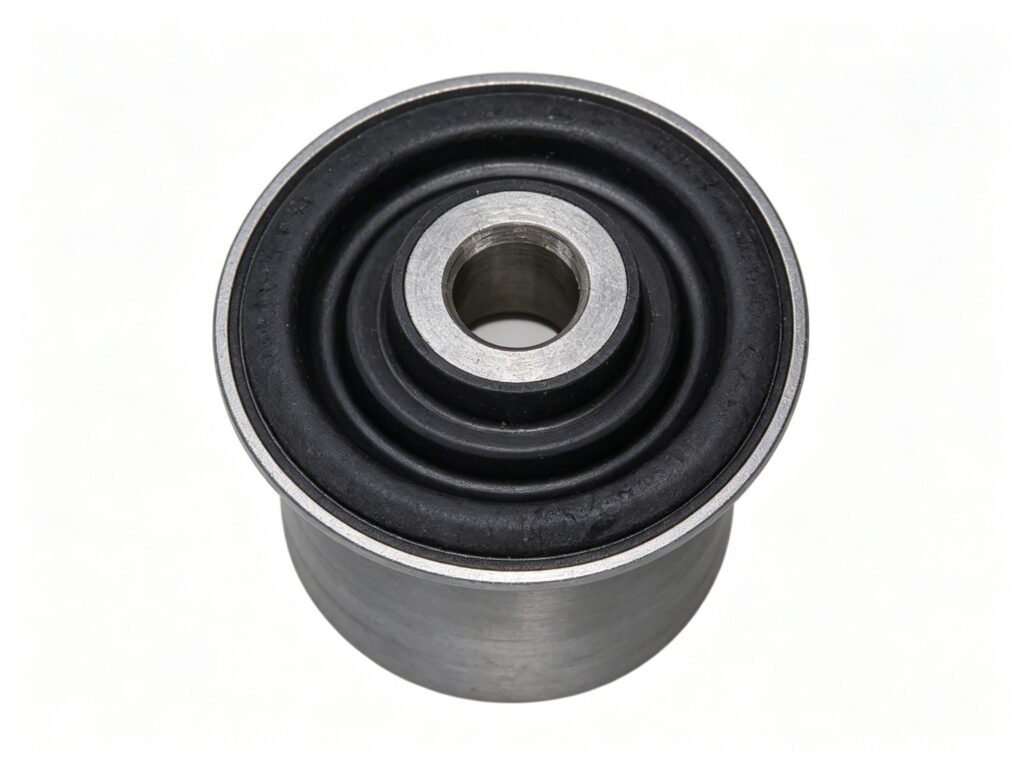
A battery-electric car is not a petrol car with a different power source. It is, on average, 20–30% heavier, and most of that extra mass sits low in the floor as a battery pack [2]. In China, where electrification moved fastest, the average new energy passenger car weighed 2,076 kg in 2025 against 1,738 kg for combustion-engine cars — a 338 kg gap, widening to more than 600 kg in the C/D SUV class [1].
That mass does not go away when the car is parked. It preloads every rubber-to-metal joint in the chassis around the clock, and the motor adds a second load path that most legacy suspension geometry was never validated for: full torque from zero rpm, then regenerative braking pulling in the opposite direction, several thousand times a week.
The conclusion for buyers is not that EV chassis parts are inherently worse. It is that the load spectrum changed while a lot of catalogues did not. Specifying by part number and price alone will produce returns. Specifying by axle load, compound and bonding will not.
Quick reference: what to specify by vehicle class
| Vehicle profile | Ball joint static rating to ask for | Bushing focus | Verification to request |
|---|---|---|---|
| Compact EV or city car, under about 1.6 t | 15–22 kN static, the range typical for mid-size passenger-car lower joints [7] | Bonded natural rubber, roughly 55–60 Shore A, standard radial stiffness | Three-axis stiffness data, salt-spray hours, boot seal integrity |
| Mid-size electric sedan or crossover, about 1.8–2.2 t | Derived from GAWR, corner by corner. Do not accept a catalogue default here. | Creep-resistant compound, reinforced rubber-to-metal bond, higher static preload capability | Compression set, heat ageing to ISO 188, 100,000-cycle three-axis fatigue |
| Large electric SUV, MPV or light electric van, over about 2.2 t | 35 kN and above for heavy-duty SUV and EV applications [7] | Voided or hydraulic bushing, stiffer radial rate, larger bond area | Peak-load test, fore-aft torque cycling, damper and bearing load case |
Why the mass gap is bigger than one headline number
Chinese industry data breaks the gain into four causes: battery capacity, dual powertrains, body growth and equipment. A larger pack alone added more than 250 kg per vehicle; a range-extender or plug-in hybrid carrying both a battery and an engine-plus-gearbox added 150 kg or more; stretching the body and wheelbase added over 100 kg; comfort and connectivity features added another 60–70 kg [1]. The result is a compounding effect — a heavier body needs stiffer structure, larger brakes and stronger suspension mounts, which adds mass again.
European comparisons land in the same place from the other direction: 200–400 kg extra for a standard hatchback or saloon, and over 500 kg for a large SUV or electric van, with packs typically between 300 kg and 600 kg [3]. Some sources put the pack range as high as 900 kg in the largest vehicles [2].
Two structural details matter more than the total. First, the mass is concentrated low and between the axles, which lowers the centre of gravity and improves roll stability but raises the static vertical load on the lower control arm and its inboard bushing. Second, the front-to-rear axle load split shifts, so a bushing specification validated on a 1,500 kg saloon is being asked to hold a different preload at a different corner.
Where the load actually lands
Load enters the chassis at the tyre contact patch, passes through the wheel bearing and knuckle, then splits between the spring or damper and the locating links. The bushing and the ball joint see different components of that load, and they fail for different reasons.
The bushing is a three-axis component. Radially it carries cornering and vertical load; axially it resists braking and acceleration forces; in torsion it allows the arm to articulate. A compound that is comfortable in radial stiffness can still tear in the axial direction if the fore-aft load case was never characterised. The ball joint, by contrast, carries vertical load plus steering articulation, and its failure mode is wear at the socket followed by play — which shows up as a knock, a wander, or uneven tyre wear long before anything breaks.
Workshops with a growing EV customer base report a fairly consistent order of failure: front lower control arm bushings and ball joints first, then anti-roll bar links and their bushes, then wheel bearings and dampers [4]. On front-wheel-drive EVs the motor drives and steers the same axle, so lateral cornering load and longitudinal torque arrive at the same joint at the same time.
Static preload: the joint that never rests
This is the part of the EV problem that a load calculation alone will miss. A combustion car’s bushing sits close to its unloaded shape when the car is empty. An EV’s battery mass keeps a permanent preload on the control arm and subframe bushings, so the rubber never fully relaxes — not overnight, not over a weekend.
Under sustained preload, rubber creeps. The bushing slowly changes shape, loses its designed rate, and micro-cracks open at the bond line. Stress relaxation weakens the rubber-to-metal bond, and de-bonding follows. Once the bond starts to go, the arm moves further than the geometry intended, camber drifts, and the tyre wear pattern becomes the first visible symptom [8].
The purchasing implication is straightforward: for a vehicle over roughly two tonnes, a supplier’s “same as OE” claim is not evidence. Ask for creep and compression-set data at the actual static preload the corner will see, not at a generic test load.
Instant torque and regeneration: the fore-aft cycle
An electric motor delivers maximum torque from zero rpm. A combustion engine builds torque progressively through the rev range, so the drivetrain and suspension mounts see a ramp. An EV sees a step. Every launch, every motorway merge and every hard exit from a roundabout loads the front wishbones, the rear subframe bushes and the wheel-end joints with a force that arrives faster than the original validation programme assumed [4].
Regenerative braking then reverses the direction of that load, often within seconds, and the friction brakes are used less. The joint is not simply loaded harder; it is cycled more often, in both directions, at a higher rate. That is the mechanism behind compression set and the tearing that starts at the bond line rather than in the bulk rubber.
Distribution-level return data supports the pattern. One North American distributor analysed returns from more than 400 repair shops and found control arm bushings on EVs failing at an average of 42,000 miles against 58,000 miles for comparable combustion sedans, with overall chassis wear running 15–25% faster [6]. Fleet data from electric and hybrid vans puts bushing and damper wear about 30% faster, with lower control arm bushings showing significant play at 70,000 miles where a diesel equivalent lasted 100,000 [5].
Note the units. North American catalogues often quote per-joint working load in pounds, where standard joints rated at 1,500–1,800 lb are being asked to carry more than 2,200 lb on an EV [6]. European and Asian catalogues quote static ratings in kN, with 15–22 kN typical for a mid-size passenger car and 35 kN or more for heavy-duty SUV and EV applications [7]. Those two figures are not interchangeable. Before comparing quotations, ask which basis the supplier is using and whether the number is a static rating, a working load or a test-rig peak.
Heat, not just load
Rubber in an EV chassis lives in a different thermal environment. The pack and the motor are close by, ambient underbody temperature swings more, and the bushing is often packaged tighter because the floor is full of battery. Heat accelerates the same chemistry that preload starts: the compound hardens, loses elasticity, and cracks at the surface.
Three ISO standards define how this should be evidenced. ISO 188:2023 specifies accelerated ageing and heat-resistance tests for vulcanised and thermoplastic rubbers, and its sixth edition cancelled and replaced the 2011 version, adding an oven type with forced air circulation and a high air-speed or air-exchange rate [9]. ISO 11346:2023 covers estimating service life and maximum temperature of use from an Arrhenius plot [10]. ISO 4665:2016 covers resistance to weathering [11].
One distinction is worth putting in writing to suppliers, because it is frequently blurred in datasheets: ISO 1817 is the standard for resistance to liquids, not for heat ageing [9]. A bushing datasheet that offers only an ISO 1817 immersion result has told you nothing about thermal life. Ask separately for heat ageing to ISO 188 and, where the application is genuinely hot, for a life estimate to ISO 11346.
Can an ICE part be used on an EV?
Sometimes yes, and sometimes it is the most expensive saving in the catalogue. Three checks settle it.
Axle load. Take the gross axle weight rating, divide by the number of load-carrying joints at that corner, and compare with the joint’s rated capacity at the actual articulation angle. If the EV’s GAWR is materially higher than the donor car’s, the part number is irrelevant.
Platform commonality. Shared parts exist where the EV was built on a platform designed for both powertrains. Where the EV sits on a dedicated skateboard platform, the arm geometry, the pick-up points and often the bushing axis differ, even when the part looks similar in a photograph.
Validation evidence. A supplier claiming EV suitability should be able to show a load spectrum, not an opinion: three-axis fatigue cycles, peak load case, heat ageing hours and a bond-strength result after ageing. If the file contains only a dimensional drawing and a salt-spray certificate, the part is an ICE part with an EV label.
What to put in the RFQ
Ten items, in the order that matters:
- Vehicle class, kerb weight and gross axle weight rating, corner by corner.
- Whether the platform is shared or dedicated, and the OE part numbers the arm must replace.
- Ball joint static rating in kN, with the calculation basis stated.
- Bushing three-axis stiffness targets: radial, axial and torsional.
- Rubber compound, hardness and the preload used for creep and compression-set testing.
- Heat ageing hours and temperature to ISO 188, plus a life estimate to ISO 11346 where applicable.
- Rubber-to-metal bond strength before and after ageing, with the failure mode recorded.
- Three-axis fatigue cycle count at the specified load amplitude, and the acceptance criterion.
- Salt-spray hours and coating system for the arm, the housing and the fasteners.
- Boot material and seal design for the ball joint, plus the articulation angle tested.
Any supplier who cannot answer items 3, 5 and 7 in numbers is selling a shape, not a chassis part.
Where Hetian fits
Hetian has been manufacturing chassis parts since 1998, operates a 160,000 m² production base, and holds IATF 16949 and CNAS accreditation. The product range covers control arms, ball joints, stabilizer links, tie rod ends, engine mounts and rubber-to-metal bushings, with more than 100 patents and exports to over 30 countries. For EV and heavy-platform programmes, the engineering team works from axle load and articulation data rather than from a catalogue default, and can supply the test evidence listed above as part of the quotation pack.
FAQ
Do electric vehicles really wear chassis parts faster?
Yes, in most comparisons. The mechanisms are higher static preload from battery mass, more frequent fore-aft load cycling from instant torque and regeneration, and a quieter cabin that hides early symptoms. Reported figures range from 15–25% faster general chassis wear to about 30% on commercial electric vans [6][5].
How much heavier is an EV, really?
Typically 20–30% against a comparable combustion car, or 200–400 kg for a standard car and more than 500 kg for a large SUV or van [2][3]. In the Chinese market, the 2025 average was 2,076 kg for a new energy passenger car versus 1,738 kg for a combustion car [1].
Can I fit combustion-car control arms to an EV?
Only after the three checks above: GAWR per corner, shared versus dedicated platform, and validation evidence. A part that physically fits can still be under-rated for the static preload and the torque cycle.
Which parts fail first on an EV?
Front lower control arm bushings and ball joints, then anti-roll bar links and bushes, then wheel bearings and dampers, particularly on front-wheel-drive EVs where one axle handles drive torque and steering load together [4].
Why do EV owners complain about handling rather than noise?
Because there is no engine to mask a light knock. A worn bushing that would have been audible in a petrol car often presents as vague steering, a slight pull or uneven tyre wear instead [4]. That makes a loaded visual inspection more important than a road test alone.
Do EV bushings need a different rubber compound?
They need a compound validated for higher sustained preload and a wider thermal range, with creep, compression set and post-ageing bond strength demonstrated. That is not the same as a stiffer compound; overly stiff rubber moves the problem to the subframe and the cabin.
Is a hydraulic bushing necessary?
Not universally. Hydraulic bushings are used where high-frequency motor vibration and fore-aft comfort both have to be controlled at the same point, typically on premium and mid-size EVs. For many fleet and aftermarket applications, a well-validated voided rubber bushing is the more cost-effective answer [8].
What load rating should I specify?
Derive it from GAWR and the number of load-carrying joints, then state the basis in the RFQ. As a reference, 15–22 kN static is typical for mid-size passenger-car lower ball joints, while heavy-duty SUV and EV units are specified at 35 kN or above [7].
Related Guides
- Audi A4 B8 Front Control Arms: OE Numbers and Replacement Guide
- Suspension Parts Fitment Check: How to Confirm a Part Before It Ships
- Ball Joint Boot: Cracked Dust Boot Inspection and Replacement Guide
- Chassis Part Corrosion Protection: Coating Systems, Salt Spray Hours and What Buyers Should Specify
- Chassis Noise Diagnosis: Identifying Worn Control Arms, Ball Joints, Bushings and Links by Sound
- Product category: Rubber-to-Metal Bushings
References
- [1] 专访中国汽车工程学会梁东明(上):三年增重 23%!多重因素推高整车重量, 央视网汽车频道, 2026-06-16, https://auto.cctv.cn/2026/06/16/ARTIaFcfz1MLAZjUU8QqAAdr260616.shtml, accessed 2026-11-08.
- [2] Are EVs Heavier Than Petrol Or Diesel Cars?, Green Car Guide, updated 2026-09-29, https://www.greencarguide.co.uk/features/electric-cars-heavier-than-petrol-or-diesel/, accessed 2026-11-08.
- [3] Are EVs Heavier Than Petrol Cars?, Pro EV, updated 2026-08-07, https://proev.co.uk/electric-vehicle-guides/are-evs-heavier-than-petrol-cars/, accessed 2026-11-08.
- [4] Suspension Wear on High-Mileage EVs: What UK Mechanics Are Discovering Under the Ramp in 2026, The Motor Trades, 2026-07-31, https://motortrades.co.uk/tag/ev-suspension-wear-uk-mechanic/, accessed 2026-11-08.
- [5] How do heavy EV vans accelerate suspension wear?, MR.FAST, 2026-05-21, https://mrfastauto.com/how-do-heavy-ev-vans-accelerate-suspension-wear/, accessed 2026-11-08.
- [6] Why Is EV Growth Driving a Boom in Heavy-Duty Suspension Parts Procurement?, MR.FAST, 2026-05-28, https://mrfastauto.com/why-is-ev-growth-driving-a-boom-in-heavy-duty-suspension-parts-procurement/, accessed 2026-11-08.
- [7] Ball Joints Guide: How to Choose Right for EVs and SUVs, Alibaba Auto Parts, 2026-08-28, https://autopart.alibaba.com/guide/ball-joints-guide-ev-suv-upgrades-explained, accessed 2026-11-08.
- [8] The Role of Suspension Bushings in Electric Vehicles: New Challenges, New Solutions, DPANS, 2026-05-21, https://zzwelcom.com/the-role-of-suspension-bushings-in-electric-vehicles-new-challenges-new-solutions/, accessed 2026-11-08.
- [9] ISO 188:2023 Rubber, vulcanized or thermoplastic — Accelerated ageing and heat resistance tests, International Organization for Standardization, 2023, https://www.iso.org/obp/ui/en/#!iso:std:80468:en, accessed 2026-11-08.
- [10] ISO 11346:2023 Rubber, vulcanized or thermoplastic — Estimation of life-time and maximum temperature of use, International Organization for Standardization, 2023, https://www.iso.org/ru/ics/83.060/x/, accessed 2026-11-08.
- [11] ISO 4665:2016 Rubber, vulcanized or thermoplastic — Resistance to weathering, International Organization for Standardization, 2016, https://www.iso.org/committee/48704/x/catalogue/, accessed 2026-11-08.
Last updated: Nov 8, 2026 · Reviewed by the Hetian engineering team