
← All technical articles · News
Industry Insights
Nissan Frontier, Navara D40 and Pathfinder R51 Front Suspension Parts: OE Numbers, Fitment and Replacement Guide (2005–2021)
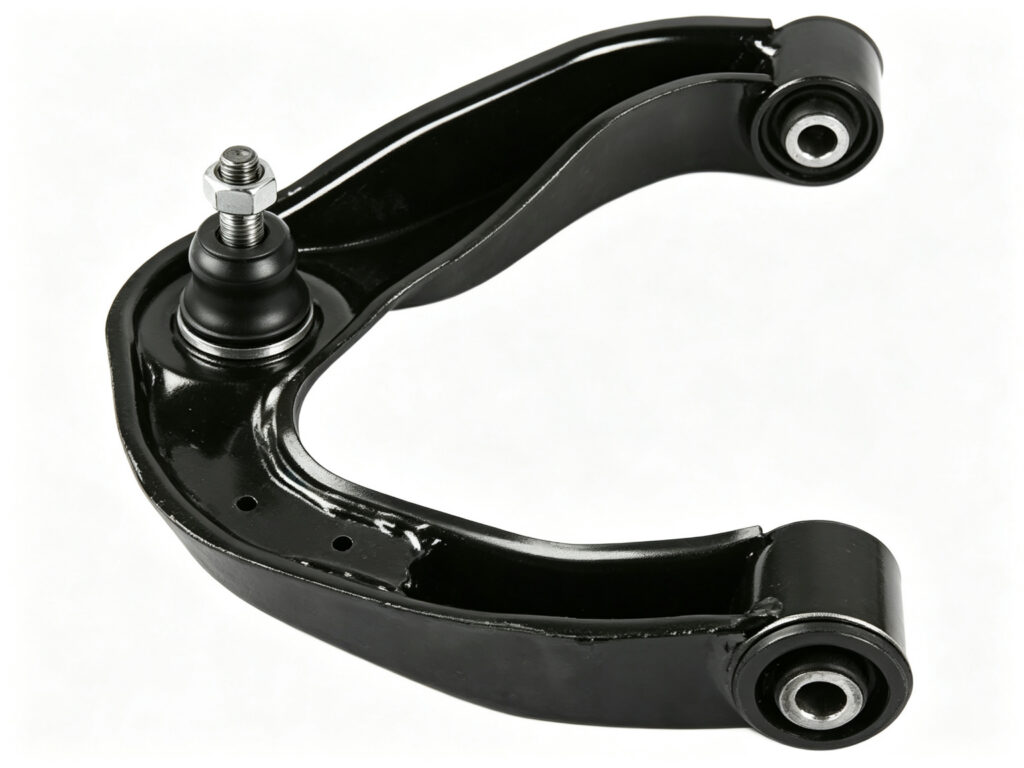
Ordering front suspension parts for a D40-era Nissan is rarely a search problem; it is an identification problem. The same upper arm serves a 2006 Frontier, a Navara D40 and a Pathfinder R51, but the joint at the end of that arm may be sold either pressed into the arm or as a separate repair part, and the left and right numbers differ by one digit that is easy to miss on a screen. This guide maps the ten front-end parts that fail most often on the Frontier D40/D41, Navara D40, Pathfinder R51 and Xterra N50 to their OE numbers and aftermarket cross references, then sets out the four checks — generation, drive layout, side, and ride height — that decide whether the part you are holding actually fits. The short version: buy arms by OE number and by side, treat upper and lower ball joints as two different parts, and never order a tie rod end without confirming whether the catalogue you are reading is left-hand-drive or right-hand-drive.
Quick reference: the ten parts that carry this front end
| Position | Hetian reference | OE numbers and cross references | What decides the order |
|---|---|---|---|
| Upper control arm, LH | H34-30144 | 54525-EA000 / 54525-EA00A; K621245 | Arm supplied with ball joint and bushings; confirm side |
| Upper control arm, RH | H34-30145 | 54524-EA000 / 54524-EA00A; K621246 | Mirror of the LH arm; not interchangeable |
| Upper ball joint, L/R | H34-51698 | 40110-EA000; 536381 | Separate repair joint; press-in |
| Lower ball joint | H34-51699 | 40160-EA000 | Different housing and taper from the upper joint |
| Outer tie rod end, LH | H34-51893 | 48520-EA025; ES800048; TA3576; MS30607; 544357 | Thread direction and side; toe setting |
| Outer tie rod end, RH | H34-51894 | 48640-EA025; ES800108; TA3575; MS30608; 544358 | Mirror of the LH end |
| Stabiliser link, LH | H34-50494 | 54668-EA000 / 54668-EA010; 56261-7S000; K80470; MK80470; 4242082Z00 | Ball-stud angle and length; side |
| Stabiliser link, RH | H34-50495 | 54618-EA000 / 54618-EA010; 56261-7S010; K80471; MK80471; 4242082Z10 | Mirror of the LH link |
| Arm bushing (upper arm family) | H34-61120 | 54542-EB70A / 54542-EB70D; 54570-EB70D | Bushing bore and shoulder; press fit |
| Arm bushing (lower arm family) | H34-61121 | 54560-EB70A; 54500-EA000 / 54500-EA00A | Different diameter from the upper bushing |
The platform: one front end, several badges
The D40 family is a double-wishbone front suspension with a separate stabiliser bar, not a strut layout [10]. That matters for parts ordering because the upper arm carries the ball joint and does the camber location, while the lower arm carries the spring or coil-over load and the lower joint. The two arms therefore have different failure modes even though they are replaced in the same job.
Nissan’s own parts catalogue groups the upper arm under one number family across several models: the LH arm is listed as 54525-EA00A and the RH as 54524-EA00A, with the assembly described as including the ball joint and bushings [1]. The same numbers are listed for Frontier, Xterra, Pathfinder and the 2WD and 4WD variants rather than split by drive layout [1]. Current Frontier listings show those arm numbers still serving D40, D41, R51 and N50 applications [2], and NISMO’s own replacement upper arms are listed for D40/D41 Frontier, N50 Xterra and R51 Pathfinder from 2005 onward [3], which is why a 2022-or-later Frontier owner and a 2006 Navara owner can end up looking at the same part page.
What that does not mean is that every D40-era part crosses to every D40-era truck. The earlier D22 platform and the later D23/NP300 Navara use different ball joint numbers, and the D41 refresh introduced its own arm and joint part numbers even where the geometry carried over [2][4]. Generation is the first filter, not the last.
Upper arms: buy the assembly, or press the joint?
The upper arm is the part that most often decides the cost of a repair. As supplied by Nissan, the joint is part of the assembly: the LH arm 54525-EA00A and the RH arm 54524-EA00A are catalogued with the ball joint and bushings already installed [1]. That is convenient for a workshop without a press, and it is also why so many aftermarket catalogues list an “upper arm” that is really an arm-plus-joint-plus-bushings kit.
The aftermarket splits the assembly back into serviceable pieces. Febest, for example, lists a D40 upper ball joint under OEM reference 54524-EB70D, using the arm number as the reference rather than a joint number of its own [4]. That is a catalogue convention, not a statement that the joint is unavailable separately. In practice, both routes exist: replace the arm as an assembly, or press a new joint into a sound arm and reuse the bushings if they still pass a stiffness check.
The decision rule is the same one that applies to any arm with two wearing ends. If the bushings are cracked, torn or visibly deflected, the arm is the better purchase, because a new joint pressed into an arm with tired bushings produces a truck that still wanders and a comeback that gets booked against the joint. If the bushings are sound and only the joint has play, a press-in joint is the cheaper correct repair.
Two details separate a good arm from a lookalike. First, the ball joint boot: it should sit square on the housing with no pinch or fold, because a boot fitted twisted will fail within a season. Second, the bushing shoulders: the rubber should be bonded to the sleeve with no gap at the shoulder, and the sleeve bore should be round enough that the mounting bolt passes without play. Both are visible before installation and both are the kind of defect that only shows up as a noise six months later.
Ball joints: upper and lower are not the same part
The most common ordering error on this platform is treating “D40 ball joint” as one SKU. It is two. In our range the upper joint is listed under 40110-EA000 and the lower under 40160-EA000, and the two differ in housing diameter and stud taper, which is why a joint that looks close in a photograph will not seat.
Aftermarket catalogues make the distinction explicitly. Alvadi’s D40/R51 listing separates an upper joint with a 42.1 mm housing diameter, a 14.7 mm taper and an M14×1.5 right-hand thread from a lower joint with a 45.1 mm housing and a 22 mm taper [5]. Those dimensions are the practical check: measure the housing bore of the old joint and the taper of the stud before ordering, rather than trusting the vehicle description alone.
The lower joint carries its own cross-reference trail. 40160-EA000 is listed against TRW JBJ756, SKF VKDS811001, Cofap PSC01007 and Nakata N91005 in a Brazilian parts listing for the Frontier, Xterra and Pathfinder applications [6], while 40110-EA000 is listed as the upper joint for the 2005-and-up D40 [7]. Cross references are useful for confirming that a supplier is talking about the same part; they are not a substitute for checking the housing and taper.
Both joints are press-fit items on this platform, which brings two installation rules. The joint must be pressed by the housing, never by the stud or the boot, and the retaining clip — where the design uses one — must seat fully in its groove before the arm goes back on the vehicle. A joint that is pressed in crooked will pass a hand check and fail an alignment check.
Tie rod ends: side, thread and steering layout
The outer tie rod ends are the parts most exposed to a wrong-side order, because the left and right numbers differ and the two look almost identical in a listing photo. On the D40 front end, the LH outer end is 48520-EA025 and the RH is 48640-EA025; the aftermarket cross references run ES800048 and TA3576 for the LH, and ES800108 and TA3575 for the RH.
There is a second trap behind the first. The part numbers above follow the left-hand-drive US catalogue. Right-hand-drive markets can carry different steering geometry and different numbers for what looks like the same truck, so a buyer sourcing for an Australian or South African Navara should confirm against the local catalogue rather than assume the US number crosses. The vehicle description “D40” is not enough on its own; the steering layout is part of the identification.
Thread condition is the third check. The outer end screws onto the inner tie rod, and the jam nut locks the toe setting. A replacement end supplied with a burred or undersized thread will either seize on the inner rod or fail to hold toe, and both outcomes come back as a warranty claim that has nothing to do with the part that was actually at fault. Check that the thread runs freely by hand over its full length before installation, and set toe only after the jam nut is correctly torqued.
Stabiliser links: the cheapest part and the most common false diagnosis
A clunk over a broken surface is blamed on the control arm far more often than the evidence supports. On this front end the stabiliser link is a short ball-and-socket assembly on each side, and it is the part that most often produces the noise: the link has small joints, a short stroke, and it works in the dustiest part of the front end.
The catalogue numbers follow the same left/right split as the rest of the corner. Our LH link is listed under 54668-EA000 and 54668-EA010, with cross references 56261-7S000, K80470 and 4242082Z00; the RH link under 54618-EA000 and 54618-EA010, with 56261-7S010, K80471 and 4242082Z10. The two versions of each number reflect a running change in the link design, so both should be treated as valid for the D40-era applications and confirmed against the vehicle rather than assumed to be interchangeable across every model year.
The diagnostic check is simple and worth doing before any arm is ordered: with the vehicle on the ground, load the link by hand and feel for axial play at either socket, then repeat with the suspension raised. A link with measurable play at either end is a fail regardless of how it looks, and a link whose boot has split is on the way even if it is still quiet. Replacing both links at the same time is normal practice because they see the same road and fail within a short interval of each other.
Bushings: the part that decides whether the arm comes off
The arms on this platform use two bushing families. The upper-arm family is listed under 54542-EB70A and 54542-EB70D, with 54570-EB70D appearing as a related reference; the lower-arm family is listed under 54560-EB70A, with 54500-EA000 and 54500-EA00A appearing alongside it [1][4]. The two families are not the same diameter, which is the practical reason a mixed set will not press in.
Bushing condition is what turns a joint replacement into an arm replacement. A bushing that has lost its bond, torn at the shoulder or taken a permanent set no longer holds the arm in position under braking, and the resulting movement shows up as a change in toe and camber that no amount of joint replacement will fix. The test is mechanical rather than visual: lever the arm against its mounting with the vehicle supported and watch for movement at the bushing that exceeds the play at the joint.
When a bushing is replaced rather than the arm, orientation matters. Many of these bushings are voided or asymmetric and must be pressed in at a specific clock position relative to the arm; pressing one in rotated 90 degrees changes the compliance in the direction that matters and produces a pull or a noise that is hard to trace. Mark the original position before removal.
Four checks before the order goes out
Generation. Confirm whether the vehicle is D22, D40, D23/NP300 or D41. The ball joint and arm numbers changed between generations, and a D40 arm will not substitute for a D41 arm even where the geometry looks similar [2][4].
Drive layout. On this platform the upper arm numbers are listed across 2WD and 4WD applications rather than split by drivetrain [1], but the lower arm and joint listings can differ by market and by spring type. Check the catalogue description against the vehicle rather than assuming the arm alone settles it.
Side. Every part in the table above has a left and a right number, and the two are not interchangeable. Order by the OE number and the side, not by the model name.
Ride height. A standard arm is designed around standard ride height. Once a D40 or R51 is lifted by roughly 30–70 mm, the original camber and caster adjusters run out of range, which is why the aftermarket sells replacement upper arms for exactly this case, with a caster range quoted at roughly +0.5° to +3.5° over standard [9]. If the truck is lifted, the arm choice is part of the alignment plan, not an afterthought.
Installation and alignment: the part is only half the repair
Three habits prevent most comebacks on this front end. Replace arms, joints and links in pairs on the same axle, because the second side is always closer to failure than the inspection suggests. Tighten suspension pivots with the vehicle at normal ride height, not with the suspension hanging, so the bushings are not pre-loaded in the wrong direction. And treat alignment as part of the repair rather than an optional extra: any job that disturbs a locating arm changes camber, caster and toe.
Nissan has published revised wheel alignment specifications for the 2016–2017 Frontier D40, which is the practical reminder that the correct target is the current specification for the specific model year, not a number remembered from an older manual [8]. Align to the published range for the vehicle in front of you, and record the before-and-after printout with the job.
One more installation detail applies to the tie rod ends. Set toe only after the new ends are fitted and the jam nuts are torqued; adjusting toe against a loose jam nut produces a setting that moves as soon as the truck is driven. And check the steering wheel centre after the toe setting, because a wheel that is off-centre is the fastest way for a customer to decide the repair was done badly, regardless of the alignment numbers.
What to look for in the parts themselves
The differences that matter between a good D40 arm and a cheap one are not visible in a listing thumbnail. They are the coating thickness on the arm, the grade of rubber in the bushing, the boot material on the joint, and whether the ball stud has been induction-hardened to the depth the application needs. A dry, thin coating will pass a salt-spray check at the factory and fail in a winter of road salt; a boot made from the wrong compound will crack at the fold before the joint has used a fraction of its grease.
For buyers qualifying a supplier, the useful questions are specific: which OE numbers does the arm cross to, which side, what is the coating system, what is the bushing rubber hardness, and does the ball joint ship with a boot that is seated and clipped. A supplier who can answer those questions in writing is a different proposition from one who can only quote a model name.
FAQ
Does one upper arm fit Frontier, Navara, Pathfinder and Xterra?
For the D40 generation, yes: the LH 54525-EA00A and RH 54524-EA00A arms are catalogued across Frontier, Xterra, Pathfinder and the 2WD and 4WD variants [1]. The arm is shared; the joint and bushing service parts are where the variations appear.
Can I replace only the ball joint and keep the arm?
Yes, if the arm and its bushings are sound. The joint is available as a press-in repair part on this platform [4], and replacing it alone is the cheaper correct repair when the bushings still pass a lever test. If the bushings are torn or have taken a set, replace the arm.
Are the upper and lower ball joints the same?
No. They differ in housing diameter and stud taper — roughly 42.1 mm and 14.7 mm for the upper joint against 45.1 mm and 22 mm for the lower on the D40/R51 listing [5]. Order by position and measure the old part before fitting.
Why do the left and right tie rod ends have different numbers?
Because the ends are handed: the LH is 48520-EA025 and the RH is 48640-EA025, with different aftermarket cross references. The numbers above follow the left-hand-drive catalogue; right-hand-drive markets can differ and should be checked locally.
Do I need an alignment after replacing a control arm?
Yes. A control arm is a locating component, so replacing it changes camber, caster and toe. Align to the current published specification for the model year — Nissan issued revised specifications for the 2016–2017 Frontier D40 [8] — and keep the printout with the job record.
Can I fit standard arms on a lifted D40?
You can fit them, but the alignment may not reach the target. Lifted D40 and R51 vehicles commonly run out of camber and caster adjustment with the standard arm, which is why replacement upper arms with additional caster range are sold for this application [9]. Decide the arm as part of the lift plan.
How do I know a stabiliser link is the source of the clunk?
Load the link by hand with the vehicle on the ground and feel for play at either socket, then repeat with the suspension raised. Play at either end, or a split boot, condemns the link. It is the cheapest part on the corner and the most frequently misdiagnosed.
Related Guides
- Front suspension rebuild: when to replace control arms, ball joints and bushings — the decision order that sits behind every parts list on this page.
- Ford Focus Mk1 (C170) suspension parts: OE cross reference and replacement guide — the same OE-first method applied to a European compact platform.
- Honda Accord front suspension parts: OE cross reference and replacement guide (2003–2022) — a multi-generation platform where the generation filter decides the order.
- Right-to-repair compliance for chassis parts suppliers: a verification checklist — what buyers should be able to ask a supplier about fitment data.
- Product category: control arms — the full range of arms and assembled joints.
References
[1] Suspension components and control arms for the 2006 Nissan Frontier, Nissan Parts & Accessories Online, accessed 14 November 2026, https://parts.nissanusa.com/v-2006-nissan-frontier–xe–2-5l-l4-gas/suspension–suspension-components
[2] Front suspension upper control arm listings, 2025 Nissan Frontier, Nissan Parts, accessed 14 November 2026, https://parts.nissanusa.com/v-2025-nissan-frontier–pro-4x–2-4l-l4-gas/suspension–suspension-components
[3] NISMO off-road front upper control arms for Frontier, Xterra and Pathfinder (2005+), Z1 Motorsports, accessed 14 November 2026, https://www.z1motorsports.com/nismo/nismo/nismo-off-road-frontier-xterra-front-upper-control-arms-p-40480.html
[4] Ball joint front lower arm and front upper arm listings for Nissan Navara D40, Febest wholesale catalogue, accessed 14 November 2026, https://wholesale.febestparts.com/site/products/page/26
[5] Control arm ball joints for Nissan Navara / Frontier D40 and Pathfinder R51 (2004–), Alvadi, accessed 14 November 2026, https://alvadi.com/spare-parts/nissan/navara-frontier-d40-pathfinder-r51-2004/control-arm-ball-joint/
[6] Pivô inferior Nissan Frontier, Xterra, Pathfinder 98–09 (40160-EA000), Ultra Pneus, accessed 14 November 2026, https://www.ultrapneus.com.br/pivo-inferior-nissan-frontier-xterra-pathfinder-98-09
[7] Suspension parts ball joint 40110-EA000 for Nissan Frontier D40, Made-in-China.com, accessed 14 November 2026, https://www.made-in-china.com/price/prodetail_Auto-Steering-Systems_pKVEZmOvnWhf.html
[8] Revised wheel alignment specifications, 2016–2017 Nissan Frontier (D40), NHTSA technical service bulletin MC-10120556-9999, 2017, https://static.nhtsa.gov/odi/tsbs/2017/MC-10120556-9999.pdf
[9] Front upper control arm assembly for Nissan Navara D40 and Pathfinder R51 (Whiteline KTA354), TSD Performance, accessed 14 November 2026, https://www.tsdperformance.com/products/front-control-arm-upper-arm-assembly-to-suit-nissan-navara-d40-and-pathfinder-r51-kta354
[10] Nissan Navara brochure, Nissan Australia, accessed 14 November 2026, https://www-asia.nissan-cdn.net/content/dam/Nissan/AU/Files/Brochures/Models/Navara/UPDATED%20NIS4257_Navara_Brochure_Update_v1.pdf
Last updated: Nov 14, 2026 · Reviewed by the Hetian engineering team