
← All technical articles · News
Industry Insights
Tie Rod End vs. Ball Joint: How to Tell Them Apart and Diagnose Wear
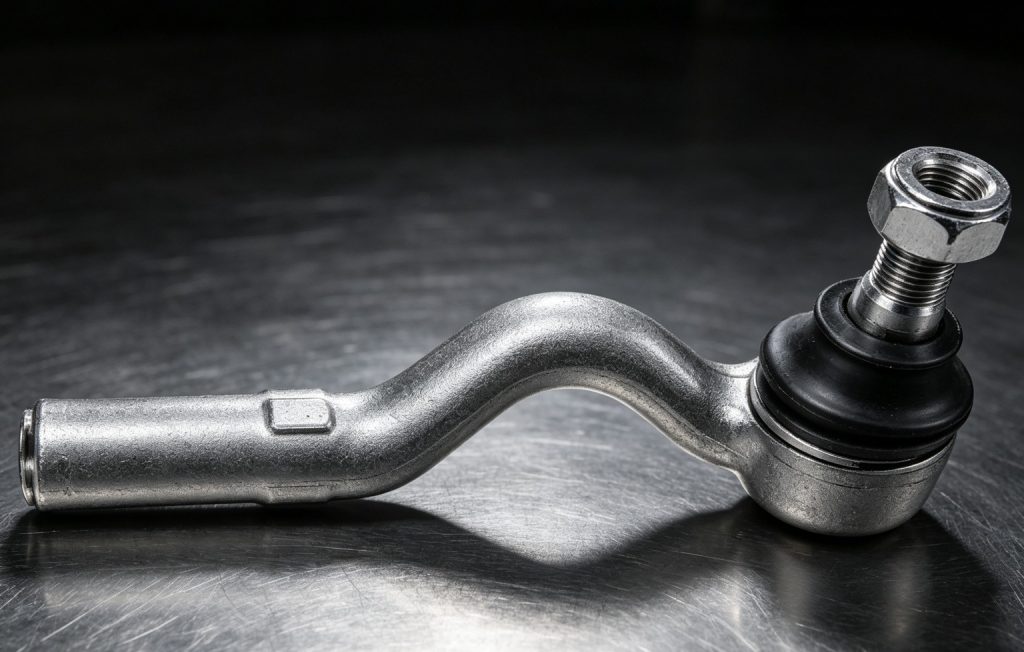
Ball joints and tie rod ends are both ball-and-socket joints, but they do different jobs and fail in different ways. A ball joint is a load-bearing suspension part that connects the control arm to the steering knuckle; a tie rod end is a steering part that connects the tie rod to the steering knuckle and transfers steering input to the wheel [1][5]. The practical distinction for diagnosis: a worn ball joint usually clunks over bumps, while a worn tie rod end usually makes the steering feel loose or vague, with excessive free play and clicking during low-speed turns [4][10]. This guide explains the difference in function, how to separate the two failure signatures, and how to inspect both correctly.
Quick Comparison Table
| Dimension | Ball Joint (Suspension) | Tie Rod End (Steering) |
|---|---|---|
| Location | Between control arm and steering knuckle [1] | Between tie rod and steering knuckle [1][4] |
| Primary function | Pivot for wheel, carries vehicle weight, links suspension to wheel [5][6] | Transmits steering input, controls toe angle [6][7] |
| Load | Bearing—supports vertical suspension load [5] | Steering load only, no vehicle weight [6] |
| Signature symptom | Clunking/knocking over bumps, felt through the floor [4][10] | Loose or wandering steering, free play in wheel, clicking on sharp turns [3][8][12] |
| Wheel-check direction | Rock wheel at 12 and 6 o’clock (vertical play) [4][11] | Rock wheel at 3 and 9 o’clock (horizontal play) [4][11] |
| Failure consequence | Wheel can collapse or detach from the knuckle [2][4] | Steering can be lost; wheel alignment (toe) disturbed [2][4] |
Same Ball-and-Socket Design, Different Jobs
Both parts use a spherical ball stud pressed into a socket, sealed by a rubber boot and packed with grease. The similarity ends there. Ball joints are suspension members: they connect the control arms to the steering knuckle, act as the pivot for up-and-down wheel travel, and carry a large share of the vehicle’s weight [1][5]. Tie rod ends are steering members: the outer tie rod end connects the tie rod assembly to the steering knuckle and converts rack movement into wheel steering, directly controlling the toe angle [1][6][7]. That is why a worn ball joint mostly affects how the wheel is located, while a worn tie rod end mostly affects how the car steers [7].
Ball Joints: The Load-Bearing Pivot
Because a ball joint carries weight, its failure shows up under load and impact. The classic symptom is a clunking or knocking noise over bumps, speed bumps, or potholes—often felt through the floor rather than the steering wheel [4][10]. As wear advances you may also feel steering wander, see uneven wear on the inside or outside tyre edges, and find vertical play in the wheel [1][8]. If a lower ball joint separates completely, the wheel assembly can collapse—this is a safety-critical failure, not just a noise issue [2][4].
Tie Rod Ends: The Steering Link
A failing tie rod end changes steering feel first. Typical complaints are a loose or vague steering wheel with excessive free play—the wheel turns an inch or two before the front tyres respond—and constant small corrections on the highway [3][8][12]. At low speed, a worn outer tie rod end can click or pop repeatedly when turning sharply in a parking lot or driveway [3][8]. Because tie rod ends control toe, tyres often show a feathered or saw-tooth wear pattern across the tread blocks [3][8].
How to Tell Which One Is Worn
1. Listen to the noise. A clunk over bumps that you feel through the floor points to a ball joint; a click when turning the wheel at low speed points to an outer tie rod end [4][8][10].
2. Feel the steering. If you are chasing the wheel to stay straight on the highway and the wheel has a dead zone before the tyres respond, start with the tie rods [10][12].
3. Inspect the boots. A torn ball-joint boot lets grit and water in and accelerates wear; the same is true for a torn tie-rod-end boot [4][8].
4. Read the tyres. Feathered or saw-tooth wear across the tread is the signature of worn tie rod ends (toe change); inner- or outer-edge wear is more typical of worn ball joints or arm bushings [3][8].
5. Check the wheel. With the vehicle lifted, rock the wheel at 12 and 6 o’clock to test ball-joint play, and at 3 and 9 o’clock to test tie-rod play [4][11]. Visible movement at the joint under load means the part is worn.
What to Look for When Buying Replacements
Both parts fail through the same mechanisms: socket wear, boot failure, and corrosion. When sourcing replacements, check the ball-socket preload and fit, the boot material (oil- and ozone-resistant rubber), and the surface treatment (zinc or other corrosion protection). Avoid cheap units with thin housings or no corrosion protection—they fail faster under road stress [6]. For both part types, a documented manufacturer with process control matters: Hetian Automotive has produced steering and suspension parts since 1998, operates a 160,000 m² facility with IATF 16949 certification and a CNAS-accredited laboratory, exports to over 30 countries, and holds more than 100 patents.
FAQ
Q: Are tie rod ends and ball joints the same part?
A: No. Both are ball-and-socket joints, but ball joints are load-bearing suspension links between the control arm and knuckle, while tie rod ends are steering links between the tie rod and knuckle [1][5].
Q: How do I know if it’s a ball joint or tie rod end?
A: Clunking over bumps felt through the floor points to ball joints; loose, wandering steering with a dead zone and clicking on sharp turns points to tie rod ends [4][8][10]. Rock the wheel at 12-6 for ball joints and 3-9 for tie rods [4][11].
Q: Can a bad tie rod end cause a clunk?
A: Yes, but the clunk tends to appear when turning the steering wheel or on sharp turns, whereas a ball joint clunks over bumps [8][9].
Q: What happens if a tie rod end fails while driving?
A: If the ball stud separates, steering to that wheel is lost and the wheel can move out of alignment—a serious safety hazard. Routine inspection is vital [2][4].
Q: Do I need an alignment after replacing tie rod ends?
A: Yes. Replacing tie rod ends changes toe settings; a wheel alignment is required after the repair to restore even tyre wear and straight-line stability [4][7].
Q: Can I replace just one side?
A: For steering and suspension joints, replacing both sides is recommended because the opposite side wears at a similar rate, and it keeps steering feel and tyre wear symmetrical.
Related Guides
- Ball Joint Failure: Symptoms, Safety Risks, and Replacement
- Stabilizer Link vs. Sway Bar Link: Function, Wear Signs, and Replacement
- Suspension Parts Replacement Intervals: When to Replace Ball Joints, Control Arm Bushings, Links and Tie Rod Ends
- Safety-Critical Auto Parts Verification: How to Check Suspension and Steering Parts for Authenticity
- Product category: Stabilizer, Ball Joint & Link
References
[1] “Ball Joint vs Tie Rod: Key Differences, Functions, and Replacement Guide,” Auto Sage Hub, February 10, 2026, https://autosagehub.org/ball-joint-tie-rod-key-differences-functions-replacement/, accessed September 14, 2026.
[2] “Ball Joint vs Tie Rod End: What You Need to Know,” GDST Auto Parts, October 31, 2025, https://gdstauto.com/ball-joint-vs-tie-rod-end-what-you-need-to-know/, accessed September 14, 2026.
[3] “Tie Rod End Failure vs. Ball Joint Wear: How to Tell the Difference,” DUHUI Bearing, April 14, 2026, https://duhui-bearing.com/tie-rod-end-failure-vs-ball-joint-wear/, accessed September 14, 2026.
[4] “How Do You Diagnose Worn Ball Joints and Loose Tie Rods?,” MR.FAST, May 28, 2026, https://mrfastauto.com/how-do-you-diagnose-worn-ball-joints-and-loose-tie-rods/, accessed September 14, 2026.
[5] “Tie Rod End Manufacturer,” MZW Motor, June 11, 2026, https://mzwmotor.com/tie-rod-end/, accessed September 14, 2026.
[6] “Ball Joint Tie Rod Guide: How to Choose & When to Replace,” CarInterior (Alibaba), January 28, 2026, https://carinterior.alibaba.com/buyingguides/ball-joint-vs-tie-rod-key-differences-when-to-replace, accessed September 14, 2026.
[7] “Pinpoint Diagnosis: Ball Joint, Tie Rod, Control Arm Differences,” Car Symptoms, January 18, 2026, https://carsymp.com/suspension-steering/ball-joint-replacement/ball-joint-vs-tie-rod-vs-control-arm-diagnosis, accessed September 14, 2026.
[8] “Tie Rod End Failure vs. Ball Joint Wear: How to Diagnose at Home,” GSP North America, October 6, 2025, https://gspnorthamerica.com/blogs/news/tie-rod-end-failure-vs-ball-joint-wear-how-to-diagnose-at-home, accessed September 14, 2026.
[9] “Tie Rod End vs. Ball Joint: Which One Should You Choose?,” Tufocar, February 12, 2026, https://www.tufocar.com/new-tie-rod-end-vs-ball-joint-which-one-should-you-choose.html, accessed September 14, 2026.
[10] “Loose Steering or Clunking Noises? Tie Rod and Ball Joint Problems Explained,” Snell Automotive, January 8, 2026, https://snellautomotive.com/blog/tie-rod-ball-joint-symptoms/, accessed September 14, 2026.
[11] “How to Check Suspension Joints: The Real Deal,” Mytopinfo, April 14, 2026, https://mytopinfo.com/how-to-check-suspension-joints/, accessed September 14, 2026.
[12] “How to Tell if Your Steering Linkage and Tie Rod Ends Are Worn — Loose Steering, Knocking Sounds, Pulling?,” AutoDataPlug, February 20, 2026, https://autodataplug.com/troubleshooting-diagnostics/how-to-tell-if-your-steering-linkage-and-tie-rod-ends-are-worn-loose-steering-knocking-sounds-pulling/, accessed September 14, 2026.
Last updated: Sep 14, 2026 · Reviewed by the Hetian engineering team