
← All technical articles · News
Industry Insights
Suspension Parts Replacement Intervals: When to Replace Ball Joints, Control Arm Bushings, Links and Tie Rod Ends
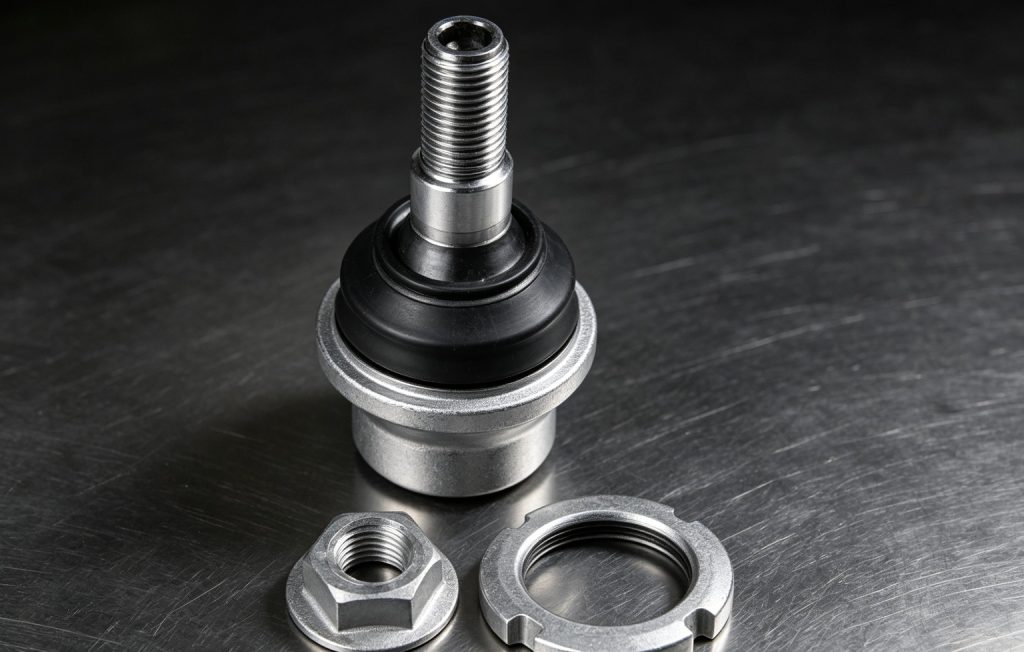
There is no single odometer reading that tells you when suspension parts need replacing—service life depends on vehicle, road quality, and driving style—but the industry has well-established typical ranges. Ball joints last roughly 70,000–150,000 miles, control arm bushings 60,000–150,000 miles, sway bar links as little as 40,000–100,000 miles, and tie rod ends about 60,000–120,000 miles [1][2][3][9]. The practical rule is inspection-first: check these parts at every service interval, and replace them when play, torn boots, or noise appears rather than waiting for a fixed mileage [1][7]. This guide gives the reference intervals, the factors that shorten them, and the inspection method workshops and owners can use.
Replacement Interval Quick-Reference Table
| Component | Typical Life (miles) | Typical Life (km) | Primary Replacement Signals |
|---|---|---|---|
| Ball joints | 70,000 – 150,000 [3][7][9] | ≈110,000 – 240,000 | Clunking when turning, loose steering, torn boot [3][7] |
| Control arm bushings | 60,000 – 150,000 [2][6] | ≈95,000 – 240,000 | Dull clunk over bumps, vague steering, cracked rubber [1][6] |
| Sway bar links | 40,000 – 100,000 [8][9] | ≈65,000 – 160,000 | Rattle/clunk over bumps, excessive body roll [8] |
| Tie rod ends | 60,000 – 120,000 [2][3] | ≈95,000 – 190,000 | Imprecise steering, vibration, uneven tyre wear [3] |
| Shocks / struts | 50,000 – 100,000 [2][3] | ≈80,000 – 160,000 | Bouncy ride, leaking fluid, poor braking stability [2] |
How Long Each Component Typically Lasts
Ball joints. Ball joints are safety-critical: if one fails completely, steering can be lost [7]. They typically last 70,000–150,000 miles under normal conditions, and some sources put the first inspection marker around 80,000 miles [3][7][9]. Rough terrain and heavy loads shorten this range.
Control arm bushings. Bushings isolate road vibration and locate the wheel. They last roughly 60,000–150,000 miles depending on rubber quality and ozone exposure [2][6]. Fluid-filled bushings fail faster once the damping fluid leaks out [1].
Sway bar links. Links are the shortest-lived front-suspension part, typically 40,000–100,000 miles, because they take constant reversal loads and their small ball sockets wear quickly [8][9]. A worn link sounds like a rattle or clunk over sharp bumps.
Tie rod ends. Tie rod ends carry steering loads and typically last 60,000–120,000 miles [2][3]. Worn ends make steering feel imprecise and can cause front-end vibration.
Shocks and struts. Dampers last 50,000–100,000 miles, and their mount bearings and top mounts often need attention at the same time [2][3].
What Shortens Suspension Part Life
Road quality. Continuous rough or unpaved roads accelerate bushing and ball-joint wear; the 30,000–50,000-mile inspection interval for control arms assumes rough-road use [1].
Load and vehicle weight. SUVs and vans put more load on each joint. Heavier vehicles wear ball joints and links faster than light sedans [5].
Rubber quality and environment. Ozone and UV degrade rubber; cheap or aged rubber cracks early, and fluid-filled bushings fail once the damping fluid leaks [1].
Driving style. Frequent hard braking, aggressive cornering, and pothole impacts transfer shock directly to arms, joints, and links [5].
Neglected alignment. A misaligned front end loads one side of each bushing and joint, wearing parts out unevenly and far sooner than their nominal interval [1].
How to Inspect Suspension Parts Correctly
1. Check for play. With the vehicle lifted and the wheel supported, use a pry bar at each joint: movement at the ball joint socket means the joint is worn; movement at the inner bushing points to bushing failure. As a practical guide, ball-joint free play above roughly 0.5 mm exceeds the acceptable threshold [4].
2. Inspect boots and rubber. A torn ball-joint boot lets in grit and water, drying out the grease and accelerating wear; cracked, perished bushing rubber means the bushing is near the end of its life [1][7].
3. Listen on the road. Clunking over bumps, rattling on rough pavement, and steering-wheel shimmy at highway speed are the classic signals that one or more front-end parts need replacement [1][3].
4. Read the tyres. Uneven or inner-edge front tyre wear indicates altered geometry from worn arms or bushings—replace the worn parts before paying for a new alignment [1][3].
5. Follow the manufacturer’s interval. For control arms, the common guidance is to inspect every 30,000–50,000 miles and replace as soon as symptoms appear, rather than waiting for a hard mileage number [1].
Why Part Quality Matters as Much as the Interval
An interval only tells you when to look. What you fit determines how long the repair lasts: a ball joint with a case-hardened stud, a sealed pre-lubricated socket, and an oil- and ozone-resistant boot will outlast a cheap copy with soft material and thin rubber [1][7]. The same logic applies to bushings—properly vulcanised rubber-to-metal bonds hold their geometry far longer than press-fit substitutes. Buying from a manufacturer with process control and test documentation makes the interval meaningful. Hetian Automotive has produced suspension and chassis parts since 1998, operates a 160,000 m² facility with IATF 16949 certification and a CNAS-accredited laboratory, exports to over 30 countries, and holds more than 100 patents.
FAQ
Q: Is there a fixed mileage for replacing ball joints?
A: No. The typical range is 70,000–150,000 miles, but the correct trigger is play, noise, or a torn boot, not a number on the odometer [3][7][9]. Inspect annually and at every service.
Q: How often should sway bar links be replaced?
A: Links are the shortest-lived part, typically 40,000–100,000 miles, and often get replaced together with other suspension work [8][9]. A rattle over sharp bumps is the usual first sign.
Q: Can I just replace the bushing instead of the whole control arm?
A: Sometimes, but pressing out old bushings is labour-intensive and the arm may be worn. ZF’s workshop guidance notes that replacing the entire arm is generally safer and more reliable.
Q: How do I check ball-joint play at home?
A: Lift the vehicle so the wheel is off the ground, support the lower arm, and pry the joint with a bar. Any noticeable movement at the socket indicates wear; free play above roughly 0.5 mm exceeds the acceptable threshold [4].
Q: Do worn bushings really affect safety?
A: Yes. Worn bushings let the wheel move out of its designed geometry, causing vague steering, uneven tyre wear, and reduced stability under braking [1][6].
Q: Should I replace both sides at once?
A: For arms, links, and ball joints, yes. Parts on both sides wear at similar rates, and replacing both keeps geometry and ride behaviour symmetrical.
Related Guides
- Ball Joint Failure: Symptoms, Safety Risks, and Replacement
- Stabilizer Link vs. Sway Bar Link: Function, Wear Signs, and Replacement
- BMW X5 E70 Front Suspension Parts: OE Cross-Reference and Replacement Guide (2007–2013)
- What Is a Suspension Bushing? Materials, Function, and Failure Modes
- Product category: Stabilizer, Ball Joint & Link
References
[1] “Essential Guide to Vehicle Suspension System: Components, Wear Signs, & Replacement Intervals,” AAA Million Auto Parts, September 13, 2026, https://www.aaamillion.com/suspension-parts-terms, accessed September 13, 2026.
[2] “Which suspension parts should I replace?,” Ryan’s Auto Care, May 9, 2026, https://www.ryansautomi.com/articles/which-suspension-parts-should-i-replace.html, accessed September 13, 2026.
[3] “How Often Should You Replace Suspension? I Learned the Hard Way,” Mytopinfo, April 4, 2026, https://mytopinfo.com/how-often-should-you-replace-suspension/, accessed September 13, 2026.
[4] “汽车摆臂更换周期推荐,” 太平洋汽车, January 16, 2026, http://m.pcauto.com.cn/note/861829651806295428.html, accessed September 13, 2026.
[5] “How Long Do Car Suspensions Last?,” T P Auto Repair, November 24, 2025, https://tpautorepair.net/how-long-do-car-suspensions-last/, accessed September 13, 2026.
[6] “Car Suspension: How It Works, Problems, and Replacement,” FlipCars, April 7, 2026, https://flipcars.ca/car-suspension-how-it-works-problems-and-replacement/, accessed September 13, 2026.
[7] “How often should I check or replace my suspension components?,” Auto and Truck Springs, April 22, 2026, https://www.autoandtrucksprings.com/help-center/how-often-should-i-check-or-replace-my-suspension-components/, accessed September 13, 2026.
[8] “How Often Does Suspension Last on a Car?,” Automotive Globe Specialist, March 4, 2026, https://www.automotiveglobespecialist.com/post/how-often-does-suspension-last-on-a-car, accessed September 13, 2026.
[9] “Suspension Repair Cost in 2026: Complete Guide for NJ Drivers,” AutoBlast, March 30, 2026, https://www.autoblast.online/blog/suspension-repair-cost, accessed September 13, 2026.
Last updated: Sep 13, 2026 · Reviewed by the Hetian engineering team