
← All technical articles · News
Industry Insights
Stabilizer Link vs. Sway Bar Link: Function, Wear Signs, and Replacement
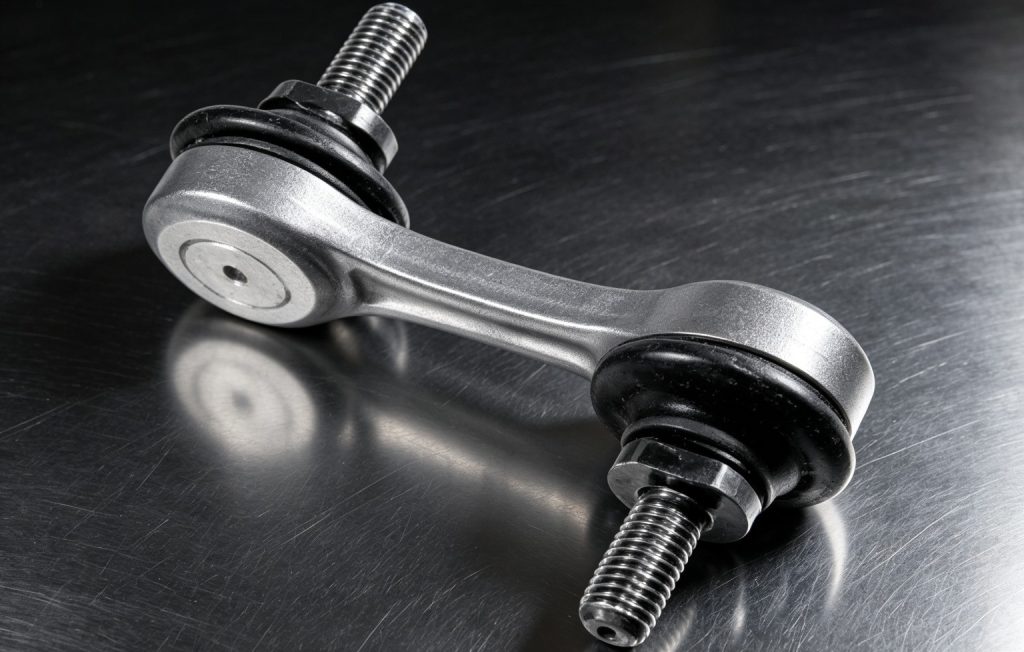
The stabilizer link and the sway bar link are the same part under different names—also called the end link, drop link, anti-roll bar link, or, in Chinese workshops, the “李子串” (plum string). It is a short rod with a ball joint at each end that connects the sway bar (anti-roll bar) to the strut or lower control arm. Its job is to transfer the sway bar’s torsion to the suspension so body roll is resisted when cornering. When the link’s ball joints wear, the most common symptoms are a sharp clunking noise over speed bumps at low speed and a continuous rattling over washboard roads. This guide explains the function, wear signs, diagnosis, and replacement of stabilizer links, and how to tell link wear apart from sway bar bushing wear and control arm bushing wear.
Symptom Quick-Reference Table
| Symptom | Most Likely Part | Characteristic | Action |
|---|---|---|---|
| Sharp “clunk” over speed bumps, low speed | Stabilizer link ball joints | Clear, metallic, from one front wheel area | Inspect links; replace if play found |
| Continuous “da-da-da” rattle on washboard/gravel roads | Stabilizer links (or multiple tie rod ball joints) | Rapid, fine, stacking rattle | Check all link and tie rod joints |
| Dull “dong-dong” from sway bar area | Sway bar bushings (bracket bushings) | Muffled, booming, at the bar mounting points | Inspect bar bushings; replace if cracked |
| Low-speed turning “crack” or creak | Link ball joints or strut mount bearing | One-off crack when load transfers | Lift and check links by hand; check top mount |
| “Clunk” over bumps plus steering vagueness | Control arm bushings / ball joints | Deep knock with handling change | Full front-end inspection |
What the Stabilizer Link Does
The sway bar is a torsion spring mounted transversely across the vehicle, attached to the chassis through rubber bushings at its mounting brackets and connected to the suspension at each end through stabilizer links [5]. When the body rolls in a corner, one side of the suspension compresses and the other extends; the sway bar twists and, through the links, pushes the compressed side’s suspension to resist further roll. The links are the mechanical messengers of this system—they must transfer both push and pull forces through ball joints that pivot in every direction.
Because each link carries two ball joints (one at the bar end, one at the strut/control arm end), a vehicle has four link ball joints in the front suspension alone. These joints are small but heavily loaded: they articulate with every bump and every steering input, and they are exposed to water, salt, and road debris because they sit low in the wheel well [4].
Wear Signs: What Each Noise Tells You
Speed bump “clunk.” The classic sign of a worn stabilizer link is a sharp, clear clunking noise when crossing a speed bump or pothole at 20–40 km/h, typically heard from one front wheel area [1]. The sound comes from metal-on-metal contact inside the ball joint after the rubber boot has failed and the grease has washed out. Some drivers describe it as a single crisp “crack” each time the suspension loads and unloads.
Washboard road “da-da-da.” On continuous washboard or gravel surfaces, worn links produce a rapid, fine rattling sound as the ball joint oscillates inside a loose socket [5]. When several ball joints (links and tie rod ends) are slightly loose at the same time, the sounds stack into a continuous chatter [4].
Cornering creak. A one-off creak or crack when turning at low speed, especially when the body rolls and load transfers, can come from a worn link ball joint moving under changing load angles [9]. The same symptom can also be caused by a failing strut mount bearing, so both should be checked.
Sway bar bushing noise is different. Deteriorated sway bar bracket bushings (the rubber mounts holding the bar to the chassis) produce a dull, muffled “dong-dong” or groan from the bar’s mounting points, not a sharp clunk [3]. Worn control arm bushings produce a deeper knock over bumps combined with steering vagueness and a loose-feeling chassis [6]. Distinguishing these three is the first step of diagnosis: links make sharp noises, bar bushings make dull ones, and control arm bushings add handling degradation.
Diagnosis: How to Verify a Worn Link
Stabilizer links are among the easiest suspension parts to inspect. With the vehicle on a lift or safely supported, grasp the link with both hands and try to move it sideways and in rotation. Any free play or click at either ball joint means the joint is worn and the link should be replaced [4]. A healthy link feels firm, with smooth resistance and no free movement. Inspect the rubber boots: a torn or cracked boot lets water and grit into the joint, and even without detected play, a split boot means contamination and accelerated wear are already underway [7].
On the ground, a second check: disconnect one end of the link and rotate the joint by hand. It should move smoothly with consistent effort. If it feels notchy or binds, the joint is damaged. Note that link play is often easier to feel than to see—a pry bar can help amplify small movements.
Replacement: What’s Involved
Replacing a stabilizer link is a straightforward job: remove the two nuts securing the ball joint studs (holding the stud with an Allen key or Torx socket to prevent it from spinning), pull the link free, and install the new one. Tighten both nuts to the manufacturer’s torque specification. Links should always be replaced in pairs (left and right) because both sides wear at the same rate and replacing one side leaves an asymmetric, soon-to-fail joint on the other [7].
Unlike control arms or tie rods, stabilizer link replacement does not change toe, camber, or caster, so a four-wheel alignment is not required after link-only work [5]. This makes links one of the most cost-effective chassis repairs: the parts are inexpensive and the labor is minimal, but replacing a worn link restores a dramatic improvement in ride tightness over bumps.
Sourcing Quality: What to Verify When Buying Links
When purchasing stabilizer links for aftermarket replacement, verify five quality points: (1) ball joint studs are case-hardened steel with precision-ground spheres and a consistent stud taper; (2) the housing is forged or cold-formed steel, not a soft casting; (3) rubber boots are oil- and ozone-resistant (neoprene or equivalent) and firmly crimped—boot failure is the number one cause of premature link failure; (4) joints are pre-lubricated for life with a quality lithium-based grease; (5) the supplier holds IATF 16949 certification and can provide dimensional data confirming stud taper, thread pitch, and link length match OE geometry.
Hetian Automotive has manufactured suspension and chassis components since 1998, with a 160,000 m² production facility, IATF 16949 certification, a CNAS-accredited laboratory, exports to over 30 countries, and more than 100 patents. Ball joints, stabilizer links, and tie rod ends are core product lines manufactured with in-house forging, machining, and rubber-to-metal bonding—the process depth that keeps boot integrity and ball joint durability consistent at aftermarket production volumes.
FAQ
Q: Is a stabilizer link the same as a sway bar link?
A: Yes. Stabilizer link, sway bar link, end link, and drop link all refer to the same component: the short rod with ball joints at each end that connects the sway bar to the suspension. Chinese workshops often call it the “李子串” (plum string) [5].
Q: What does a worn stabilizer link sound like?
A: The classic symptom is a sharp, clear “clunk” or “crack” when crossing speed bumps or potholes at 20–40 km/h, usually from one front wheel area. On continuous washboard roads, worn links produce a rapid “da-da-da” rattle. Sway bar bushing wear sounds different: a dull, muffled “dong-dong” from the bar mounting points [1][5].
Q: How do I check if my stabilizer links are worn?
A: With the vehicle lifted, grasp the link with both hands and try to move it sideways and in rotation. Any free play or click at either ball joint means the joint is worn. Also inspect the rubber boots—a torn or cracked boot lets contamination in and accelerates wear even before play is detectable [4][7].
Q: Do stabilizer links need to be replaced in pairs?
A: Yes. Both sides wear at the same rate under the same loads. Replacing only one side leaves a soon-to-fail joint on the other and an asymmetric suspension. Pairs also save a second trip to the shop [7].
Q: Do I need a wheel alignment after replacing stabilizer links?
A: No. Stabilizer links do not affect toe, camber, or caster angles, so a four-wheel alignment is not required after link-only replacement. This is different from control arm or tie rod replacement, which does require alignment [5].
Q: How long do stabilizer links last?
A: Service life depends on road conditions and boot integrity. On normal roads, quality links typically last 80,000–120,000 km. Vehicles driven on rough roads or with failed boots may need links much sooner. Because the boots fail first, inspecting boots at each tire rotation is the best preventive practice [1][7].
Related Guides
- Ball Joint Failure: Symptoms, Safety Risks, and Replacement
- BMW 3 Series (F30/F35) Front Suspension Parts: OE Cross-Reference and Replacement Guide
- Audi A4 (B8/B9) Tie Rod Ends & Stabilizer Links: OE Cross-Reference and Replacement Guide
- Strut Mount Bearing Problems: Diagnosis and Replacement Guide
- Product category: Stabilizer, Ball Joint & Link
References
[1] “底盘异响是隐患,拉杆胶损坏的5个典型表现,” 搜狐, August 25, 2026, https://m.sohu.com/a/1067150398_122759267/, accessed September 10, 2026.
[2] “打方向时底盘异响吱吱声?3步锁定故障源与解决方案,” 搜狐, September 10, 2026, https://m.sohu.com/a/1074088160_122956113/, accessed September 10, 2026.
[3] “9种不同的底盘异响,对应这9种底盘故障,去修理前先了解一下,” 今日头条, September 29, 2024, http://m.toutiao.com/group/7420021849670713919/, accessed September 10, 2026.
[4] “底盘异响修了几次还是响,问题到底出在哪?,” 搜狐, August 8, 2026, https://m.sohu.com/a/1060298075_122935891/, accessed September 10, 2026.
[5] “你的车底盘是不是开始’散’了?聊聊底盘松散和异响那些事,” 搜狐, August 11, 2026, https://m.sohu.com/a/1061497917_122935891/, accessed September 10, 2026.
[6] “底盘松散、过减速带哐哐响?一文讲清哪里松了、怎么查、怎么治,” 搜狐, September 7, 2026, https://m.sohu.com/a/1072726959_122994703/, accessed September 10, 2026.
[7] “拉杆胶套损坏影响操控吗,” 搜狐, August 11, 2026, https://m.sohu.com/a/1061487633_122971628/, accessed September 10, 2026.
[8] “华胜淮安开发区店底盘松散异响治理效果解析,” 汽车之家车家号, August 14, 2026, https://chejiahao.m.autohome.com.cn/pingan/chejiahao/detailinfo/26190832, accessed September 10, 2026.
[9] “转向异响反复,底盘胶套更换究竟管不管用?,” 搜狐, August 29, 2026, https://m.sohu.com/a/1069327831_122768213/, accessed September 10, 2026.
[10] “底盘异响、松散发飘!优先更换胶套不换总成,省钱恢复底盘紧致质感,” 搜狐, August 16, 2026, https://m.sohu.com/a/1063486211_122711152/, accessed September 10, 2026.
Last updated: Sep 10, 2026 · Reviewed by the Hetian engineering team