
← All technical articles · News
Industry Insights
How Engine Mounts Are Tested for Durability: OEM Standards Explained
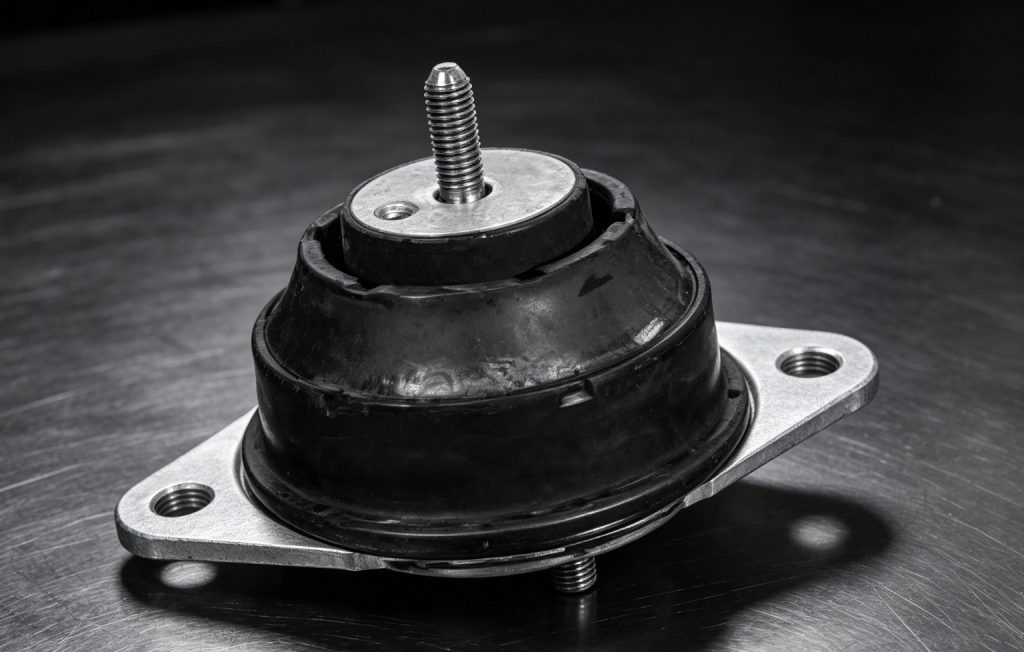
Engine mounts are among the most safety- and NVH-critical rubber-to-metal components in a vehicle, and their durability is proven not by appearance but by a defined sequence of laboratory tests: static and dynamic stiffness measurement, fatigue cycling that simulates millions of kilometers of engine and road vibration, and environmental aging under heat and oil. For buyers sourcing aftermarket or OE-quality engine mounts, understanding these test methods and the standards behind them—ISO 16750-3, GB/T 28046.3, QC/T 521, and OEM-specific specifications such as VW TL822 and Toyota TSC—is the difference between accepting a part on faith and verifying it on evidence [3]. This guide explains how engine mounts are tested for durability, what the pass criteria mean, and how buyers should verify that a supplier actually runs these tests.
Durability Test Methods at a Glance
| Test | Standard / Method | Key Parameters | Pass Criteria |
|---|---|---|---|
| Static stiffness | Quasi-static load-deflection curve | Rated load in X/Y/Z axes | Stiffness within ±15% of design spec |
| Dynamic stiffness & damping | Dynamic stiffness test at 5–50 Hz | Amplitude ±0.1–±0.5 mm | Dynamic stiffness and loss angle within spec |
| Constant-amplitude fatigue | 1G preload + sinusoidal cycling | ±0.3–±0.8 mm amplitude, ~5 Hz, 1M+ cycles | No cracking, no rubber-to-metal debonding, stiffness decay within limit |
| Random vibration | ISO 16750-3 / GB/T 28046.3 | PSD profile per mounting location, 24h+ | No functional or structural failure |
| Sine sweep resonance | 5 Hz–2000 Hz sweep | Sweep rate per spec | No resonance damage, no separation |
| Static overload | GB/T 5296-type static load | 3.5× full load | No weld cracking, deformation ≤0.3 mm |
Why Engine Mounts Need Dedicated Durability Testing
An engine mount experiences three simultaneous load regimes: the engine’s own excitation (idle vibration, torque reaction under acceleration and deceleration), road-induced vibration transmitted through the body, and temperature cycles from engine heat, ranging from cold starts below -30°C to under-hood temperatures above 120°C. Fatigue simulation replicates millions of alternating vibrations, verifying that stiffness does not decay, rubber does not crack, and the rubber-to-metal bond does not separate over the part’s service life [1]. Because the mount’s job is to isolate vibration while carrying static engine weight, a part that fails in testing will cause noise, vibration and harshness (NVH) degradation long before it fails structurally—which is why dynamic stiffness is measured before and after fatigue cycling [1].
Automotive vibration testing follows a multi-layer standard framework: the international core is ISO 16750-3 for mechanical loads, supported by regional standards and OEM-specific specifications such as VW TL822 and Toyota TSC [3]. Chinese national standards such as GB/T 28046.3 cover random vibration testing for road-load simulation, and QC/T 521 specifies vibration durability test methods for automotive metal components [4][8].
Static and Dynamic Stiffness Testing
Before any fatigue test, the mount’s stiffness characteristics are established. Static stiffness is measured by applying a quasi-static load and recording the deflection curve in the principal load axes, verifying that the mount carries the engine’s weight at the designed rate. Dynamic stiffness and damping (loss angle) are measured with a small-amplitude sinusoidal excitation, typically at frequencies from 5 Hz to 50 Hz, because the mount’s dynamic stiffness—not its static rate—determines how effectively it isolates engine idle vibration [1]. A mount with correct static stiffness but excessive dynamic stiffness will transmit more vibration to the body, so both values must be verified against the design specification.
Some laboratories also measure the material properties that underpin durability: hardness per GB/T 4340.1 (Vickers) and the rubber compound’s tensile strength and compression set, which correlate with long-term load retention [8]. These material-level checks are the foundation of the S-N curve-based fatigue analysis used to design the test profile [6].
Fatigue Durability Testing
The core durability proof for an engine mount is fatigue cycling. The most common production-validation method is constant-amplitude sinusoidal fatigue: the mount is held under a 1G static preload (its installed static load) while a sinusoidal displacement of ±0.3 to ±0.8 mm—matching real vehicle vibration amplitudes—is applied at a frequency around 5 Hz for one million or more cycles [1]. During the test, load and displacement are recorded, and at defined checkpoints the part is inspected for cracking, rubber-to-metal debonding, and stiffness decay. Acceptable parts show no cracks and no bond separation, with stiffness decay within the manufacturer’s limit [1].
In addition to constant-amplitude fatigue, random vibration testing per ISO 16750-3 or GB/T 28046.3 applies a power spectral density (PSD) profile that reproduces the composite vibration environment of engine excitation plus road roughness, using severity levels matched to the part’s mounting location [4][7]. Sine sweep testing from 5 Hz to 2000 Hz identifies resonance modes and verifies that the mount survives resonance without damage [2]. For shock-type events, transient tests simulate the impact loads seen during pothole strikes. A complete validation program runs these tests in sequence: stiffness measurement → fatigue cycling → stiffness re-measurement → environmental aging → final inspection, mirroring how the part must perform over its entire service life [1].
Environmental and Material Aging Tests
Engine mounts live in a hostile thermal and chemical environment. Durability validation therefore includes temperature cycling (from low-temperature cold starts to sustained under-hood heat), oil and coolant immersion to verify the rubber compound resists swelling and degradation, and aging tests that simulate years of heat exposure [8]. These tests are critical because a mount that passes mechanical fatigue but fails under heat and oil exposure will harden, crack, or debond in service—producing the exact NVH complaints and premature failures that plague low-quality aftermarket mounts.
For comparison, related suspension and driveline components are validated with the same philosophy: shock absorbers, for example, are fatigue-tested per QC/T 491-2018 with up to one million cycles and periodic damping-function re-checks [9]. The consistency of this approach across component categories is why buyers should treat an engine mount supplier’s test evidence as a proxy for its overall engineering discipline.
How Buyers Should Verify Supplier Test Capability
When qualifying an engine mount supplier, ask for the actual test evidence, not just a certificate. Five verification points: (1) laboratory accreditation—a CNAS-accredited lab means test methods and results are audited against national standards; (2) test reports for the specific part number, including load-deflection curves, dynamic stiffness values, and fatigue test logs with cycle counts; (3) traceability to the design specification, showing which OEM or national standard the test profile was derived from [3]; (4) equipment capability—electro-hydraulic servo test rigs capable of multi-axis load and displacement control [9]; and (5) process controls—IATF 16949 certification and PPAP documentation, which require the supplier to maintain process capability and traceability across production runs. A supplier that cannot produce fatigue test logs for the exact part you are buying is effectively asking you to accept unvalidated durability.
Hetian Auto has manufactured suspension and chassis components since 1998, operates a 160,000 m² facility, holds IATF 16949 certification and CNAS laboratory accreditation, exports to more than 30 countries, and holds over 100 patents—the manufacturing and validation depth that buyers should look for when sourcing engine mounts.
FAQ
Q: What standards apply to engine mount vibration testing?
A: The core international standard is ISO 16750-3 (mechanical loads for road vehicles), supported by national standards such as GB/T 28046.3 (random vibration with road-load simulation) and QC/T 521 (vibration durability for automotive metal components), plus OEM-specific specifications such as VW TL822 and Toyota TSC [3][4][8].
Q: How many fatigue cycles must an engine mount survive?
A: Production validation commonly applies one million or more constant-amplitude fatigue cycles with a 1G static preload and ±0.3–±0.8 mm sinusoidal displacement at roughly 5 Hz, simulating the cumulative vibration of real driving. After cycling, the part must show no cracking, no rubber-to-metal debonding, and stiffness decay within the manufacturer’s limit [1].
Q: What is the difference between static and dynamic stiffness?
A: Static stiffness is the load-deflection rate under quasi-static load, which determines how the mount carries engine weight. Dynamic stiffness is measured under small-amplitude sinusoidal excitation (typically 5–50 Hz) and governs how effectively the mount isolates idle and cruising vibration. Both must meet specification—a mount can carry load correctly yet transmit excessive vibration if dynamic stiffness is too high [1].
Q: Why do cheap aftermarket engine mounts fail quickly?
A: Common causes include rubber compounds without adequate heat and oil resistance, weak rubber-to-metal bonding, and missing fatigue validation—parts shipped without any test evidence may pass visually but crack, debond, or lose stiffness in service. Buyers should demand fatigue test logs and environmental aging reports for the exact part number [1][8].
Q: Can I verify an engine mount supplier’s test capability remotely?
A: Yes. Request laboratory accreditation certificates (CNAS), IATF 16949 certification, PPAP documents, and part-specific test reports including load-deflection curves and fatigue logs. Verify the lab scope covers the standards relevant to your market (ISO 16750-3, GB/T 28046.3, or the OEM specification), and check that the equipment list includes electro-hydraulic servo fatigue rigs [3][9].
Q: Do EV powertrains change engine mount durability requirements?
A: EVs eliminate combustion idle vibration but introduce high instantaneous torque, so mounts for electric drive units are validated for higher load amplitudes and torque reaction cycles, while retaining the same stiffness, fatigue, and environmental test framework. The test methodology is the same—the profiles are re-derived for the electric powertrain’s characteristics.
Related Guides
- Engine Mount Failure Symptoms: Vibration, Clunks, and When to Replace
- Strut Mount Bearing Problems: Diagnosis and Replacement Guide
- Rubber vs. Polyurethane vs. Hydraulic Bushings: A Buyer’s Comparison
- Custom Rubber-to-Metal Bonded Parts: What Buyers Should Specify
- Product category: Engine & Transmission Mounts
References
[1] “发动机机脚胶(动力总成悬置)动静刚度 + 疲劳完整检测,” 顺企网, September 3, 2026, https://m.11467.com/product/d54675066.htm, accessed September 6, 2026.
[2] “汽车发动机支架正弦振动(5Hz~2000Hz)可靠性测试,” 顺企网, September 2, 2026, https://m.11467.com/product/d43251339.htm, accessed September 6, 2026.
[3] “汽车零部件的振动测试需满足哪些特定标准(如 ISO 16750)的要求,” 顺企网, September 5, 2026, https://m.11467.com/product/d44653730.htm, accessed September 6, 2026.
[4] “汽车零部件随机振动测试(GB/T 28046.3-2011)道路工况模拟分析,” 顺企网, September 5, 2026, https://m.11467.com/product/d41268323.htm, accessed September 6, 2026.
[5] “苏州汽车零件疲劳试验,” 顺企网, September 3, 2026, https://m.11467.com/product/d45604499.htm, accessed September 6, 2026.
[6] “底盘零部件疲劳耐久测试|国标 ISO 严苛可靠性验证,” 顺企网, September 3, 2026, https://m.11467.com/product/d51439431.htm, accessed September 6, 2026.
[7] “汽车发动机振动疲劳可靠性测试(ISO 16750-3),” 顺企网, August 17, 2026, https://m.11467.com/product/d42547082.htm, accessed September 6, 2026.
[8] “发动机支架检测机构 支架振动耐久性能检测,” 顺企网, August 16, 2026, https://m.11467.com/product/d54462486.htm, accessed September 6, 2026.
[9] “电液伺服疲劳试验机如何测试汽车减震器循环耐久性能,” 搜狐汽车, August 13, 2026, https://m.sohu.com/a/1062275003_121095329/, accessed September 6, 2026.
Last updated: Sep 6, 2026 · Reviewed by the Hetian engineering team