
← All technical articles · News
Industry Insights
EU REACH Compliance for Suspension Parts: An SVHC Verification Guide for Importers
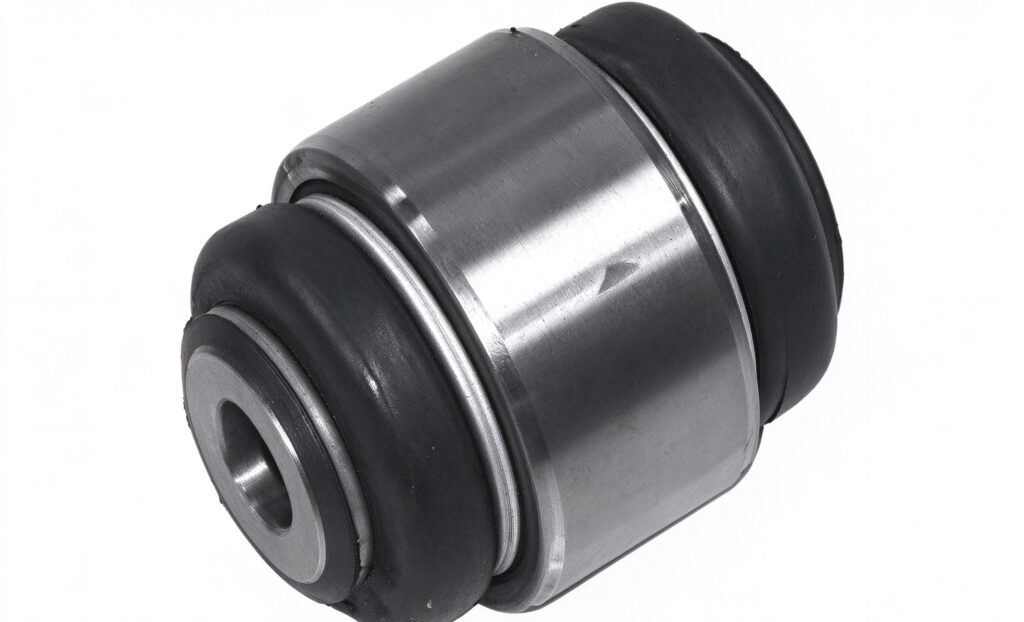
If you import suspension parts into the European Union, REACH is no longer a paperwork formality — it is now a customs gate. In January 2026, the European Automobile Manufacturers’ Association (ACEA) together with the European Chemicals Agency (ECHA) published a sector-specific REACH compliance framework, and from 1 July 2026 all automotive parts entering the EU market are required to submit a full supply-chain SVHC (Substances of Very High Concern) conformity report; parts without one, or with a non-compliant report, are refused entry [1]. For importers of control arms, ball joints, bushings and other chassis rubber-metal parts, the practical question is not “is REACH real” but “what evidence do I need to collect, from which supplier, and how do I verify it”. This guide lays out a verification workflow that survives a customs check and an ECHA audit.
Quick Reference: REACH Obligation Levels for Articles
| Trigger | Obligation | Where It Comes From |
|---|---|---|
| Any SVHC above 0.1% w/w in the article | Information duty: supplier must provide safe-use information to customers | REACH Article 33 [5] |
| SVHC above 0.1% w/w AND total annual volume above 1 tonne | Notification to ECHA | REACH Article 7(2) [5] |
| Any SVHC above 0.1% w/w in articles supplied in the EU | SCIP database notification for every affected article | Waste Framework Directive 2008/98/EC as amended, Art. 9(1)(i) [6] |
| Substances restricted under Annex XVII (e.g. PAH in rubber) | Comply with the restriction limits or the article cannot be placed on the market | REACH Annex XVII, Entry 50 [7][8] |
| Lead, mercury, cadmium, hexavalent chromium in vehicle materials | Banned unless covered by an ELV Annex II exemption | ELV Directive 2000/53/EC, Art. 4(2)(a) [9][10] |
The 2026 automotive-parts rule change
From 1 July 2026, automotive parts entering the EU — complete vehicles, parts and raw materials alike — must be accompanied by a full supply-chain SVHC conformity report [1]. This is not a new restriction list; it is a transparency requirement. It means the importer must be able to show, substance by substance and component by component, where SVHCs are absent or declared, all the way back through the supply chain. The consequence of non-compliance is direct: goods are refused entry at the border [1].
Know the list you are verifying against
The SVHC Candidate List is updated roughly twice a year [3]. On 4 February 2026 ECHA published the 34th update, adding two substances — n-hexane and 4,4'-[2,2,2-trifluoro-1-(trifluoromethyl)ethylidene]diphenol (Bisphenol AF) — and bringing the Candidate List to 253 entries [3][4]. Because new entries create immediate obligations once the 0.1% threshold is exceeded, the verification baseline must always be the current list, not the one from last year’s shipment. Your supplier documentation should reference the list version it was verified against.
Where suspension parts actually get flagged
Chassis parts are flagged in four material groups in practice:
1. Rubber components. Bushings, boots and dampers are the highest-risk area. Polycyclic aromatic hydrocarbons (PAH) in extender oils and carbon black are restricted under Annex XVII Entry 50: plastic and rubber articles that come into direct and prolonged or short-term repetitive skin or oral contact may not contain more than 1 mg/kg of the sum of eight specified PAHs, verified using EN 16143:2013 [7][8]. Plasticizers and vulcanisation aids can also carry SVHC-listed phthalates.
2. Corrosion-protection coatings. Hexavalent chromium passivation was long used on fasteners, ball studs and brackets. Under the ELV Directive, lead, mercury, cadmium and hexavalent chromium are banned in vehicle materials and components placed on the market after 1 July 2003, subject to the exemptions in Annex II — for example, corrosion-preventive coatings on chassis bolt and nut assemblies for vehicles placed on the market before 1 July 2008 [9][10]. Trivalent chromium or zinc-nickel alternatives are the compliant norm.
3. Metal alloys. Lead in free-machining steel, solder and some alloys, and cadmium in coatings, are classic findings in small metallic parts and threaded components.
4. Greases and lubricants. Pre-filled joints may contain SVHC-listed substances in the grease; the grease must be declared in the component’s material documentation.
An importer’s SVHC verification checklist
Step 1 — Demand a substance declaration per part number. Require a full material declaration (or IMDS/GADSL data) for every part number, not a generic company statement [10].
Step 2 — Cross-check against the current SVHC list. Verify declared substances against the latest Candidate List (253 entries as of February 2026) and against Annex XVII restrictions for the article type [3][8].
Step 3 — Demand test evidence where declarations are thin. For rubber parts, request PAH testing per EN 16143:2013 or the applicable migration method; for coatings, ask for chromium(VI)-free confirmation or analytical results [7].
Step 4 — Check ELV exemptions before accepting hexavalent chromium. Any chromium(VI) use must map to a live Annex II exemption entry and an expiry date; otherwise the part is non-compliant [9][10].
Step 5 — Confirm SCIP notifications. Where an article contains an SVHC above 0.1%, the EU supplier (including the importer) must have filed a SCIP notification under the Waste Framework Directive [6]. Ask for the SCIP dossier reference.
Step 6 — Audit batch traceability. The conformity report required since July 2026 is supply-chain wide [1]; your supplier must map each batch back to material lots and declarations, so a customs hold can be answered with evidence, not promises.
Step 7 — Re-verify on every list update. The Candidate List grows twice a year; a compliant part can become a non-compliant part overnight when a new substance is added [3]. Build re-verification into your annual supplier review.
What a compliant supplier looks like
Manufacturers who sell chassis parts into Europe on a regular basis run these obligations as routine engineering practice. As a company founded in 1998 with a 160,000 m² facility, IATF 16949-certified processes, a CNAS-accredited laboratory and exports to more than 30 countries, Hetian maintains substance declarations and material data for the suspension parts it ships, so importers receive the documentation the new EU rule demands instead of a verbal assurance [11].
FAQ
1. What does the July 2026 automotive REACH rule actually require?
From 1 July 2026, automotive parts entering the EU must be accompanied by a full supply-chain SVHC conformity report; parts without one, or with a non-compliant report, are refused entry [1].
2. What is the SVHC threshold that triggers obligations?
The trigger is 0.1% by weight (w/w) at the article level. Above it, REACH Article 33 information duties apply; above 0.1% with more than 1 tonne/year also triggers ECHA notification [5].
3. How many substances are on the SVHC Candidate List now?
253 entries as of the ECHA update of 4 February 2026 (the 34th update), with roughly two updates per year [3][4].
4. Why are rubber bushings and boots flagged so often?
Rubber compounds can contain PAHs from extender oils and carbon black, restricted under Annex XVII Entry 50 (1 mg/kg for the sum of eight PAHs in skin-contact plastic and rubber articles, per EN 16143:2013), plus phthalate plasticizers that appear on the SVHC list [7][8].
5. Can I still import parts with hexavalent chromium coatings?
Only if the specific use is covered by a live exemption in Annex II of the ELV Directive, such as corrosion-preventive coatings on chassis bolt and nut assemblies for vehicles placed on the market before 1 July 2008; otherwise the part is non-compliant [9][10].
6. What is SCIP and do I have to file it?
SCIP is the ECHA database for SVHC information on articles, required under the Waste Framework Directive for any EU supplier of articles containing SVHC above 0.1%, including importers [6].
7. How often must I re-verify compliance?
Every time the Candidate List is updated — roughly twice a year — because a newly added substance can turn a previously compliant part non-compliant [3].
Related Guides
- How to Qualify a Bushing Supplier: A Technical Buyer’s Checklist
- How to Select a Control Arm Manufacturer: A Buyer’s Guide
- OEM vs. Aftermarket Suspension Parts: Quality Explained
- What Is a Suspension Bushing?
- Product category: Bushings
References
[1] “汽车零部件REACH合规新规:2026年起强制提交全供应链SVHC符合性报告(ACEA联合ECHA发布,2026-07-01生效)”, 深圳市华锦检测技术有限公司, 2026-04-24, https://shenzhen01137280.11467.com/m/news/16384205.asp, accessed 2026-10-13.
[2] “Registering chemicals in the EU (REACH regulation)”, European Union (Your Europe), 2026-06-23, https://europa.eu/youreurope/business/product-requirements/chemicals/registering-chemicals-reach/, accessed 2026-10-13.
[3] “EU REACH: Candidate list includes 253 SVHCs now”, TÜV SÜD, 2026-10-06, https://www.tuvsud.com/en/knowledge-hub/technical-updates/consumer-products-and-retail-essentials/eu-reach—candidate-list-includes-253-svhcs-now, accessed 2026-10-13.
[4] “欧盟REACH正式发布2项新增高关注物质,SVHC已更新至253项”, WTO/FTA咨询网(商务部), 2026-02-06, https://chinawto.mofcom.gov.cn/article/jsbl/dtxx/202602/20260203618285.shtml, accessed 2026-10-13.
[5] “REACH SVHC List 2026: Current Candidate List & Compliance Guide”, Enviropass, 2026-02-04, https://getenviropass.com/reach-svhc/, accessed 2026-10-13.
[6] “2021年1月5日起欧盟物品供应商须对物品中的SVHC物质进行SCIP通报”, 中国技术性贸易措施公共服务平台, 2020-09-04, https://tbtrs.imsilkroad.com/p/17474.html, accessed 2026-10-13.
[7] “Commission Regulation (EU) 2021/1199 amending Entry 50 of Annex XVII to REACH as regards polycyclic aromatic hydrocarbons”, EUR-Lex, 2021-07, https://eur-lex.europa.eu/legal-content/EN/TXT/HTML/?uri=CELEX:32021R1199, accessed 2026-10-13.
[8] “ECHA Annex XVII to REACH – Conditions of restriction, Entry 50 Polycyclic-aromatic hydrocarbons (PAH)”, ECHA (via I Read Labels For You), https://ireadlabelsforyou.com/wp-content/uploads/2021/07/EU-Conditions-of-Restriction-for-PAHs.pdf, accessed 2026-10-13.
[9] “Directive 2000/53/EC on end-of-life vehicles, Annex II (exemptions)”, EUR-Lex / legislation.gov.uk, https://www.legislation.gov.uk/eudr/2000/53/annex/II, accessed 2026-10-13.
[10] “Requirements for Chromium(VI)-free corrosion protection systems applied to metallic materials (HN 999-1, referencing ELV Annex II and GADSL)”, Huf Group, https://www.huf-group.com/sites/default/files/documents/2020-12/hn999-1-index-i_en.pdf, accessed 2026-10-13.
[11] Hetian Auto (芜湖禾田汽车工业有限公司), company profile, https://hetianparts.com, accessed 2026-10-13.
Last updated: Oct 13, 2026 · Reviewed by the Hetian engineering team