
← All technical articles · News
Industry Insights
BMW X5 E70 Front Suspension Parts: OE Cross-Reference and Replacement Guide (2007–2013)
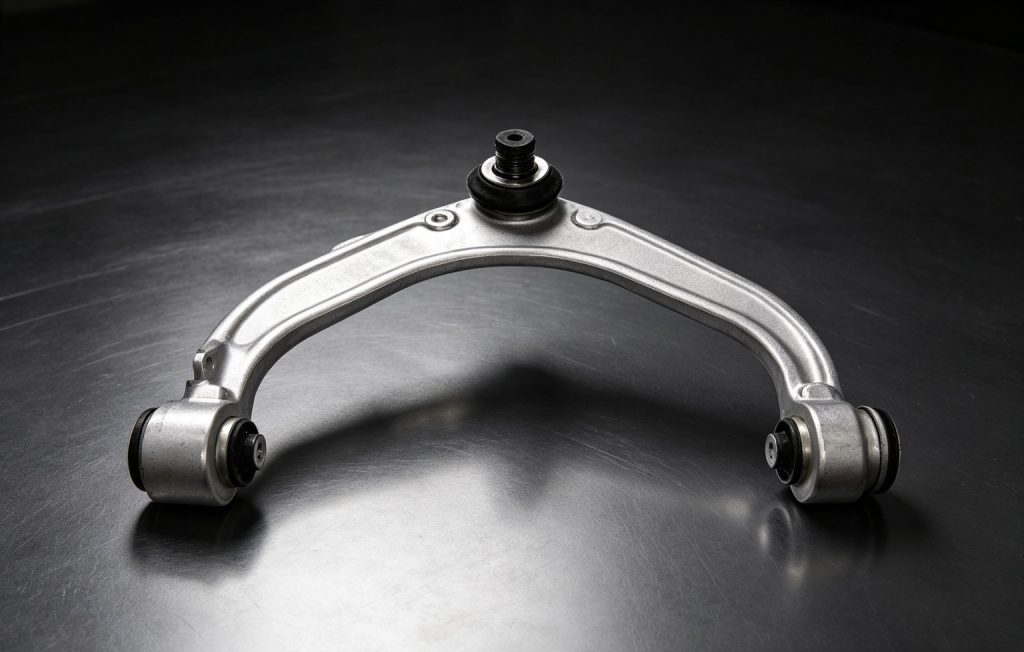
The BMW X5 E70 (2007–2013) uses a double-wishbone front suspension in which the upper and lower control arms, the tie rod assembly, and the stabilizer bar links share the corner loads and steering inputs. These parts are wear items: the rubber bushings fatigue and crack from continual deflection and ozone degradation, and the ball joints develop play that shows up as clunking, vibration, and uneven tyre wear [1][2]. Because the front end uses multiple arms with different OE numbers per side, the fastest way to a correct replacement is an accurate OE cross-reference before ordering. This guide maps the E70 front suspension parts to their OE numbers, explains failure symptoms, and gives a buying and fitting checklist for workshops and DIY owners.
OE Cross-Reference: Quick-Reference Table
| Part | Position | Part No. | OE Numbers |
|---|---|---|---|
| Front upper control arm | Left | H13-6303 | 31126773950, 31126863170 |
| Front upper control arm | Right | H13-6304 | 31126773949, 31126863169 |
| Front lower control arm | Left | H13-6300 | 31126771894 |
| Front lower control arm | Right | H13-6299 | 31126771893 |
| Front lower wishbone (thrust arm) | Left | H13-3834 | 31126776417, 31126863785 |
| Front lower wishbone (thrust arm) | Right | H13-3835 | 31126776418, 31126863786 |
| Front lower track arm | Left | H13-3836 | 33324046917, 33326770963, 33326779387 |
| Front lower track arm | Right | H13-3837 | 33324046918, 33326770964, 33326779388 |
| Tie rod assembly | Outer, either side | H13-6310 | 32106793496, 32106780985, 32216773741 |
| Tie rod axle joint | Outer | H13-51603 | 32106793496, 32216773740, TA2520 |
| Front stabilizer bar link | Left | H13-5934 | 31356773023, 31356857623 |
| Front stabilizer bar link | Right | H13-5935 | 31356773024, 31356857624 |
How the E70 Front Suspension Is Built
Unlike the MacPherson strut layout used on many crossovers, the E70 front axle uses an upper and a lower wishbone on each side, with the steering knuckle between them. The upper arm locates the top of the knuckle; the lower arm set—consisting of a thrust arm and a track arm—carries most of the vertical and longitudinal loads [1][5]. Rubber bushings at the inner pivot points allow the arms to move while absorbing road vibration, and the outer ball joint connects the arm to the knuckle [1]. This design gives precise geometry, but it also means more moving joints per corner, each of which wears over time [2].
Failure Symptoms: When the Front End Needs New Parts
Clunking or knocking over bumps. A worn control arm bushing or ball joint produces a dull clunk or knock over potholes, expansion joints, and rough pavement, usually from the lower front suspension area [4][5].
Steering-wheel shimmy or vibration. Vibration is often most noticeable at 80–120 km/h and is a classic sign of a tired front arm or its bushings [2][3].
Wandering and tramlining. The car follows road ruts and needs constant steering correction, and the front end feels vague or floaty on the motorway [2][3].
Uneven front tyre wear. Altered geometry from a collapsed arm or bushing wears the inner edge of the front tyres rapidly [2][3][5].
Braking instability. A slight wobble or pull under braking can be mistaken for warped discs but is often a suspension-arm issue [2][3].
Ball-joint-specific noises. A clicking or squeaking sound when turning slowly or crossing speed bumps points to a worn ball joint with a torn boot and dry grease [8].
Once one arm shows symptoms, inspect the matching arm on the other side: E70 front parts wear symmetrically, and replacing both sides at the same time is the standard workshop practice [1][5].
Buying and Fitting Checklist
1. Cross-reference OE numbers per side. Left and right arms have different OE numbers, and late-model E70 production introduced superseded part numbers. Confirm the arm’s position (upper, lower, thrust, or track) and side before ordering, using the table above as the starting point.
2. Prefer complete arms over bushing-only repairs. Replacing bushings and ball joints in an old arm can be complex and costly, and ZF’s workshop guidance notes that replacing the entire arm is generally safer and more reliable [6].
3. Check the rubber quality. Genuine-grade bushings are oil- and ozone-resistant; cheap rubber cracks and leaks damping fluid quickly [1]. Look for arms with properly vulcanised bushings and a correctly sealed, pre-lubricated ball joint.
4. Verify surface quality. The arm body should show a uniform anti-corrosion coating with no rust, peeling, or weld defects, and the ball stud should be case-hardened with a smooth, unmarked surface.
5. Follow torque and alignment requirements. E70 arm fasteners must be tightened to the specified torque with the suspension loaded at normal ride height, and a four-wheel alignment is required after replacement [7][9]. Skipping the alignment is the most common reason new arms fail early.
6. Confirm the manufacturer’s traceability. A supplier that can provide OE cross-reference documents, material certificates, and batch-level test reports makes the whole job auditable.
Why Sourcing from a Certified Manufacturer Matters
The E70’s double-wishbone design means aftermarket parts must match OE geometry exactly, or alignment will be out and tyres will wear unevenly [5]. A manufacturer that has produced suspension components for decades—with in-house forging, machining, and rubber-to-metal bonding and a certified laboratory—can hold the tolerances the design requires. Hetian Automotive has manufactured chassis and suspension parts since 1998, operates a 160,000 m² facility with IATF 16949 certification and a CNAS-accredited laboratory, exports to over 30 countries, and holds more than 100 patents. Its E70 front arms and links are supplied with full process control and documented test data, giving workshops parts they can fit with confidence.
FAQ
Q: How do I know which E70 control arm is worn?
A: Jack the front end and check each arm for play with a pry bar: movement at the inner bushings points to bushing wear; movement at the outer joint points to ball-joint wear. Clunking over bumps and vibration at 80–120 km/h are the typical first signs [2][4].
Q: Should I replace both sides at the same time?
A: Yes. E70 front arms wear symmetrically, and replacing both sides at once is standard practice so the two sides keep identical geometry and ride characteristics [1][5].
Q: Can I just replace the bushings instead of the whole arm?
A: In some cases, but pressing out old bushings and ball joints is complex and costly, and the joint housing may be worn. ZF’s guidance recommends replacing the entire arm as the generally safer option [6].
Q: What are the most common OE numbers for the E70 front upper arm?
A: 31126773950 (left) and 31126773949 (right), with superseded variants 31126863170 and 31126863169. Confirm the side before ordering, because left and right are not interchangeable.
Q: Do aftermarket E70 arms need special torque or alignment?
A: Yes. Tighten fasteners to the specified torque with the suspension loaded, then perform a four-wheel alignment; new arms fitted without alignment wear tyres and bushings prematurely [7][9].
Q: How long do E70 front arms typically last?
A: Service life depends on mileage, road quality, and load. Fluid-filled bushings fatigue and crack from continual deflection and ozone degradation, and once the damping fluid leaks the bushing fails [1]. Inspection at every service interval is the reliable way to catch wear early.
Related Guides
- BMW 3 Series (F30/F35) Front Suspension Parts: OE Cross-Reference and Replacement Guide
- Ball Joint Failure: Symptoms, Safety Risks, and Replacement
- Stabilizer Link vs. Sway Bar Link: Function, Wear Signs, and Replacement
- Safety-Critical Auto Parts Verification: How to Check Suspension and Steering Parts for Authenticity
- Product category: Control Arm
References
[1] “Front Control Arm for BMW X Series E70 (2007-2013),” Turner Motorsport, https://www.turnermotorsport.com/BMW-E70/c-755-bmw-front-control-arm, accessed September 12, 2026.
[2] “BMW X5 E70 xDrive35i Front Control Arm Failure — Symptoms and Fix,” Automatika, March 21, 2026, https://automatika.tech/bmw-x5-e70-xdrive35i-front-control-arm-failure-symptoms-and-fix/, accessed September 12, 2026.
[3] “BMW X5 E70 Front Control Arm Failure Signs and Best Replacement Options,” Automatika, May 23, 2026, https://automatika.tech/bmw-x5-e70-front-control-arm-failure-signs-and-best-replacement-options/, accessed September 12, 2026.
[4] “BMW X5 Control Arm Bushing Symptoms: How to Spot Wear, Diagnose Noise, and Know When to Replace It,” BMW Insights, August 25, 2026, https://bmwinsights.com/bmw-x5-control-arm-bushing-symptoms/, accessed September 12, 2026.
[5] “Front Lower Suspension Wishbone Control Arms Kit – BMW X5 & X6 E70-E72,” D2P Autoparts UK, August 22, 2026, https://d2pautoparts.com/products/front-lower-suspension-wishbone-kit-bmw-x5-x6-e70-e72, accessed September 12, 2026.
[6] “Replacing Control Arms,” ZF Aftermarket, https://aftermarket.zf.com/en/aftermarket-portal/for-workshops/useful-tips/suspension/replacing-control-arms/, accessed September 12, 2026.
[7] “BMW X5 E70 Front Suspension Torque Spec: What You Need to Know Before Replacing Your Control Arms,” AliExpress, July 11, 2026, https://www.aliexpress.com/s/wiki-ssr/article/bmw-x5-e70-front-suspension-torque-spec, accessed September 12, 2026.
[8] “宝马底盘异响:常见故障揭秘,” 易车, August 27, 2025, https://news.yiche.com/hao/wenzhang/103175105/, accessed September 12, 2026.
[9] “E70 Control Arm,” Alibaba.com, May 25, 2026, https://www.alibaba.com/showroom/e70-control-arm.html, accessed September 12, 2026.
Last updated: Sep 12, 2026 · Reviewed by the Hetian engineering team