
← All technical articles · News
Industry Insights
BMW X5 (E53) Front Suspension Control Arms: OE Cross-Reference and Replacement Guide
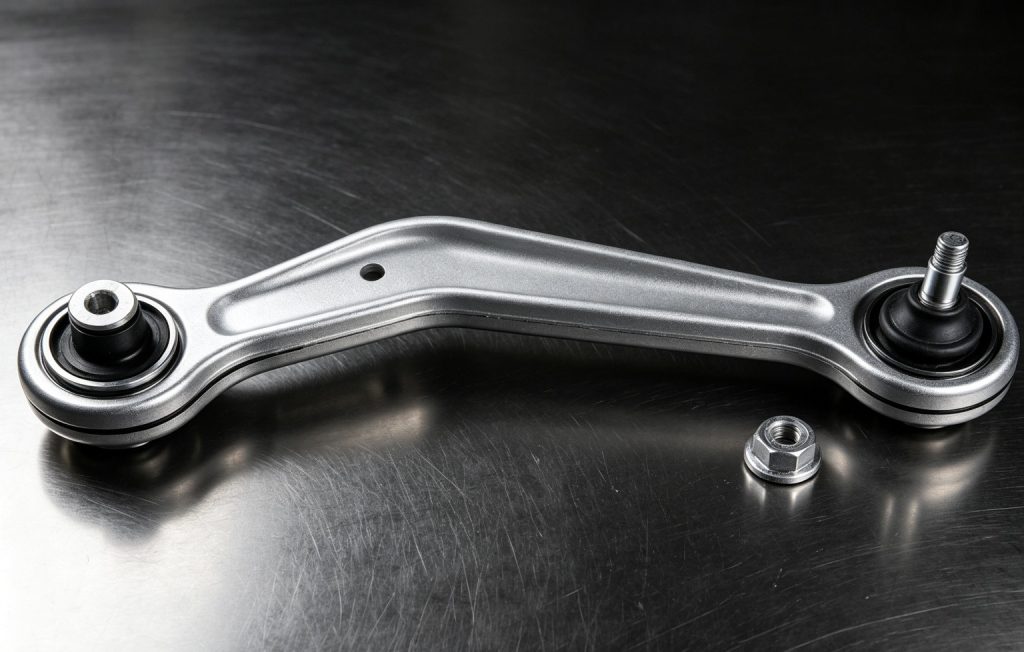
The first-generation BMW X5 (E53, 2000–2006) front suspension uses six replaceable control arms per axle—two upper, two lower—each with pressed-in rubber bushings and integrated ball joints [1]. When the ball joints loosen they pop over bumps, and when the bushings split the ride becomes clunky and the alignment drifts [2][4]. This guide maps the E53 front control arm positions to their OE numbers, explains the failure symptoms and replacement sequence, and lists what to verify before buying aftermarket arms [3][10].
E53 Front Control Arm OE Cross-Reference Quick-Reference Table
| Position | Function | Common OE Numbers (Left / Right) | Typical Failure |
|---|---|---|---|
| Front upper (track arm) | Locates knuckle to subframe, ball joint at outer end [1] | 33326768273 / 33326768274 | Ball joint play → popping; bushing split [2][4] |
| Rear upper (track arm) | Second upper pivot, shares load with front upper [1] | 33321095411 / 33321095412; 33326770747 / 33326770748; 33326770859 / 33326770860 | Bushing wear, ball joint looseness [2][10] |
| Front lower (wishbone) | Main load-bearing lower arm, ball joint to knuckle [1][11] | 31126760275 / 31126760276 | Ball joint wear → clunk; bushing crack [10][11] |
| Rear lower | Lower rear pivot, alignment-critical [1] | 31121096315 / 31121096316 | Bushing split, alignment drift [10] |
E53 Front Axle Layout: Six Arms, Three Jobs
The E53 uses a double-wishbone front axle. Per side there are two upper arms (front and rear track arms) and two lower arms (front and rear wishbones), plus a ball joint and bushings in each arm [1]. The upper control arm connects the steering knuckle to the subframe through a spherical ball joint at the outer end and a rubber bushing at the inner end; the lower arm carries most of the vertical load and is the first part to show wear on high-mileage cars [1][11]. Because every arm affects camber and caster, worn arms show up as uneven tyre wear and vague steering long before they fail completely [4][8].
OE Numbers: Which Arm Is Which
The E53 front arms use two OE families. The upper track arms carry the 3332 prefix: 33326768273/274 for the front upper pair, and 33321095411/412, 33326770747/748 and 33326770859/860 for the rear upper pair (left/right, depending on production period) [10]. The lower wishbones use the 3112 prefix: 31126760275/276 front lower, 31121096315/316 rear lower [10]. When buying aftermarket, match the arm to the exact OE number rather than the model year alone—E53 arms were revised during production, and a mismatched arm changes the alignment range [3][10].
Symptoms of Worn E53 Control Arms
1. Popping or clicking over bumps. The ball joint wears and becomes loose, producing a pop or click from the front end, especially at low speed over rough surfaces [2].
2. Clunking and ride degradation. Split bushings let the arm move out of its designed arc, causing clunks and a loss of the original X5 ride quality [2][4].
3. Brake shudder. On BMW double-wishbone cars, a failed thrust-arm hydraulic bushing can cause steering-wheel vibration under braking that is easily misdiagnosed as warped rotors [9].
4. Alignment drift and tyre wear. Worn bushings change camber and caster; tyres wear unevenly on the inner or outer edge and the car pulls or wanders [4][8].
5. Steering vagueness. Bushings are the pivot between the arm and chassis; once they soften, steering response becomes vague and the car needs constant correction [7][8].
Replacement Intervals and Procedure Notes
BMW E- and F-series front control arm bushings commonly need attention in the 40,000–50,000-mile range on demanding roads, and many owners replace complete arm assemblies instead of pressing new bushings [5]. On the E53, the front lower arm replacement is a lift-and-wheel-off job that also requires removing the wheel arch liner; after replacing any arm, a wheel alignment is mandatory because the arms set the camber and caster [11][12]. If the guide arm is detached from the rear axle carrier during work, the alignment check is required after reinstallation [12].
What to Verify Before Buying Aftermarket Arms
Check the OE number match for both left and right positions, the bushing type (hydro or solid rubber) and durometer, the ball joint preload, and the surface treatment—E53 arms are exposed to winter salt, so corrosion protection matters [3][4]. Prefer a manufacturer that validates to OE-style protocols: Hetian Automotive has produced steering and suspension parts since 1998, operates a 160,000 m² facility with IATF 16949 certification and a CNAS-accredited laboratory, exports to over 30 countries, and holds more than 100 patents.
FAQ
Q: How many control arms does a BMW X5 E53 front axle have?
A: Six per axle pair—two upper arms and two lower arms per side, each with pressed-in bushings and an integrated ball joint [1].
Q: What are the OE numbers for E53 front lower control arms?
A: 31126760275 (left) and 31126760276 (right) for the front lower pair; the rear lower pair uses 31121096315/316 [10].
Q: What OE numbers cover the E53 upper track arms?
A: Front upper: 33326768273/274. Rear upper: 33321095411/412, 33326770747/748 and 33326770859/860, depending on production period [10].
Q: Why does my X5 clunk over bumps?
A: The most common causes are worn control arm bushings or loose ball joints; both let the arm move out of its designed arc [2][4].
Q: Can a control arm bushing cause brake shudder?
A> Yes. On BMW double-wishbone suspensions, a failed thrust-arm hydraulic bushing can produce steering-wheel vibration under braking that is often misdiagnosed as warped rotors [9].
Q: Do I need an alignment after replacing E53 control arms?
A> Yes. The arms set camber and caster, so a wheel alignment is required after replacement to restore geometry and even tyre wear [11][12].
Related Guides
- BMW X5 E70 Front Suspension Parts: OE Cross-Reference and Replacement Guide (2007–2013)
- BMW 3 Series (F30/F35) Front Suspension Parts: OE Cross-Reference and Replacement Guide
- Tie Rod End vs. Ball Joint: How to Tell Them Apart and Diagnose Wear
- Suspension Parts Replacement Intervals: When to Replace Ball Joints, Control Arm Bushings, Links and Tie Rod Ends
- Product category: Control Arm
References
[1] “BMW X5 E53 Front Suspension Diagram: The Complete Guide to Choosing and Installing the Right Control Arm Kit,” AliExpress Wiki, May 28, 2026, https://www.aliexpress.com/s/wiki-ssr/article/bmw-x5-e53-front-suspension-diagram, accessed September 16, 2026.
[2] “Rear Control Arm for BMW X Series E53 (2000-2006),” Turner Motorsport, September 15, 2026, https://www.turnermotorsport.com/BMW-E53/c-754-bmw-rear-control-arm, accessed September 16, 2026.
[3] “URO BMW Control Arm Replacements & Upgrades for BMW X Series E53 (2000-2006),” Turner Motorsport, September 4, 2026, https://www.turnermotorsport.com/BMW-E53/c-86-bmw-control-arms/m-664-uro, accessed September 16, 2026.
[4] “BMW X5 Control Arm Bushing Symptoms: How to Spot Wear, Diagnose Noise, and Know When to Replace It,” BMW Insights, August 25, 2026, https://bmwinsights.com/bmw-x5-control-arm-bushing-symptoms/, accessed September 16, 2026.
[5] “Why BMW E/F-Series Front Control Arm Bushings Need Replacing Every 40-50k Miles,” AutoPlug, February 20, 2026, https://autodataplug.com/maintenance-prevention/why-bmw-ef-series-front-control-arm-bushings-need-replacing-every-40-50k-miles/, accessed September 16, 2026.
[6] “How To Know When Your BMW Needs Its Control Arm Bushing Replacement,” Tanner Motors, November 14, 2025, https://www.tanner-motors.com/how-to-know-when-your-bmw-needs-its-control-arm-bushing-replacement/, accessed September 16, 2026.
[7] “How to Spot Early Signs of Control Arm Bushing Failure,” German Automotive Repair, January 8, 2026, https://www.germanautomotive.ca/how-to-spot-early-signs-of-control-arm-bushing-failuregerman-automotive-repair/, accessed September 16, 2026.
[8] “BMW Control Arm Bushing: Function, Symptoms, Replacement Guide,” Auto Sage Hub, November 25, 2025, https://autosagehub.org/bmw-control-arm-bushing-function-symptoms-replacement/, accessed September 16, 2026.
[9] “What Does a Control Arm Do? Suspension Geometry, Wear, and Diagnosis,” Motronix, August 4, 2026, https://motronix.net/expertise/control-arm/, accessed September 16, 2026.
[10] “Control Arm For Bmw X5 E53,” Alibaba Showroom, December 21, 2025, https://www.alibaba.com/showroom/control-arm-for-bmw-x5-e53.html, accessed September 16, 2026.
[11] “Comment changer: bras inférieur avant sur BMW X5 E53 – Guide de remplacement,” AUTODOC Club, https://club.auto-doc.fr/pdf-manuals/x5/e-53/front-lower-arm/FR-Comment-changer-bras-inferieur-avant-sur-BMW-X5-E53-Guide-de-remplacement.pdf, accessed September 16, 2026.
[12] “Replacing Control Arms,” ZF Aftermarket, August 4, 2026, https://aftermarket.zf.com/en/aftermarket-portal/for-workshops/useful-tips/suspension/replacing-control-arms/, accessed September 16, 2026.
Last updated: Sep 16, 2026 · Reviewed by the Hetian engineering team