
← All technical articles · News
Industry Insights
BMW 3 Series (F30/F35) Front Suspension Parts: OE Cross-Reference and Replacement Guide
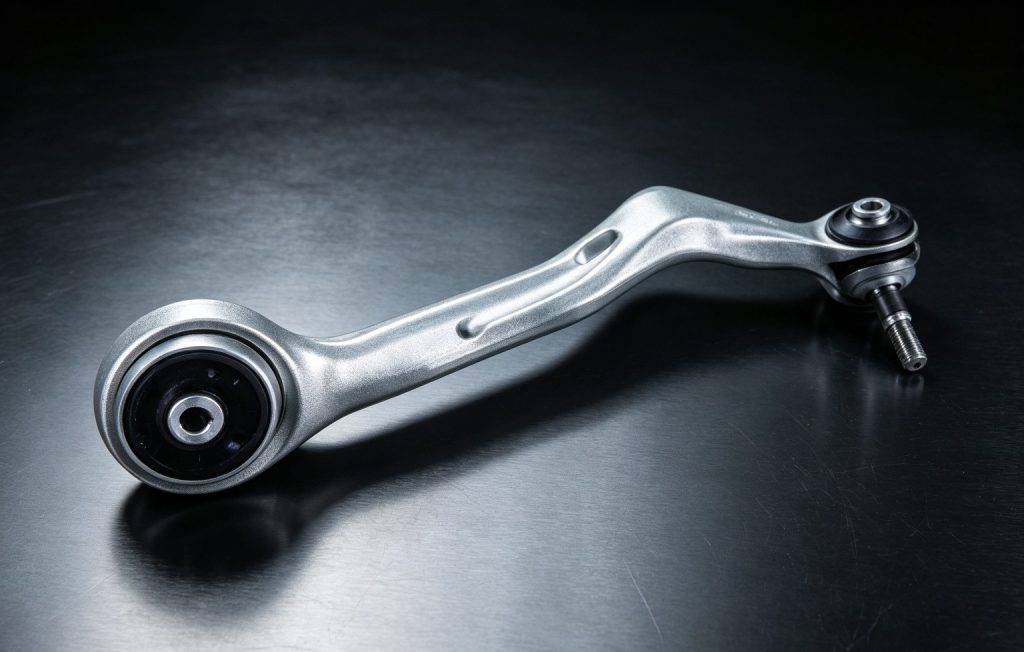
The BMW 3 Series F30 (sedan) and F35 (long-wheelbase sedan, China market), produced from 2012 to 2019, use a double-joint spring strut front axle with two lower control arms per side—a tension strut (straight arm) and a track rod (curved arm)—plus outer and inner tie rod ends and stabilizer links. This design delivers precise steering and sharp handling, but after 80,000–120,000 km the rubber bushings and ball joints begin to wear, causing clunking noises over bumps, steering vagueness, and uneven tire wear. This guide provides an OE cross-reference for 12 core front suspension parts for the F30/F35, explains failure symptoms and diagnosis, and outlines replacement procedures and quality verification for aftermarket sourcing.
OE Cross-Reference Table (12 Core Parts)
| Hetian Part No. | Component | Position | OE Number | Fitment |
|---|---|---|---|---|
| H13-6702 | Front lower control arm (curved / track rod) | Left | 31126855741, 31126851259 | F30/F31/F34/F35 |
| H13-6703 | Front lower control arm (curved / track rod) | Right | 31126855742, 31126851260 | F30/F31/F34/F35 |
| H13-9261 | Front lower control arm (straight / tension strut) | Left | 31126854723, 31126793881 | F30/F31/F34/F35 |
| H13-9262 | Front lower control arm (straight / tension strut) | Right | 31126854724, 31126793882 | F30/F31/F34/F35 |
| H13-9081 | Front lower control arm (rear arm) | Left | 31126854727, 31106793885 | F30/F31/F34/F35 |
| H13-9082 | Front lower control arm (rear arm) | Right | 31126854728, 31106793886 | F30/F31/F34/F35 |
| H13-7090 | Tie rod end (outer) | Left | 32106799960 | F30/F31/F34/F35 |
| H13-7091 | Tie rod end (outer) | Right | 32106799965 | F30/F31/F34/F35 |
| H13-8755 | Tie rod end (inner / axial joint) | Left | 32106799966 | F30/F31/F34/F35 |
| H13-8756 | Tie rod end (inner / axial joint) | Right | 32106799967 | F30/F31/F34/F35 |
| H13-8295 | Stabilizer link (sway bar end link) | Left & Right | 31306792211 | F30/F31/F34/F35 |
| H13-7234 | Stabilizer link (sway bar end link) | Right | 31306792212 | F30/F31/F34/F35 |
Front Suspension Architecture
The F30/F35 front axle is BMW’s double-joint spring strut design, an evolution of the MacPherson strut that uses two separate lower control arms per wheel instead of a single wishbone [1]. The tension strut (straight arm, H13-9261/9262) runs longitudinally from the subframe to the wheel carrier, primarily controlling acceleration and braking forces. The track rod (curved arm, H13-6702/6703) runs laterally, controlling lateral forces and steering geometry. A third rear arm (H13-9081/9082) provides additional longitudinal location. This split-arm design reduces unsprung mass and allows precise tuning of camber and caster, but it means there are more bushings and ball joints to inspect and replace than on a conventional single-arm setup.
The steering system uses a rack-and-pinion steering gear with inner axial joints (H13-8755/8756) and outer tie rod ends (H13-7090/7091). The stabilizer (sway bar) connects to the strut housing via stabilizer links (H13-8295/7234). All of these components contain either rubber-to-metal bonded bushings or ball-and-socket joints that wear over time.
Failure Symptoms and Diagnosis
Control arm bushings. The most common wear point on F30/F30 front suspension is the rubber bushing in the tension strut and track rod. As the rubber ages and cracks, the driver notices clunking or knocking noises over speed bumps and rough roads, a floating or vague feeling at highway speeds, and increased brake dive [2]. A classic F30-specific symptom is torque steer under acceleration: the car pulls to one side when accelerating and to the other when decelerating, caused by excessive play in the tension strut bushing [10]. Diagnosis is visual—inspect the rubber for cracks, tears, or separation from the metal sleeve—and physical, by prying the arm with a pry bar to check for excess movement.
Ball joints (control arm and tie rod). The ball joint in the track rod (curved arm) and the outer/inner tie rod ends wear with mileage. Symptoms include steering play or vagueness, a knocking sound when turning the steering wheel at low speed, and uneven tire wear (feathering on the inner or outer edge) [5]. A front-end shimmy above 110 km/h can indicate a worn lower ball joint [5]. Diagnosis: with the vehicle lifted and the front wheels off the ground, grasp the wheel at 3 o’clock and 9 o’clock and rock it side to side—any perceptible play in the tie rod indicates a worn joint. Grasp at 12 o’clock and 6 o’clock to check lower ball joint play.
Stabilizer links. Worn stabilizer links produce a rattle or clunk over small bumps and uneven pavement, especially at low speed. The noise is often more noticeable when the suspension is working independently (one wheel on a bump). Diagnosis: grasp the link and try to move it by hand—any free play means the joint is worn. Alternatively, disconnect one end and test for resistance; a good link should feel firm with no free play [6].
Replacement Procedures and Torque
For the F30/F35, front lower control arms are typically replaced as complete assemblies (arm + bushing + ball joint) rather than pressing out individual bushings, because the aluminum arms are forged and the bushings are hydraulically damped. Replacement steps: (1) loosen the wheel lug nuts, raise the vehicle and support it on jack stands, remove the front wheel. (2) Remove the ball joint nut at the wheel carrier and press the ball joint stud out of the steering knuckle using a ball joint separator. (3) Remove the bushing bolts at the subframe. (4) Install the new arm in reverse order, tightening the ball joint nut and subframe bolts to manufacturer torque specifications. (5) Reinstall the wheel, lower the vehicle, and perform a four-wheel alignment.
Critical torque note: the subframe bushing bolts must be tightened with the vehicle at ride height (weight on the wheels), not with the suspension hanging. Tightening with the suspension unloaded pre-twists the rubber bushing, dramatically shortening its life and causing binding noises [3]. After any control arm or tie rod replacement, a four-wheel alignment is mandatory because the new parts change toe and camber settings [3].
Tie rod end replacement: loosen the outer tie rod jam nut, count the number of turns to remove the old end, and screw on the new end the same number of turns to preserve approximate toe setting. Tighten the jam nut. Always perform a full alignment after tie rod work.
Aftermarket Sourcing and Quality Verification
When sourcing F30/F35 front suspension parts for aftermarket replacement, buyers should verify five quality points: (1) the control arm is forged aluminum (not cast or steel) matching OE geometry, with correct hole spacing and ball joint stud taper; (2) the rubber bushings are hydraulically damped (hydro-bushings) with oil-filled chambers, not solid rubber—solid rubber bushings transmit more noise and vibration and do not match OE ride quality; (3) the ball joint uses a case-hardened steel stud with a precision-ground sphere, a sealed rubber boot, and permanent pre-greasing; (4) the supplier holds IATF 16949 certification and can provide PPAP documentation for the part; (5) all parts carry correct OE cross-reference numbers and are packaged with factory name, address, and execution standard.
Hetian Automotive has manufactured suspension and chassis components since 1998, operating a 160,000 m² production facility with IATF 16949 certification and a CNAS-accredited laboratory. The company exports to over 30 countries and holds more than 100 patents, with forging, machining, rubber-to-metal bonding, and assembly all in-house—providing the manufacturing depth needed to produce hydro-bushed aluminum control arms that match OE geometry and durability.
FAQ
Q: How long do F30/F35 front control arm bushings typically last?
A: On normal roads, the hydraulic bushings in the tension strut and track rod typically last 80,000–120,000 km. Cars driven frequently on rough roads, over potholes, or with aggressive driving may see bushing failure as early as 60,000 km. Visual inspection for cracks and pry-bar play testing is the most reliable way to determine replacement need [2][10].
Q: Should I replace control arms in pairs (left and right)?
A: Yes. Both sides experience the same mileage and load conditions. If one side’s bushings are worn, the other side is likely close to failure. Replacing both sides at once ensures symmetric steering geometry and avoids a second alignment job. After replacement, a four-wheel alignment is mandatory [3].
Q: Can I press out and replace just the bushing, or must I replace the whole arm?
A: On F30/F35 aluminum control arms, the bushings are hydraulically damped and pressed into the forged arm. While bushing-only replacement is technically possible with a hydraulic press, most aftermarket suppliers offer complete arm assemblies because the aluminum arm can be damaged during pressing, and the cost difference is often small. Complete assemblies also include a new ball joint, which wears at a similar rate.
Q: What is the difference between the tension strut (straight arm) and track rod (curved arm)?
A: The tension strut (H13-9261/9262, straight arm) runs longitudinally from subframe to wheel carrier and primarily controls fore-aft movement under acceleration and braking. The track rod (H13-6702/6703, curved arm) runs laterally and controls lateral forces and steering geometry. Both must be in good condition for proper handling; wear in either causes distinct symptoms [1][10].
Q: Why does my F30 pull to one side under acceleration and the other under braking?
A: This is a classic symptom of a worn tension strut (straight arm) bushing. Excessive play in the longitudinal bushing allows the wheel to move fore and aft under load changes, causing torque steer-like behavior. Replacing the tension strut (both sides recommended) and performing an alignment resolves this [10].
Q: What quality checks should I perform on aftermarket F30 control arms?
A: Verify: (1) forged aluminum construction matching OE weight and geometry; (2) hydraulically damped bushings (not solid rubber); (3) case-hardened ball joint stud with sealed boot and pre-greasing; (4) IATF 16949 certification and PPAP documentation from the supplier; (5) correct OE cross-reference numbers on packaging. Avoid arms with visible casting porosity, misaligned holes, or bushings that feel hard and non-compliant.
Related Guides
- Audi A4 (B8/B9) Tie Rod Ends & Stabilizer Links: OE Cross-Reference and Replacement Guide
- Ball Joint Failure: Symptoms, Safety Risks, and Replacement
- Strut Mount Bearing Problems: Diagnosis and Replacement Guide
- Automotive Rubber Bushing Supplier Qualification: A Buyer’s Checklist
- Product category: Control Arms & Suspension Components
References
[1] “如何精准识别三角臂损坏的各种迹象,” 太平洋汽车百科, August 30, 2026, https://m.pcauto.com.cn/baike/1758217/, accessed September 9, 2026.
[2] “底盘整备逻辑:宝马胶套更换如何还原新车级底盘紧致度,” 搜狐, August 5, 2026, https://m.sohu.com/a/1058959595_122951895/, accessed September 9, 2026.
[3] “摆臂换完方向变沉?底盘整备后排查指南,” 搜狐, September 3, 2026, https://m.sohu.com/a/1071379530_122768213/, accessed September 9, 2026.
[4] “北京宝马过减速带底盘哐哐异响,底盘松散,必须更换整套摆臂总成吗?,” 搜狐, August 23, 2026, https://m.sohu.com/a/1066411342_122711152/, accessed September 9, 2026.
[5] “宝马底盘松散需检查哪些部件,” 搜狐, September 8, 2026, https://m.sohu.com/a/1073291339_123001319/, accessed September 9, 2026.
[6] “华胜悬架松散维修解析,” 搜狐, August 8, 2026, https://m.sohu.com/a/1060266546_122953210/, accessed September 9, 2026.
[7] “底盘松散?先看看减震器,” 搜狐, August 13, 2026, https://m.sohu.com/a/1062304879_122759267/, accessed September 9, 2026.
[8] “宝马X5底盘异响就是摆臂胶套坏了?先别急着换,检查流程要知道,” 搜狐, August 18, 2026, https://m.sohu.com/a/1064249650_122949139/, accessed September 9, 2026.
[9] “底盘异响、松散发飘!优先更换胶套不换总成,省钱恢复底盘紧致质感,” 搜狐, August 16, 2026, https://m.sohu.com/a/1063486211_122711152/, accessed September 9, 2026.
[10] “前悬挂松散异响(6)对照本文章,不同异响自己也能找出问题点,” 今日头条, January 20, 2024, http://m.toutiao.com/group/7326159995626816051/, accessed September 9, 2026.
Last updated: Sep 9, 2026 · Reviewed by the Hetian engineering team