
← All technical articles · News
Industry Insights
EV Suspension Parts Replacement: Common Failure Patterns and a Buyer’s Sourcing Guide
Electric vehicles are transforming more than the powertrain—they are changing how suspension and chassis components wear, when they fail, and what aftermarket buyers should source. A 2026 industry sampling of ten-year-old EVs found that battery and electric drive systems accounted for only 18% of total failures, while over 80% were concentrated in low-voltage electronics, smart hardware, thermal management, and chassis wear parts—with suspension bushings and shock absorbers emerging as the single largest weak point [1]. EVs typically weigh 300–600 kg more than comparable ICE vehicles, and this extra mass accelerates suspension bushing and shock absorber failure to the 5–8 year range, with a full set of bushings and four shock absorbers costing 4,000–7,000 RMB at OEM dealerships [1]. As China’s NEV penetration rate is projected to exceed 55% in 2026 [3] and the global EV fleet moves into the high-mileage service window, understanding EV-specific suspension failure patterns and sourcing quality replacement parts has become essential for aftermarket distributors and repair shops.
EV Suspension Failure Quick Reference
| Component | Typical EV Failure Mileage | Primary Cause | Diagnostic Sign | Sourcing Priority |
|---|---|---|---|---|
| Control arm bushing | 60,000–100,000 km | Higher curb weight increases radial and axial loads | Clunking over bumps, steering wander, uneven tire wear | High-durometer rubber, reinforced steel sleeve, bond strength ≥3 MPa |
| Shock absorber / strut | 80,000–120,000 km | Increased damping load from heavier vehicle mass | Excessive body roll, bouncy ride, oil leakage | EV-rated damping force, corrosion-resistant coating, gas-charged |
| Strut mount / top bearing | 70,000–110,000 km | Bearing preload increased by heavier strut assembly | Creaking during low-speed steering, clunking over bumps | Sealed thrust bearing, correct durometer rubber, salt spray ≥480h |
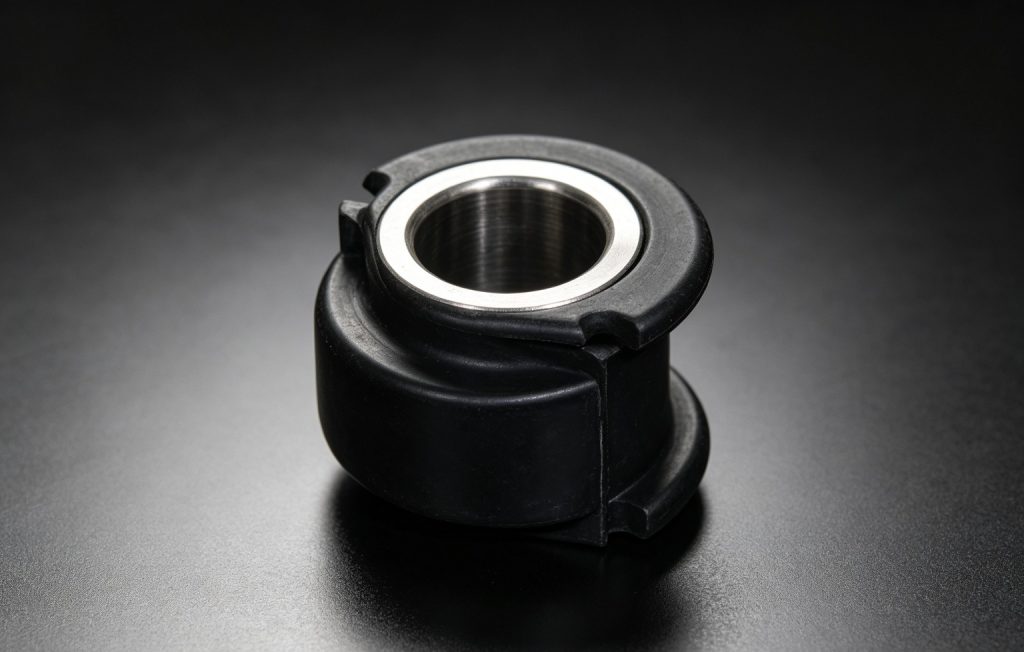
| Stabilizer bar bushing | 50,000–90,000 km | Higher body roll forces from increased mass | Clunking over small bumps, squeaking during body roll | Natural rubber with PTFE liner, correct inner diameter tolerance |
| Sway bar end link | 40,000–80,000 km | Increased lateral load transfer | Rattling over uneven surfaces, play when pried | Forged steel body, sealed ball joints, corrosion-resistant plating |
Why EVs Wear Suspension Parts Faster
Higher Curb Weight and Increased Load Forces
The most significant factor accelerating EV suspension wear is vehicle mass. Battery packs typically add 300–600 kg to a vehicle’s curb weight compared to an equivalent ICE model [1]. UK used EV repair data confirms that A-type control arms (wishbones) are the second most common EV failure component, accounting for 18.4% of claims with an average repair cost of £1,230, because EV curb weights are 20–35% higher than comparable ICE vehicles—for example, the VW ID.3 weighs approximately 320 kg more than the equivalent Golf [2]. This additional mass increases static and dynamic loads on every suspension pivot point: control arm bushings experience higher radial and axial forces, shock absorbers must damp greater kinetic energy, and stabilizer bar components transfer higher body roll moments. Under hard cornering and emergency maneuvers, the lateral forces transmitted through rubber-to-metal bonded bushings are proportionally higher, accelerating bond fatigue and permanent deformation.
Instant Torque and Acceleration Dynamics
EVs deliver maximum torque from zero RPM, producing rapid acceleration that places sudden longitudinal loads on suspension bushings and control arm pivots. Unlike ICE vehicles, where torque builds gradually with engine RPM, EVs apply full torque instantly, causing the suspension to compress and transfer load more abruptly. This repeated sudden loading accelerates bushing bond fatigue and can cause the rubber to develop internal cracks that are not visible from the outside. Over time, these internal cracks propagate to the surface, producing the characteristic clunking noise over bumps. For performance-oriented EVs with 0–100 km/h times under 5 seconds, the longitudinal load forces are even higher, and suspension components may need to be inspected as early as 40,000 km.
Regenerative Braking and Reduced Friction Brake Use
While regenerative braking reduces wear on brake pads and rotors, it changes the load dynamics on suspension components. During regenerative braking, the electric motor applies resistance to the drivetrain, creating a deceleration force that is transmitted through the suspension differently than friction braking. This can produce subtle alignment shifts over time, particularly in vehicles with single-pedal driving modes where regenerative braking is used almost exclusively. Additionally, because brake pads are used less frequently, caliper pins and sliding surfaces can seize from lack of movement, causing uneven pad wear and subtle pulling during braking that is often misdiagnosed as a suspension alignment issue. For aftermarket buyers, this means that EV suspension inspections should always include checking brake caliper movement and pad condition, even when the primary complaint is suspension noise or handling.
Common EV Suspension Failure Patterns
Based on field data and repair statistics, EV suspension failures follow predictable patterns that differ from ICE vehicles. Control arm bushings fail earlier—typically at 60,000–100,000 km compared to 80,000–120,000 km for ICE vehicles—because the higher curb weight increases load on the rubber-to-metal bond [1]. The UK EV repair data confirms that control arm (wishbone) failures are the second most common EV suspension issue, with higher claim costs due to the increased labor time required for EV-specific suspension geometries [2]. Shock absorbers also fail earlier, as the increased vehicle mass requires greater damping force and the seal and valve components wear faster under higher loads. Strut mount bearings experience increased preload from the heavier strut assembly, leading to bearing seizure and creaking noises during low-speed steering—often the first noticeable symptom of EV suspension wear.
J.D. Power’s 2026 China NEV quality study found that new energy vehicle problem incidence reached 46.1%, up 12% year-over-year, with accident repair costs averaging 1.7 times those of ICE vehicles [5]. While much of this cost increase is driven by integrated die-cast body structures and sensor-integrated components, suspension and chassis repairs contribute significantly because EV-specific parts are often more expensive and less available in the independent aftermarket. For distributors and repair shops, stocking quality EV suspension parts—particularly control arm bushings, shock absorbers, and strut mounts—represents a growing revenue opportunity as the first wave of mass-market EVs reaches the 80,000–120,000 km service window.
Sourcing Guide: What to Look for in EV Suspension Parts
When sourcing suspension replacement parts for EV applications, several quality factors are critical. First, rubber compounds should be specified for higher load applications: control arm bushings for EVs may require 5–10 Shore A higher durometer than equivalent ICE parts to handle the increased vehicle mass, while still maintaining adequate NVH isolation [4]. The rubber should be natural rubber (NR) or NR/polybutadiene blends with proper antioxidant and antiozonant packages, as EV engine bay and underbody temperatures can be higher due to battery thermal management systems. Second, bond strength must be verified: minimum 3 MPa peel strength with cohesive rubber failure, as the higher loads in EVs make bond separation the most common failure mode. Third, metal components should have corrosion-resistant plating (zinc or zinc-nickel) with minimum 480 hours salt spray resistance, as EVs are often used in urban environments with winter road salt exposure.
For shock absorbers and struts, buyers should verify that the damping force is rated for the specific EV model’s curb weight—using an ICE-rated shock absorber on a heavier EV will result in insufficient damping, accelerated wear, and poor handling. Strut mount bearings should be sealed, pre-greased thrust bearings with corrosion-resistant races, as the increased preload from heavier EV strut assemblies makes open bearings particularly vulnerable to water and dirt ingress. For stabilizer bar bushings, a PTFE (Teflon) liner on the inner surface reduces friction and squeaking, which is more noticeable in EVs due to the absence of engine noise masking. Buyers should prioritize suppliers that can provide documented material specifications, bond strength test data, corrosion test reports, and dimensional inspection data—suppliers holding IATF 16949 certification are preferred, as this ensures the same quality management system applies to aftermarket parts as to OEM components.
FAQ
Q: Do EV suspension parts wear out faster than ICE parts?
A: Yes, generally. EVs typically weigh 300–600 kg more than comparable ICE vehicles [1], and this extra mass accelerates wear on suspension bushings, shock absorbers, and strut mounts. Industry data shows that EV suspension bushings and shock absorbers typically fail in the 5–8 year range [1], compared to 7–10 years for ICE vehicles. Control arm bushings may need replacement as early as 60,000 km in EVs, versus 80,000–120,000 km for ICE vehicles.
Q: Can I use ICE suspension parts on an EV?
A: Not recommended. While some parts may physically fit, ICE suspension components are designed for lower vehicle masses and different load dynamics. Using an ICE-rated shock absorber on a heavier EV will result in insufficient damping force, causing excessive body roll, poor handling, and accelerated shock absorber wear. Control arm bushings designed for ICE vehicles may have lower durometer rubber that deforms permanently under the higher EV loads, leading to alignment drift and uneven tire wear. Always source EV-specific or load-rated suspension parts.
Q: What is the most common EV suspension failure?
A: Based on industry sampling, suspension bushings and shock absorbers are the largest weak point in aging EVs [1]. In UK used EV repair data, A-type control arms (wishbones) are the second most common failure component, accounting for 18.4% of claims [2]. Strut mount bearings are also a frequent early failure, producing creaking noises during low-speed steering because the increased preload from heavier EV strut assemblies accelerates bearing wear.
Q: How much does it cost to replace EV suspension parts?
A: At OEM dealerships, a full set of suspension bushings plus four shock absorbers typically costs 4,000–7,000 RMB [1]. In the UK, control arm (wishbone) replacement on EVs averages £1,230 per claim [2]. Independent aftermarket shops can often reduce costs by 30–50% by sourcing quality aftermarket parts, but labor costs may be higher for EV-specific suspension geometries. J.D. Power data shows that overall NEV accident repair costs average 1.7 times those of ICE vehicles [5], though suspension-only repairs are less affected by this multiplier.
Q: What should I inspect during an EV suspension service?
A: A comprehensive EV suspension inspection should include: (1) visual inspection of all rubber bushings for cracks, tears, or separation from metal housings; (2) pry-bar testing of control arm bushings, ball joints, and sway bar end links for excessive play; (3) inspection of shock absorbers for oil leakage and physical damage; (4) checking strut mount bearings for binding by turning the steering wheel lock-to-lock with the vehicle raised; (5) verifying brake caliper movement and pad condition, as reduced friction brake use in EVs can cause caliper seizure; (6) measuring alignment angles, particularly camber and toe, which can drift as bushings wear. Inspection should be performed every 40,000 km or annually for EVs.
Q: Are there specific quality certifications I should look for?
A: Yes. Prioritize suppliers holding IATF 16949 certification, as this ensures the same quality management system, traceability, and process capability controls apply to aftermarket replacement parts as to OEM components. Request documented evidence of: rubber compound material specifications (polymer type, filler loading, durometer, tensile strength), bond strength test data (minimum 3 MPa peel strength with cohesive failure), corrosion test reports (minimum 480 hours salt spray for metal components), and dimensional inspection data. For shock absorbers, verify that the damping force curve is matched to the specific EV model’s curb weight and suspension geometry.
Related Guides
- Strut Mount Bearing Problems: Diagnosis and Replacement Guide
- What Is a Suspension Bushing? Materials, Function, and Failure Modes
- Rubber vs. Polyurethane vs. Hydraulic Bushings: A Buyer’s Comparison
- Custom Rubber-to-Metal Bonded Parts: What Buyers Should Specify
- Product category: Control Arms & Suspension Parts
References
[1] “十年电车故障分布:底盘悬挂/减震器成最大短板,全套换装4000-7000元,” 行业抽样(今日头条), July 12, 2026, http://m.toutiao.com/group/7661453663591793203/, accessed September 4, 2026.
[2] “英国二手电动车维修数据:传感器与控制臂故障率高于电池,” 顺企网, July 31, 2026, https://m.11467.com/blog/d18492026.htm, accessed September 4, 2026.
[3] “2026年汽车减震配件市场趋势与供应格局分析,” 智研咨询(顺企网转载), August 10, 2026, https://m.11467.com/blog/d18741573.htm, accessed September 4, 2026.
[4] “2026年汽车橡胶零配件行业供应趋势分析,” 顺企网, August 22, 2026, https://m.11467.com/blog/d19055074.htm, accessed September 4, 2026.
[5] “J.D. Power: 2026年国内新能源车问题发生率46.1%,同比上涨12%,” 新浪财经, August 9, 2026, https://finance.sina.com.cn/tech/roll/2026-08-09/doc-inimtpwi3337607.shtml, accessed September 4, 2026.
Last updated: Sep 4, 2026 · Reviewed by the Hetian engineering team