
← All technical articles · News
Industry Insights
Mercedes-Benz C-Class (W204) Suspension Parts: OE Cross-Reference and Fitment Guide (2007-2014)
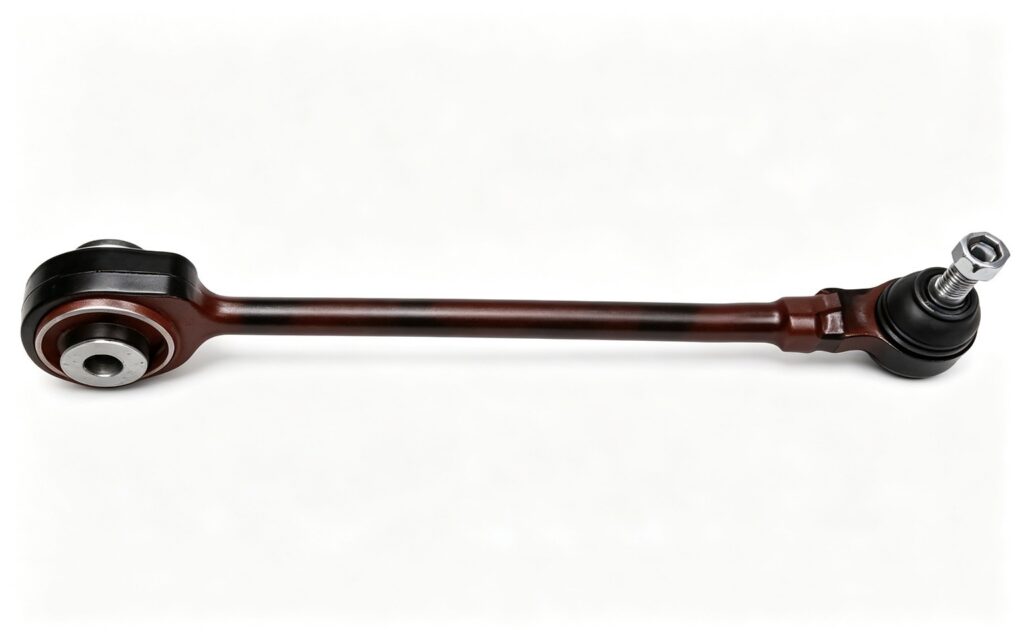
Ordering suspension parts for a W204 C-Class is not a “pick the model year and go” job. The 2007–2014 C-Class uses a three-link front axle in which the lower level is split into two separate arms — a torque strut and a cross strut — with the tie rod acting as the third link, and the stabilizer bar attached to the suspension strut rather than to a control arm [1][2]. A listing that only says “W204 front control arm” can therefore describe four different parts. This guide maps the OE numbers used on the W204 front axle, the parts that fail first, and the checks that prevent a wrong-side or wrong-drive order.
W204 Front Axle Quick-Reference: OE Numbers by Position
| Component | Position | Key OE numbers | Hetian part No. | First wear signal |
|---|---|---|---|---|
| Lower arm (cross strut) | Front left | 204 330 29 11 | H12-8690 | Clunk over bumps at low speed |
| Lower arm (cross strut) | Front right | 204 330 30 11 | H12-8691 | Clunk over bumps at low speed |
| Upper arm | Front left (RWD) | 204 330 33 11 / 203 330 39 11 / K620086 | H12-2646 | Vague steering, inner-edge tire wear |
| Upper arm | Front right (RWD) | 204 330 34 11 / 203 330 40 11 / K620087 | H12-2647 | Vague steering, inner-edge tire wear |
| Upper arm (4MATIC) | Front left | 204 330 73 11 → 204 330 90 11 | H12-7859 | Clunk under load, steering wander |
| Upper arm (4MATIC) | Front right | 204 330 74 11 → 204 330 91 11 | H12-7860 | Clunk under load, steering wander |
| Stabilizer link | Front left / right | 204 320 05 89 (L) / 204 320 04 89 (R) | H12-5985 / H12-5984 | Rattle over small bumps, more body roll |
| Stabilizer link (alt.) | Front left / right | 204 320 37 89 (L) / 204 320 38 89 (R) | H12-7074 / H12-7075 | Rattle over small bumps |
| Tie rod — axle joint (inner) | Left & right | 204 338 04 15 / 204 338 00 15 | H12-6283 | Steering play, wander at highway speed |
| Tie rod end (outer) | Front left / right | 204 330 33 03 (L) / 204 330 34 03 (R) | H12-11476 / H12-11477 | Uneven front tire wear, alignment drift |
| Control arm bushing | Front arm | 204 333 11 14 | H12-6879 | Cracked rubber, clunk when braking |
| Stabilizer bushing | Bar to body | 204 323 06 65 | H12-60397 | Rattle, reduced roll control |
Why the W204 Front Axle Decides What You Order
Mercedes-Benz built the W204 front suspension around a three-link axle with MacPherson spring struts. At the lower level, the engineers split the classic single lower arm into two individual links — a torque strut and a cross strut — to cut unsprung mass and improve ride comfort, while the stabilizer bar is connected to the suspension strut instead of the arm, and the third link is the tie rod that connects the steering gear to the wheel [1][2].
Two practical consequences follow. First, the lower level is genuinely two parts per side, so “lower control arm” is ambiguous until you name the strut and the side. Second, because the stabilizer bar loads the strut rather than the arm, stabilizer link noise on a W204 often appears before the arm bushings are completely gone — and the two are frequently misdiagnosed for one another [1][10].
Reading Mercedes-Benz Part Numbers Before You Cross-Reference
Mercedes part numbers are structured, not random. The first group identifies the chassis type, and the following groups identify the assembly group and sub-group [11]. On the W204, the prefix 204 marks the platform: 204 330 xx xx belongs to the front axle and steering assembly, 204 350 xx xx to rear axle arms, and 204 320 xx xx to stabilizer bar and link components. Dashes and the “A” prefix are formatting only — 204 330 29 11, 2043302911 and A2043302911 are the same number. Use the full 10-digit string when you search, and never assume a part fits because two listings show the same photo.
Front Axle Components: OE Numbers and Fitment Notes
Lower arms (cross strut / torque strut). The left and right lower arms are mirror-image parts with different OE numbers: 204 330 29 11 (left) and 204 330 30 11 (right), both used across 2006–2015 C-Class applications [3]. They carry the bulk of the braking and cornering load, which is why their bushings are the first to show cracking.
Upper arms — RWD versus 4MATIC. Rear-wheel-drive cars use 204 330 33 11 / 204 330 34 11 (left / right), which cross-reference to the earlier 203 330 39 11 and 203 330 40 11 castings and to aftermarket numbers K620086 / K620087. All-wheel-drive cars take a different arm: 204 330 73 11 / 204 330 74 11, which Mercedes-Benz has superseded to 204 330 90 11 / 204 330 91 11 [4]. Mixing the two is the single most common fitment error on this platform.
Stabilizer links. Two link families appear in W204 catalogues: 204 320 05 89 / 204 320 04 89 (left / right) and 204 320 37 89 / 204 320 38 89 (left / right). Both are valid depending on build date and specification, and both are shared with the GLK-Class X204 and E-Class W212 [1].
Tie rods. The steering linkage divides into an inner axle joint — 204 338 04 15 / 204 338 00 15, side-independent — and outer tie rod ends 204 330 33 03 (left) and 204 330 34 03 (right). Worn tie rods show up first as imprecise steering and uneven, premature front tire wear rather than as a single loud noise [12].
Bushings. Arm bushings (204 333 11 14) and stabilizer bushings (204 323 06 65) are the low-cost parts that decide whether a new arm feels new. A pressed-in bushing that has hardened or separated from its metal housing lets the arm move under load and produces exactly the clunk the new arm was meant to remove [10].
While the front end is apart. High-mileage W204s usually need strut mounts (204 320 12 73 / 204 320 00 73) and engine mounts (204 240 07 17 on the C-Class family) at the same service, since worn strut mounts and thrust arm bushings are a documented source of steering complaints on this chassis [5].
Wear Symptoms and Realistic Replacement Intervals
There is no factory replacement interval for control arms — they are inspected, not scheduled. Field data gives usable planning numbers: aluminium arms with pressed-in rubber bushings typically deteriorate between 60,000 and 80,000 miles, and the W204/W205 lower-arm bushings are known to show failure from around 60,000 miles in salt-belt or rough-road use [5][6]. Bushing service life is commonly quoted at 60,000–100,000 miles, and it shortens sharply with pothole exposure [7]. Stabilizer bar links and bushings generally give 75,000–150,000 miles, with many technicians replacing them around the 100,000-mile mark [8][9].
The symptoms that justify an inspection are consistent across the chassis: a clunk or knock over bumps at low speed from a lower arm bushing [10], a rattle over small bumps that points at the stabilizer links [8], steering that needs constant correction, and inner-edge front tire wear that returns after an alignment [5][10]. Any of these, combined with 60,000-plus miles, is reason enough to put the car on a lift and check for play before ordering parts.
Fitment by Scenario
Daily-driven RWD sedan (C180–C300). Start with the front lower arms and their bushings, then stabilizer links. RWD upper arms (204 330 33 11 / 204 330 34 11) are the correct choice here.
4MATIC cars. Use 204 330 73 11 / 204 330 74 11 or their supersessions 204 330 90 11 / 204 330 91 11. The front axle carries drive torque as well as braking load, so bushings and links wear faster and are usually replaced as a pair per side.
AMG C63 and sport-suspension cars. Ride height, camber and spring rates differ. Verify the arm by OE number and not by chassis code alone, and expect tighter alignment tolerances after installation.
High-mileage cars (100,000+ miles) in cold or coastal climates. Plan a front-end refresh in one pass — arms, bushings, stabilizer links, tie rod ends, strut mounts — then align once. Replacing a single arm on a car where every rubber part has aged the same way usually produces a repeat visit and a second alignment bill [5][7].
Aftermarket distributors building a W204 range. The platform shares arms with the W205, W212 and C218 in several positions, so a single W204 listing frequently covers four model lines. Publish the complete OE cross-reference for each part number rather than one number per listing.
What to Verify Before Ordering
Check six things: the full 10-digit OE number including superseded numbers; left or right (they are not interchangeable); RWD or 4MATIC; arm type — cross strut, torque strut or upper arm; whether the bushing is supplied installed or separately; and the supplier’s quality-system certification. Hetian Automotive has manufactured steering and suspension components since 1998, operates a 160,000 m² facility certified to IATF 16949, runs a CNAS-accredited laboratory, exports to more than 30 countries and holds over 100 patents. Our control arm range lists the OE numbers covered by each part; the same reference data is available through the contact page for distributors building a range.
FAQ
Q: How do I know if my W204 has the RWD or 4MATIC upper arm?
A: Match the OE number rather than the model year. RWD cars use 204 330 33 11 / 204 330 34 11; 4MATIC cars use 204 330 73 11 / 204 330 74 11, superseded to 204 330 90 11 / 204 330 91 11 [4].
Q: Are the W204 left and right lower arms the same part?
A: No. They carry different OE numbers — 204 330 29 11 (left) and 204 330 30 11 (right) — and are mirror images [3].
Q: How long do W204 control arm bushings last?
A: Typically 60,000–80,000 miles for arms with pressed-in rubber bushings, with failures reported from around 60,000 miles on rough roads or in salt-belt climates [5][6][7].
Q: Why does my C-Class clunk over bumps but pass an alignment?
A: Alignment readings can sit inside spec while a bushing is still compliant enough to allow movement under load. A worn lower arm bushing is the most common cause of low-speed clunking on this chassis [10].
Q: Do I need an alignment after replacing arms or tie rods?
A: Yes. Any arm, bushing or tie rod change alters camber, caster or toe, and a wheel alignment is required afterwards [5][12].
Q: Can W204 arms fit a W205 or W212?
A: Several positions are shared across W204, W205, W212 and C218. Always confirm with the full OE cross-reference list for the part number you are ordering.
Q: What else should be replaced at the same time?
A: On high-mileage cars, strut mounts (204 320 12 73) and engine mounts (204 240 07 17) are commonly due in the same service window [5].
Related Guides
- Lightweight Chassis Trends: Aluminum Forged vs. Stamped Steel Control Arms
- Tie Rod End vs. Ball Joint: How to Tell Them Apart and Diagnose Wear
- Stabilizer Link vs. Sway Bar Link: Function and Wear Signs
- What Is a Suspension Bushing? Definition, Function and Types
- How to Select a Control Arm Manufacturer: A Buyer’s Guide
- Product category: Control Arms
References
[1] “Mercedes-Benz C-Class (W204) 2007–2014 Training Manual: Front Axle,” Mersec, https://www.mersec.net/272/front_axle.html, accessed October 7, 2026.
[2] “Mercedes C204 C-Class Coupe 2011 — Chassis and Suspension,” 500SEC.com, https://500sec.com/models/mercedes-c204-c-class-coupe-2011/, accessed October 7, 2026.
[3] “Cross Strut — Mercedes-Benz (204-330-29-11),” Mercedes-Benz USA Parts, https://mbparts.mbusa.com/oem-parts/mercedes-benz-lower-control-arm-2043302911, accessed October 7, 2026.
[4] “Upper Control Arm — Mercedes-Benz (204-330-90-11) — Replaces 2043305711, 2043307311,” Mercedes-Benz Classic Center USA, https://classicparts.mbusa.com/oem-parts/mercedes-benz-upper-control-arm-2043309011, accessed October 7, 2026.
[5] “Mercedes-Benz Steering Problems Linked to Suspension Wear,” Southside Euro, March 11, 2026, https://southsideeuro.com/blog/mercedes-benz-steering-problems-linked-suspension-wear/, accessed October 7, 2026.
[6] “C-Class Steering Wheel Vibration Causes,” CarInterior, March 2, 2026, https://carinterior.alibaba.com/tips/c-class-steering-wheel-vibration-causes, accessed October 7, 2026.
[7] “Mercedes C230 Control Arm Bushing Parts and Service Life,” AutohausAZ, August 6, 2026, https://www.autohausaz.com/mercedes-auto-parts/mercedes-c230-control_arm_bushing-replacement.html, accessed October 7, 2026.
[8] “Replace Sway (Stabilizer) Bar Bushings and Links — C/CLK Class W203/W209,” MB Medic, https://www.mercedesmedic.com/replace-sway-stabilizer-bar-bushings-and-links-c-clk-class-w203-w209/, accessed October 7, 2026.
[9] “How Long Does Sway Bar Link Replacement Take? Labor Time & Cost Guide 2026,” Car Symptoms, March 2, 2026, https://carsymp.com/suspension-steering/sway-bar-link-replacement/sway-bar-link-replacement-labor-time/, accessed October 7, 2026.
[10] “Mercedes Suspension Noise: Diagnose Knocking & Clunking Sounds,” BeefyTools, June 6, 2025, https://beefytools.com/mercedes-suspension-noise-diagnose-knocking-clunking-sounds/, accessed October 7, 2026.
[11] “Mercedes-Benz Model, Chassis, and Engine Guide 1946–1996 — Part Number Structure,” Manuals+, https://manuals.plus/m/27ca17f3cfe8de228fd3a986bf389ba9df33d7ca74ddd21477e0387cba473862, accessed October 7, 2026.
[12] “Mercedes-Benz Tie Rod Linkages,” Mercedes-Benz USA Parts, https://mbparts.mbusa.com/tie-rod-linkages, accessed October 7, 2026.
Last updated: Oct 7, 2026 · Reviewed by the Hetian engineering team